
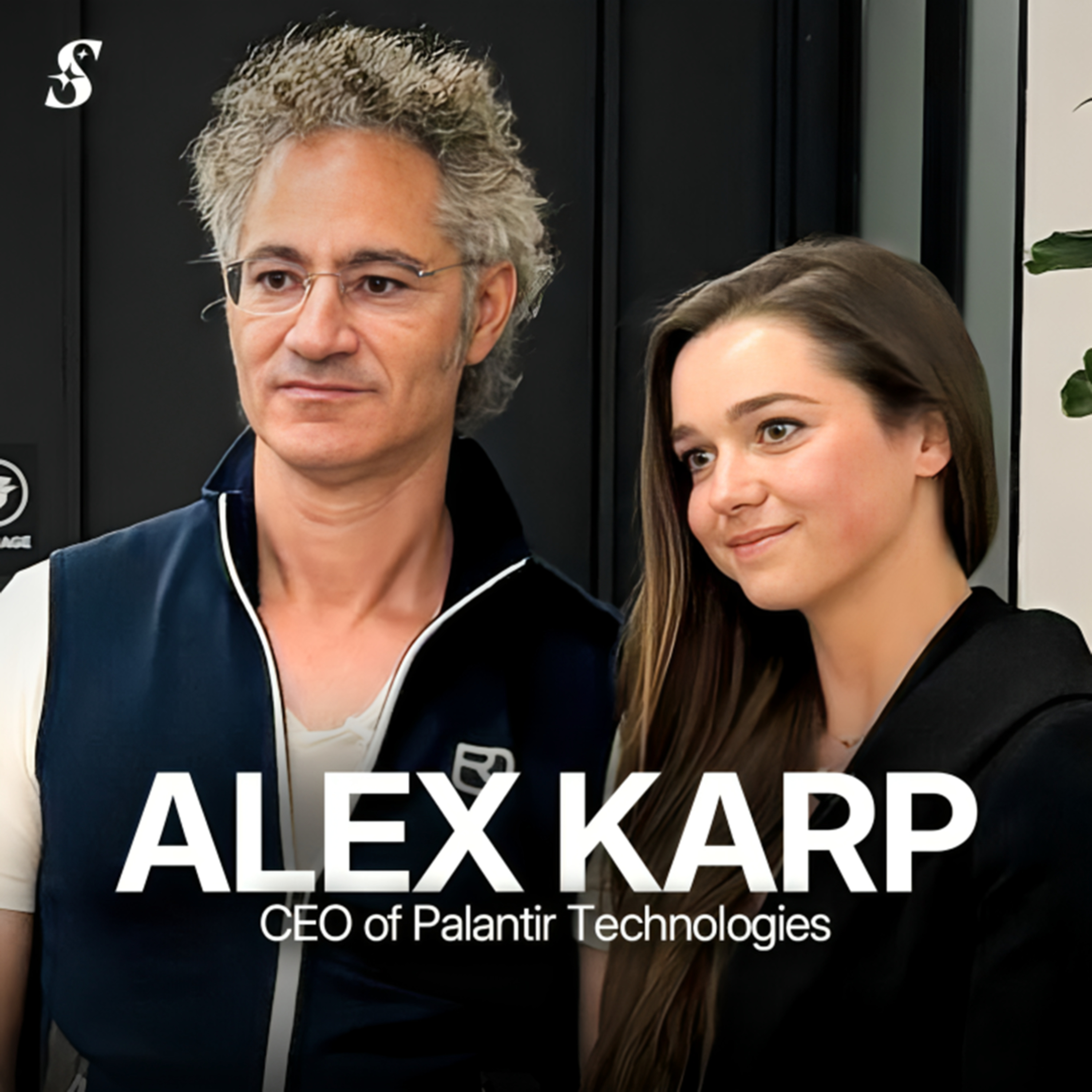

Alex Karp, CEO of Palantir, joins Molly O’Shea for a rare look inside his company’s values and vision.
He shares the unconventional philosophies on business, technology, and morality that guided Palantir from an outsider idea to one of the world's most influential software companies.
Key takeaways
- A company's rate of 'anti-aging' is directly correlated with its layers of hierarchy; a flatter structure allows a 20-year-old company to maintain the vibe of a much younger one.
- True art, in business or otherwise, involves tapping into something deep and misunderstood about the current era that only becomes clear decades later.
- People on the front lines often have a more accurate, unfiltered view of reality than the expert class, which has been wrong about most substantive issues for the past 20 years.
- Sticking to an unconventional vision is unsafe and usually fails. However, in the rare instance where you truly change the world, it is the only path to success.
- Feeling like an outsider can create a deep affinity with those who feel the system isn't designed for them, such as soldiers and factory workers.
- The global adoption of American values is not inherent; it is a direct result of US military superiority, a fact adversaries understand better than many Americans.
- America is unique in its history of fighting major conflicts like the Civil War and World War II for primarily moral, rather than economic, reasons.
- The ultimate goal of military technology is deterrence. Achieving dominance prevents adversaries from attacking, which in turn saves soldiers from having to fight and die.
- Dyslexia can be an advantage in a world where the standard playbook is no longer valuable, as it forces one to invent new and generative approaches.
- America's unique 'maximal freedom' culture allows individuals to be themselves and rewards them for delivering results, even if their methods are unconventional and they appear to be failing for years.
- Unlike many software companies that build addictive products to create client dependency, Palantir's approach is to build what the client ought to want, not necessarily what they ask for.
- A truly valuable product strategy involves anticipating a customer's future needs and building for them today, even if it goes against current market trends or expert opinions.
- The market has shifted from not believing AI software would work to expecting it to work, changing the sales conversation from proving 'if' to explaining 'how'.
- When a product's value is proven and demand exceeds supply, the sales dynamic can flip, allowing the seller to dictate terms and focus on efficient value creation rather than persuasion.
- The AI revolution must benefit everyone, not just the elite. A society where factory workers get poorer while others get richer is not sustainable.
- Technology can help American workers adopt the highly efficient manufacturing processes of other countries, enabling successful re-industrialization.
- Alex's family chose their dog, Rosita, from the pound precisely because she was a troublemaker. Her intelligence in breaking herself and other dogs out of their cages was the very quality that made her a perfect fit for their unconventional family.
- The bond with Rosita was so profound that years later, Alex used his resources to exhume her remains from his old family home and create a new burial site for her near his current house.
Palantir's artistic and anti-playbook approach to success
Alex Karp reflects on Palantir's journey, which began with ideas considered highly controversial. These included being fully meritocratic, maintaining a low hierarchy, and aiming to give America an unfair advantage. The company built products like PGA, Gaia, and Foundry years before their relevance was widely understood. Despite its scale, Palantir maintains a "startup vibe" and is still considered a "freak show." Alex notes that the company has provided venture-level returns to average people willing to challenge conventional wisdom, positioning Palantir as the "anti-playbook company."
He is proud of where the company stands, judging its success partly by its enemies. He suggests looking at who hates Palantir and him personally to understand its value. Internally, the company feels young and has managed to "anti-age." Alex believes a company's ability to anti-age is directly correlated with its layers of hierarchy. Palantir, at 20 years old, has the scale of an established company but the vibe of a much younger one. This flat structure allows for rapid decision-making, such as launching a new meritocracy initiative in about three minutes.
Alex describes Palantir's operational style as more artistic than scientific. He attributes this to his family background. His mother was a world-class artist, and his father's family was involved in commercial art for centuries. He explains that the common perception of art as simple doodling is mistaken.
Art is you tap into something very, very deep that is not understood about the period of time you're in and does not become understood until like 20, 30 years later. And that art captures something in the zeitgeist that is so special, but then the depth also transmutes to something more universal.
Why frontline observers see reality more clearly than experts
People on the front lines, such as soldiers, workers, and retail investors, look at data in an unfiltered way. In contrast, almost everyone else has outsourced their value assessment to an expert class. Alex Karp argues that these experts have been wrong about almost every substantive issue in the last 20 years.
He views these experts, like analysts and journalists, as a medium whose job is to interpret what is happening on the ground.
You are actually a medium, and it's your job to transfer the reality on the ground into a reality you can understand. But the reality you can understand is not reality.
This situation is similar to a great artist who sticks to their vision, even when the world tells them they are wrong. Alex uses his own parents as an example. They had a high level of intellect but were not economically privileged because they stuck to their view of the world. The experts are correct that this path is unsafe and usually fails. But in the one case where you actually change the world, it is the only way it can work.
Alex Karp on Palantir's 20-year American-first philosophy
Alex Karp explains his commitment to the American worker, which stems from both economic and psychological alignment. He rejects what he calls "victimhood BS," arguing that while many who subscribe to it deserve better, the ideology itself cannot work. He reflects on his own background, coming from an environment where his success was not expected. He describes himself as an "amorphous racially dyslexic person" from a unique culture, which led him to assume the world was not looking out for him.
This perspective created a kinship with other groups who share a similar vibe: soldiers and people on the factory floor. He notes these are the people who do the dying and bleeding for the country. Alex criticizes legal scholars who interpret the Constitution expansively to protect their own rights but fail to address crises like the fentanyl epidemic, which has killed more people in the last two years than all American soldiers since World War II. He believes this is because the elite do not see themselves as sharing the same fate as those affected.
So what other group of people in this culture have exactly the same vibe? Yeah, soldiers, people on the factory floor. Who does the dying and bleeding for us? Soldiers, people on the factory floor.
He praises the US Army as a pioneering institution of meritocracy, integrating long before the rest of American society and providing opportunities regardless of background. He then outlines the principles Palantir has consistently advocated for over the last 20 years: closing the border, rejecting identity politics, maintaining a strong military to give America an unfair advantage, and skepticism towards making the rest of the world like America. He asserts that technology is the key determinant of global power and that the global adoption of American values is a direct result of US military superiority, a reality he says adversaries understand well.
Alex Karp on American morality and deterrence
When asked about receiving the Dwight Eisenhower Award, Alex Karp expressed admiration for Eisenhower as a pivotal figure who helped win World War II and advanced desegregation. This led to a broader reflection on American values. Alex argues that a unique characteristic of America is its history of fighting for moral reasons. He points to the Civil War, asserting its primary cause was the moral wrong of slavery, not economics. Similarly, he views World War II as a moral fight where Americans fought because they believed their way of living was superior and just.
He contrasts this with other cultures, drawing on his experience living in Germany. He also highlights meritocracy as a value that, until recently, was particularly embraced in America's elite institutions. In Europe, he claims, hiring the best person is not always the priority. Alex connects these ideas to the mission of Palantir. The company's purpose is to protect the soldiers who fight for these American ideals. The ultimate goal is to establish such overwhelming technological dominance that potential adversaries are deterred from attacking in the first place, thereby preventing conflict and saving lives.
The primary purpose of Palantir is to be so dominant that those people don't have to fight and die. Because everyone knows you're going to die 10 times more if you attack America. You want to sleep at night. You want to make sure our soldiers don't have to fight and die. Make sure the adversary knows they are going to get totally effed up if they screw with us.
He frames this mission as a noble purpose, one that has become even more critical over time.
Becoming self-made in a non-playbook world
Alex Karp describes himself as self-made in a moral and values sense, shaped by a unique combination of factors. These include having highly educated parents, attending a rough school that taught him the world is violent, and having dyslexia. He suggests that dyslexia can be an advantage in the modern world.
We're in a non-playbook world and the playbook's not that valuable. But if you're dyslexic, you can't follow the playbook or only in a third-rate way. So you invent new and generative things.
At a high level of accomplishment, Alex believes you enter an artistic space where insights are hard to explain and are driven by impulse. He has allowed himself the freedom to live this way, a freedom he attributes largely to American culture. He points out that his own company was considered a failure by most investors for 15 or even 18 years.
In America, if you deliver, you can be you... This is a maximal freedom culture. It's the only culture like this in the world and it'll allow you to self-express. And if you self-express, that self-expression, because it's not playbook, creates an environment that is exceedingly hard to compete with and will piss off all the right people.
He argues that this culture, which rewards results even if they take a long time to manifest, is what makes such non-traditional paths possible.
Palantir’s philosophy is to build what the client ought to want
Palantir's approach to value creation is fundamentally different from traditional SaaS companies because it's driven by a core set of beliefs, including the nobility of its clients' missions, such as those of the US government. Alex Karp explains that this belief system prevents them from building "parasitic products." Instead of creating software designed to be addictive, their goal is to provide what the client truly needs to succeed in their mission.
What you're supposed to do in software is build the product that the client gets addicted to, not the one they need. And this is absolutely a truism in software development of any kind.
The company's most radical decision was to build what their partners ought to ask for, rather than what they explicitly requested. This is described as a very "artistic" approach. While traditional software integrators give clients what they want, and successful software companies often create products that lock clients in, Palantir focuses on future needs. This might mean that at first, some clients don't particularly like them. However, that changes when the product delivers critical outcomes.
But you know what? When you bring someone home safely, they learn to love you.
This forward-looking strategy was evident in the launch of their AI platform, AIP. Alex launched it "in the darkness of night," against internal resistance and conventional wisdom. He believed that while LLMs would become commodity products, the real value would lie in orchestrating various components. This decision was not based on what experts were saying or what customers were asking for, but on a conviction about where the world was heading. This bet on orchestration over the models themselves ultimately proved to be correct, affirming their unique, value-driven approach.
A zeitgeist shift has changed how AI is sold
The introduction of Palantir's AIP platform coincided with a major shift in the market's perception of AI, a change in the zeitgeist that has compressed sales cycles. Previously, there was widespread doubt that the software would work. Now, leaders in both the corporate and government worlds know of successful AI projects, many of them involving Palantir, and have seen public companies visibly improve their unit economics as a result.
There used to be no one believed the software would work. Now everyone believes it should work. And they wonder, well, if mine isn't working, where can I find something that is?
This shift is particularly strong in the U.S. Customers now approach Palantir with a different mindset. The conversation has evolved, giving Palantir more authority from the start. Instead of having to convince a client's non-expert tech team, the dynamic is much more collaborative.
It's gone from 'I'm not sure this works, but my life is on the line' in commercial and government like five years ago to 'I know this, I've heard and know this will work. How do I do this optimally?'
With demand now exceeding supply, the sales approach has become more direct. For allied countries seeking proven technologies, Palantir is no longer engaging in lengthy sales meetings for products that are known to be effective. The focus is purely on implementation and value creation.
We're not selling you steak dinner, we're not selling you our charm, we're selling you significant value creation in ridiculously short times.
This assertive stance is backed by strong financial performance, which Alex Karp says gives him the license to have a strong opinion. He notes that many companies want that ability to have an opinion again, framing Palantir's value as delivering private equity-style outcomes for large public companies.
Empowering the American worker through AI and re-industrialization
While external observers focus on financial metrics, Palantir's internal focus is on improving the product and its implementation. The core mission is to provide the US with a long-term strategic advantage in both government and commercial sectors. This work-centric culture is non-hierarchical, where performance is the ultimate measure of value. The environment allows people to be themselves, not just the CEO.
I'm working, I have no time. CEO, move out of the way.
A key concern is ensuring the benefits of the AI revolution are widely distributed, addressing the fear that it will only enrich a select few. The person on the factory floor wonders if they will be left behind.
The person on the factory floor right now wonders, are we going to get rich and are they going to get poor? That will not work for our society.
Palantir's role in American re-industrialization involves more than just bringing foreign manufacturing back. It requires adapting those processes for American workers. For example, when a Japanese factory opens in the US, the challenge is to scale American workers to operate within that system. Technology can bridge this gap by enhancing their capabilities.
We can use foundry and ontology to bring out the advantages of American worker and give them the capacity to roughly work like a Japanese engineer.
This approach of empowering domain experts is proving successful in the US military. Individuals with specific expertise, such as those in special operations, are using the tools to achieve significant results, demonstrating that the real value is created by the people on the ground doing the work.
The story of Rosita, the lock-picking dog
Alex Karp shares a heartwarming story about his family dog, Rosita. He describes his family as a "total freak show on all variables" to the outside world. But on the inside, it was an exceedingly intellectual, vibrant, and warm environment. When they went to a pound to get a dog, they found one the warden couldn't stand.
The dog, Rosita, was scheduled to be put down the next day. The warden hated her because she was incredibly intelligent. Rosita could figure out how to open the lock on her cage. Not only would she break herself out, but she would then free the other dogs as well.
Rosita would go back and break open the other locks for other people. And then my mom was like, that's our dog.
This act of rebellious solidarity is what made Alex's mother choose her. Rosita became a huge part of their lives, and her high IQ made her seem more like a person than a dog. The connection was so deep that years later, Alex used his resources to get permission to exhume Rosita's remains from his old childhood home and rebury her near his current house.