
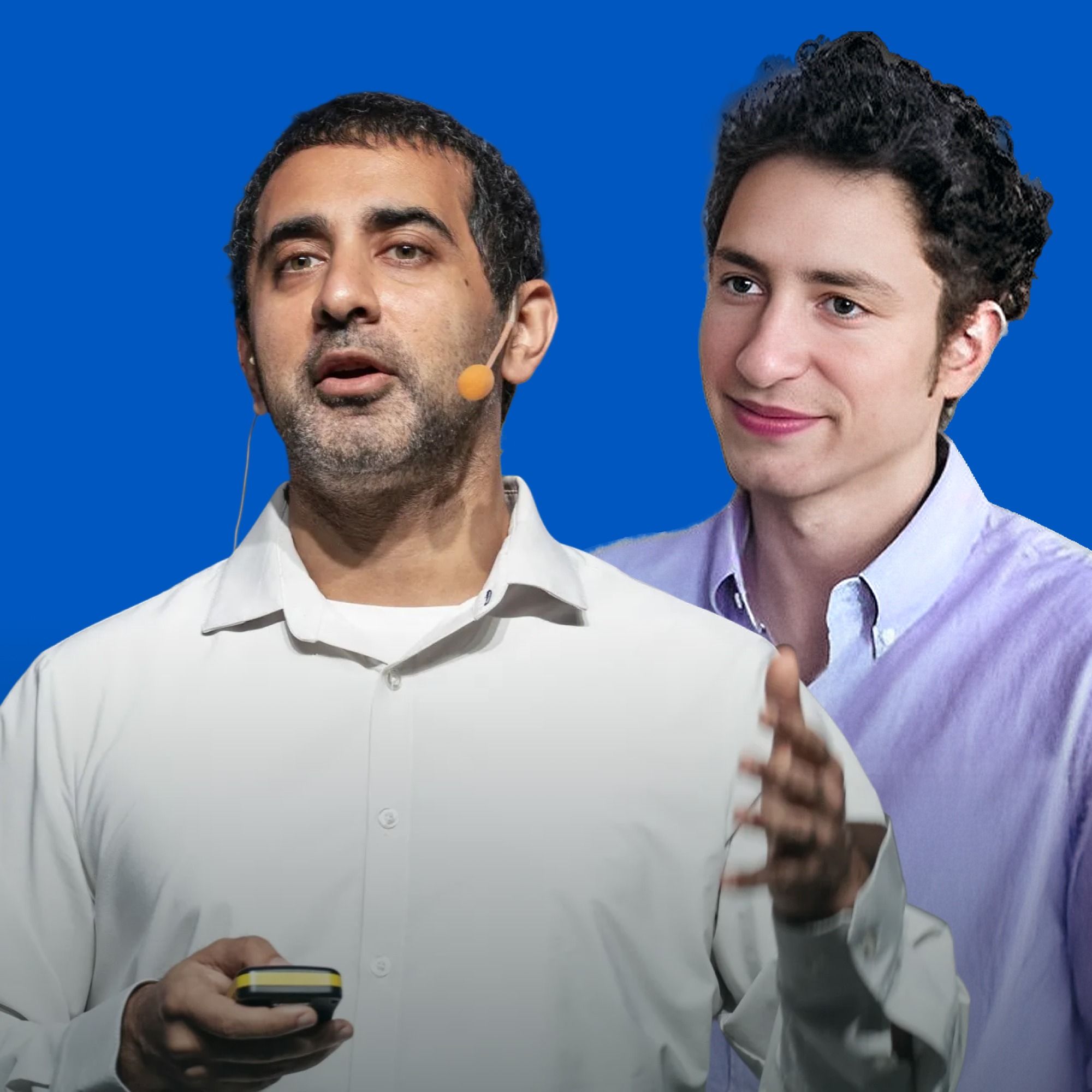

What if the media’s war on tech has nothing to do with holding power to account, and everything to do with economic desperation?
Balaji Srinivasan, an entrepreneur, investor, and author of The Network State, dismantles the official story of the conflict between Silicon Valley and legacy journalism. He argues the media's hostility is rooted in its own economic collapse, reframing the entire conflict as a fundamental war between the 'state' (legacy institutions) and the 'network' (the internet).
Key takeaways
- The media's hostility toward tech isn't ideological, it's economic. The saying isn't 'go woke, go broke,' but 'go broke, go woke.' As the internet crushed their revenue, legacy media turned on the tech industry.
- Modern conflicts can be viewed as a battle between the 'State' and the 'Network.' The State passes laws; the Network writes code. This framework explains everything from Bitcoin vs. the Fed to SpaceX vs. NASA.
- Tech leaders like Mark Zuckerberg are hyper-visible and constantly scrutinized, while media owners like A.G. Sulzberger of The New York Times are virtually unknown. The person surrounded by journalists has privacy, while the one in charge of them is invisible.
- Our understanding of unfamiliar professions is often shaped by movies, a phenomenon called the 'Jurassic Ballpark' effect. We think of journalists as heroes from films, but reality can be far different.
- A blunt definition of legacy media: 'the non-consensual invasion of privacy for profit.' It operates like a stalker you can't block, profiting from invading your life without your consent.
- The internet disrupted legacy media's control over distribution. In the past, distribution was so scarce that the Unabomber had to kill people just to get his manifesto published in a newspaper.
- The media operates on a one-way ratchet of blame. They hold tech responsible for any negative societal outcome but deny any responsibility for the harm their own stories cause, while taking full credit for any positive change.
- Every accusation can be a confession. When journalists accuse tech of being driven by envy and nepotism, they may be projecting the reality of their own industry onto a rival tribe.
- The acquisition of Twitter (now X) was a 'D-Day' moment in the social war. Its liberation from ideological capture had a domino effect, freeing other platforms like Meta and YouTube to allow more open discourse.
- Renaming Twitter to X was a powerful display of institutional force. It was tech's revenge for being forced to rename things like 'master' branches on GitHub, showing who now has the power to inconvenience everyone.
- Today's ideological conflict is a digital social war fought online, not over land. The goal is to 'flip' opponents to your side, like in the game Othello, by capturing institutions and individuals.
- Foreign aid can be like taking steroids; it shuts down a country's natural ability to produce for itself. True charity is investment, which respects and rewards strength, while aid often incentivizes helplessness.
- In the competition for venture capital, even the losers get stronger by building and proving themselves. In the competition for aid, everyone is weakened by trying to prove who is the most pathetic.
- Stop talking to journalists. Their business model thrives on conflict and drama, while a company's goal is to build value. Giving them a story is like paying someone to make you look bad.
- The 'founding creator' is a new, essential role in startups, as important as the founding engineer. The engineer handles the 'how' (implementation), while the creator handles the 'why' (distribution and narrative).
- Modern character assassination tactics mirror the East German Stasi's strategy of 'Zersetzung'—psychological warfare designed to disrupt a person's life so they can no longer function as a political opponent.
- The opposite of love isn't hate; it's indifference. The most powerful way to respond to a media hit piece is to ignore it completely. Rage-clicks are their lifeblood; denying them is a strategic victory.
- The ultimate solution to media bias is to build a new system of 'decentralized cryptographic truth.' A blockchain-based 'ledger of record' can replace the traditional 'paper of record,' creating a verifiable feed of facts.
- AI can act as a hypocrisy detector. With its vast context window, an AI can scan a publication's entire archive and instantly identify every internal contradiction, such as praising a policy for themselves while condemning it for others.
- The word 'democracy' has been inverted to mean one-party rule. The truest form of democratic choice left is the right to exit—to vote with your feet, wallet, and ballot by moving to a startup city or network state that aligns with your values.
Podchemy Weekly
Save hours every week! Get hand-picked podcast insights delivered straight to your inbox.
The economic roots of the media's war on tech
Balaji Srinivasan argues that the media's hostility toward the tech industry is fundamentally an economic story. He points to a graph showing newspaper revenue collapsing after the 2008 financial crisis, just as Google and Facebook's revenues went vertical. This event was the internet disrupting 'blue America.' This economic collapse, he argues, is what led to the rise of wokeness in media. The saying isn't 'go woke, go broke,' but rather 'go broke, go woke.'
Before this shift, tech was considered part of the Democratic coalition. Up until 2012, tech companies like Facebook were actively helping President Obama's campaign, and the media was generally positive. However, Balaji pinpoints the change to the spring and summer of 2013, right after Obama's second inauguration. It was then that 'the knives came out,' and the media began to attack the tech industry.
Without understanding these economic drivers, the media's animosity can seem baffling. He points to journalists who have openly admitted the nature of their work.
Journalism, particularly at its highest level, is about raw power.
This aggressive stance wasn't always the case. In the 1990s and 2000s, journalists were economically secure enough that while they did 'kill,' they didn't feel the need to 'kill all the time.' For a young person today, the war between journalists and tech seems like a permanent state of affairs, but it has specific historical roots in this economic collapse.
Janet Malcolm on the moral indefensibility of journalism
Janet Malcolm's book, The Journalist and the Murderer, offers a critical perspective on journalism. Its famous opening line argues that the profession is inherently morally indefensible.
Every journalist who is not too stupid or too full of himself to know what is going on knows the way he does is morally indefensible. He is a kind of confidence man, preying on people's vanity, ignorance or loneliness. Gaining their trust and betraying them without remorse. Like the credulous widow who wakes up one day to find the charming young man and all her savings on. The consenting subject of a piece of nonfiction writing learns, when the article or book appears, his hard lesson.
According to Malcolm, journalists justify their treachery in various ways depending on their temperament. The more pompous cite freedom of speech and the public's right to know. The least talented refer to art, while the seemliest simply mention earning a living. This book is considered one of the top 100 nonfiction books of the 20th century. Another recommended book on a similar theme is The Gray Lady Winked by Ashley Rindsberg.
Balaji explains the tech vs. media conflict as a battle between network and state
Balaji suggests the hostility between media and tech can be understood through the framework of state versus network. This lens applies to many modern conflicts: Elon Musk versus mainstream media, social media versus mainstream media, and even a programmer attacking government institutions. The framework positions the network against the state in various domains.
SpaceX's network, NASA's state, Uber is a network, taxi medallions are the state, Bitcoin is the network, the Fed is the state, and so on and so forth.
These represent two fundamentally different ways of organizing the world. The state's approach is to pass a law, while the network's is to write code. People who make their living from the government are part of the state, while those who monetize on the internet are part of the network. When someone moves from The New York Times to Substack, they are shifting from the state to the network. The state-aligned institutions are angry because tech is encroaching on their traditional territory, like government, finance, and media, shrinking their share of influence.
They're like, stay in your lane. Why are they saying that? They're like, you should just be hitting keys on computers and being a nerd... You should not be rewriting the code base of how the world works.
This conflict is also about old money versus new money. The state includes not just the government but also the unelected institutions that influence it, such as universities, philanthropies, and the media. These entities often benefit from state-granted advantages like tax exemptions. The media, for example, claims to hold power accountable but never criticizes its own bosses. Balaji points to Bloomberg News, which stated it would "report on but not investigate Michael Bloomberg" during his presidential run. He notes that the leaders of major media outlets, like the Sulzbergers at The New York Times or the Murdochs at Fox News, are heirs, not self-made individuals. In contrast, tech companies often give employees equity, allowing them to build wealth. Media outlets, however, compensate journalists with status, creating an illusion of independence while they remain unable to challenge their employers. This leads to a stark difference in accountability. A tech leader like Mark Zuckerberg is a public figure who has faced criticism for decades. In contrast, a media owner like Sulzberger is largely invisible to the public.
If I say Zuckerberg, everybody can summon a face to the name... If I say Sellsberger, it's a blank. 99% of people don't even know the guy exists.
A.G. Sulzberger's shield of privacy versus Mark Zuckerberg's public scrutiny
Mark Zuckerberg is a public figure who runs a major communications channel, and his face is recognizable to billions. In contrast, A.G. Sulzberger, the publisher of The New York Times, is virtually unknown. Most people have never even seen his face. This presents an interesting paradox: who holds Sulzberger accountable? He gets no media coverage, while Zuckerberg is constantly scrutinized.
The guy who's surrounded by thousands of journalists at all times is the only person in the world who has any privacy.
When there's a policy issue with Meta, it is personally attributed to Zuckerberg. However, when there are issues with The New York Times, the publication is granted the shield of being an institution. It's referred to as "the NYT" rather than "Sulzberger's paper." In reality, it is his paper, a family business inherited through five generations. Nothing is published without his approval, making it effectively his blog.
Journalism as the non-consensual invasion of privacy for profit
Paul Graham once tweeted about his surprise at how unethical reporters are, contrasting with their heroic portrayal in movies. Balaji explains this phenomenon with a concept he calls "Jurassic Ballpark." The idea is that when we lack personal experience with something, we fill in the gaps with what we've seen in movies, which can be completely wrong.
Unless you have personal experience of something, your impression of it is the movie version. And this is a non obvious point... video is a high bandwidth pathway to the human brain... Maybe your system two can distinguish between true and false for the video, but your system one can't.
This applies directly to journalists. While movies depict them as heroes, Balaji argues that in reality, they are more like the unreliable narrator Keyser Söze, who controls the story while everyone else suffers. He claims they obtain information through questionable means, like using stolen documents or coercing sources. This leads to his definition of legacy media.
The non consensual invasion of privacy for profit is what legacy media is.
This definition breaks down into key parts. It's "non-consensual" because you cannot opt out or get them to stop, similar to stalking or spamming. Balaji suggests that anti-stalking laws should be applied to journalists. He describes them as con men who flatter subjects to get quotes, only to twist their words and attack them in the final article. This reflects Janet Malcolm's famous observation about non-fiction subjects.
The consenting subject of a piece of nonfiction learns when the article appears his hard lesson, because you talk to this person, they presented themselves as a human being... and actually they twisted every word to try to stab you.
Journalism's goal is to put a man out of work, tech's is to put one on the moon
A critical view of journalism defines it as printing something someone wants to keep private, or more bluntly, as the "non-consensual invasion of privacy for profit." Major media corporations like The New York Times are not neutral referees but for-profit companies, just like Facebook. They are direct competitors, vying for the same advertising revenue. When tech companies won this economic battle with better analytics and scale, the media couldn't compete by building better products, so they focused on what they could do: write stories and shape narratives.
Historically, freedom of speech was limited by access to distribution. The saying "never argue with a man who buys ink by the barrel" reflected a time when only the wealthy could afford a printing press or a broadcast license. Distribution was incredibly scarce, a fact illustrated by the Unabomber. Balaji points out he didn't kill people for no reason; he did it to get his manifesto published.
He killed those people so he could get an op ed in the Washington Post. Distribution was so scarce back then that he wanted to get his manifesto out. So he literally killed people for the distribution. That was just within our lifetimes.
Today, that person would just be a crazy voice on the internet, but the underlying drive for distribution explains the behavior of online trolls who engage in character assassination. This leads to a fundamental difference in the ethos of tech and journalism. Tech product announcements are about creating positive additions to the world, like more storage or new AI features. Media stories, however, often require villains. The ultimate goals of each field are starkly different.
The best thing they can do is to put a man out of work. And for us the best thing we can do is we can put a man on the moon.
The highest honor in journalism, like the Pulitzer Prize, often celebrates stories that lead to state action, such as an FTC investigation, new regulations, or someone getting fired. The pinnacle is an achievement like Watergate, which brought down a president. Journalists see themselves as a check on power, almost like a board of directors overseeing the presidency.
Journalists project their own flawed world onto the tech industry
Historically, major newspapers like The Wall Street Journal, The New York Times, and The Washington Post held the true power. The President was a titular CEO, but these publications acted as a board of directors that could effectively get a president fired through negative stories. This was the nature of "holding the government accountable."
However, this power operates on a double standard. The media will claim credit for positive outcomes that result from their reporting, but deny any responsibility for negative consequences. Balaji calls this a one-way ratchet.
It's a one way ratchet where they take all the credit and avoid all the blame.
This hypocrisy extends to how they attribute cause and effect. They are quick to claim a causal link between tech platforms and negative outcomes, such as Facebook causing depression. Yet, they deny any causal link between their own stories and destructive events. Erik notes the pattern: tech is blamed for everything negative, while journalism claims credit for everything positive. Once you see this framework, Balaji notes, you can mentally block their narratives like Neo in The Matrix.
Another example of this hypocrisy was the media's criticism of the tech industry's lack of diversity. In reality, newsrooms like the New York Times' editorial board are often less diverse than teams in tech. Balaji argues that this is all projection. He suggests that journalists work in an environment of nepotism and favoritism, where envious people harm others to advance their careers. They then project this reality onto everyone else, viewing the tech world as a rival tribe that operates by the same cynical rules.
Every accusation's a confession. You realize, oh, this is how the world works in their stupid Brooklyn side of things. And they think of us as a rival tribe that acts the same way.
The internet is a fork of east coast culture
There is a gigantic war between the internet and what Balaji calls "blue America." This conflict wasn't intentional; tech innovators were just building great products that became so popular they took customers from legacy media institutions like The New York Times and The Washington Post. In reality, tech and media share a deep similarity. Both are focused on the collection, dissemination, and presentation of information. The internet can be seen as a fork of east coast culture, much like America was a fork of Britain.
We're a fork of them in the same way that Yale was a fork of Harvard or America was a fork of Britain. The Internet's a fork of the east coast culture.
Many figures in tech today would have been part of the establishment in a previous era. Mike Moritz and Katherine Boyle were journalists who became investors. Peter Thiel might have been a Supreme Court jurist, and Paul Graham, Larry Page, and Sergey Brin would have likely been professors. The key difference between these two worlds lies in their feedback loops. In tech, if code is wrong, a compiler immediately flags it. The work is fact-checked by reality itself. For traditional media, the feedback mechanism is different.
Their only fact check is not by the world, but by their peers. It's only when they lose status among other journos that they ever course correct.
This dynamic fits into a broader framework for understanding recent history. The internet disrupted blue America, which responded with wokeness and a "tech lash" to reclaim influence. Simultaneously, China disrupted red America, which led to the trade war and the rise of Trump. After a massive push, blue America has largely lost its war against the internet. Balaji points to Elon Musk's acquisition of Twitter (now X) as a "D-Day" moment, highlighting the incredible speed at which these changes are happening.
How X day became tech's revenge on the media establishment
The acquisition of Twitter was a monumental event referred to as "X day." The $44 billion price tag was a huge undertaking even for Elon Musk, requiring a coalition of centrist tech and finance figures to assemble the necessary capital. Balaji characterizes this as an "Avengers Assemble" moment.
This occurred in a context where, according to Balaji, the free world seemed to be losing to a dominant, restrictive ideology. He argues that the takeover of Twitter was a pivotal moment, much like D-Day, that turned the tide. Because X is so influential in setting the public conversation, its liberation led to a domino effect, freeing up other platforms like Meta and YouTube from similar pressures.
Sulzberger and Soros, they thought they were going to win and then X day boom came in and... with X flipping YouTube uncensored, like meta, uncensored, everything uncensored.
The transformation wasn't immediate. It required several rounds of firings to change the company's internal culture, which Balaji likens to a difficult medical treatment.
It was like the third round of chemo to get rid of the wokes that had just infested Twitter to actually change things.
Renaming the platform to X was a deeply symbolic and strategic move. It stripped established journalists of their status by devaluing the blue check and altering the platform they had built their profiles on. It was a demonstration of absolute control. Balaji compares this to the tech industry being forced to rename "master" branches to "main" in countless GitHub repositories. He sees Elon's rebranding of Twitter as a reciprocal move, a powerful show of institutional force.
This X.com was in a sense tech's revenge for making every GitHub renamed from master to main... Renaming means you cause a massive inconvenience for everybody to show that you have institutional power. So now Elon returns the favor and does it at even greater scale.
X is the Seoul of the Korean War
The principle of "network over state" means engaging in conflict within a domain where one holds a strategic advantage. A recent example is the battle over the platform X. This struggle can be compared to a significant, hard-fought city changing hands during a war.
Think of X as being like Seoul during the Korean War. How many times did Seoul change hands during the Korean War? It was like several times. It went back and forth.
The social war to flip Red nodes to Blue
Balaji describes the current political conflict as a digital social war between a Blue tribe and a Red tribe. An analysis of social media connections from 2017 shows this split clearly, with blue-leaning individuals primarily connected to other blues and red to reds. Unlike the Civil War of 1861 where ideology and geography aligned, the modern divide is geographically fractal. Red and Blue supporters live next to each other on land.
However, there is a domain where these two factions are completely distinct: the cloud. The war is not fought over land but over minds, online. The goal is to ideologically conquer the other side, similar to the game Othello where you flip your opponent's pieces to your color. Balaji argues that the Blue tribe's objective has been to flip every Red node to Blue.
The goal for Blue was to win ideologically and flip every red node to blue.
This process operates with a kind of colony intelligence, like an ant colony where individuals may not see the big picture but the collective acts with purpose. When legacy Blue institutions lost economic power due to internet disruption, they adopted a more fundamentalist ideology, much like how fundamentalism returns to nations on hard times. This led to a campaign to capture as many institutions as possible.
Tactics in this social war include canceling individuals and forcing public declarations of allegiance. Forcing a CEO to say "Black Lives Matter," for example, is not just about the statement itself.
What was the point of that? It's like the Shahada in Islam. The point of that was to show you're a convert to Blue, to flip a Red node Blue because it's a check mark over your head to show they flipped that node. Now that's part of Blue Tribe, and now they can turn attention on the next one.
All the cancellations, censorship, and deplatforming can be understood as Blue's attempt to reunify the country on its own terms. Even calls to "defund the police" were seen as a way to redirect budgets to their own NGOs, creating a "homeless industrial complex." The primary weapon in this war is accusation. Labeling someone as racist, sexist, or homophobic is the language used to force them out of institutions.
We are in wartime mode with the journos
Balaji describes the current relationship with journalists as a social war. He explains how accusations of racism are used as a weapon. An institution might have its "borders busted" and be forced to accept "unqualified hires" to avoid being labeled racist. The same language used to criticize border control is inverted to force ideological conformity within organizations.
So the same language they'd use to strengthen their borders and deport reds, they'd use to bust your borders and import blues.
This tactic reveals that the true allegiance is not to racial groups but to a political tribe, the "blues." Understanding this dynamic clarifies why the relationship is so adversarial. Balaji compares the situation to historical conflicts between nations that cycle between trade and warfare.
You know how at various times in history, France and Germany have traded and France, Germany have fought... We are in wartime mode with the journos. So it is extremely stupid for anybody to [cooperate].
Technologists should go direct and build their own distribution to avoid media distortion
Technologists should stop engaging with traditional journalists and instead build their own distribution channels. Any content or scoop should be posted directly on your own feeds, because legacy media outlets no longer control distribution. Their business model relies on conflict and controversy to generate clicks, which is fundamentally misaligned with a company's goal of building value.
If you're writing a screenplay and it's just somebody sitting on the grass enjoying a fine, sunny day that's boring. But if a meteor hits, suddenly you've got attention. So what works in a movie setting is not what works in real life. Journals want conflict.
The media's role is to mediate reality, and they often apply a distorting filter. By giving a journalist free content, you are essentially paying them to make you look bad and create a permanent, damaging link about your company. An example is when Flo Crevello gave TechCrunch an exclusive for his remote office startup, only for them to publish a critical piece. The journalist's only metric is ad revenue from that article, not the health or valuation of your company.
They call them the media because they mediate your experience of reality. When you're putting anything through media, it's like an Instagram filter that makes you into a villain. Why would you do that to yourself?
The solution is to build your own distribution. This involves hiring creators. For a startup, it is best to have a single "founding creator" with a strong vision, supported by a production team. Larger companies can have multiple personalities driving different product lines, such as Jesse Pollock's work at Base for Coinbase. In an era of uncensored platforms, hiring PR firms and talking to journalists is an outdated practice.
The founding creator is the new critical role in startups
There has been a broad shift from the institutional to the individual. This is visually represented by the change in screen orientation from widescreen to portrait mode on phones. A widescreen format is suited for panoramic shots of large crowds, representing the institution. A portrait or TikTok-style format, however, is designed for a single person, highlighting the individual. This trend is also evident on social media platforms like X, where journalists with massive followings now receive minimal engagement, indicating a decline in trust for institutional voices.
This shift has created a new essential role in startups: the founding creator. This role is just as important as the founding engineer. The creator answers the fundamental question of why a product should exist and handles distribution, while the engineer focuses on implementation.
The founding engineer is implementation, but the founding creator is the distribution. The founding engineer is the how, but the founding creator is the why.
The traditional startup model involved an engineering founder and a business founder. Now, a content founder is a third, crucial component. Balaji notes that many younger, Gen Z founders are building careers in content rather than traditional tech, leveraging platforms to build communities. Content is now upstream of the product. Instead of building something and then marketing it, you can start with a creator who has a community and build a product specifically for them. Examples range from lower-tech products like Mr. Beast's Feastables to higher-tech ventures like Bryan Johnson's Blueprint, which distributes quantified-self concepts through a creator-led platform.
The case for building your own media and avoiding journalists
Content is as crucial as code and should not be outsourced. It requires dedicated effort and should be developed in-house. Balaji suggests treating your content library like a code base. To facilitate this, content creation should transition from a single-player to a multiplayer activity. Tools like Frame.io and CapCut's web interface can enable teams to collaborate on content, similar to how GitHub functions for code.
Content's as key as code. Content happens in the house. Content, you have to sweat over it.
While AI is a powerful new tool, it should be used judiciously. Over-reliance on AI can lead to generic, average-quality content. Balaji observes that what used to be considered mediocre or "midwit" writing now sounds like AI-generated text, as it pulls from the average of all internet content. A fully AI-generated podcast, for instance, would lack the unique interest of human interaction.
It's funny, I was saying this other day, midwit writing used to be woke. Now all midwit writing is AI. Like, it's not this, it's that.
To avoid media distortion, it's essential to build your own distribution channels and communicate directly with your audience. Balaji strongly advises against engaging with journalists, suggesting hiring creators and influencers instead. He compares journalists to con men who prey on people's egos to extract statements they can then use to attack them. He advocates for a hard-line policy: "no journos."
He believes mainstream outlets like The New York Times have lost their influence over the center by prioritizing subscriptions from a narrow demographic over influential thinkers. In his view, they traded away figures like Glenn Greenwald, Marc Andreessen, and Nate Silver, which he sees as a victory for independent thought.
Balaji argues that to be a journalist today, one must possess the soul of a hater. He describes this personality as envious and stalker-like. He claims that good-natured individuals in the field, like Derek Thompson, eventually leave because they don't fit this mold.
You have to have the soul of a hater to be a journo today. You have to have a soul which is like a stalker envious kind of person, Gollum like personality or whatever to be a journo.
The historical link between journalists and communists
A key concept for understanding certain influential groups is to see them as a for-profit CIA or FBI. Most people mistakenly believe the CIA's main activity is physical assassination, an idea largely learned from movies. However, a significant part of its work is character assassination. Planting a discrediting story is much cleaner than using bullets and blood.
This method of discrediting opponents is pervasive. Wikipedia, for instance, can be unreliable for contemporary or political topics because it has a "garbage in, garbage out" problem. It primarily allows citations from legacy media and not social media, effectively making it a rehash of the established narrative.
A historical parallel to these tactics is the East German concept of Zersetzung. The communists in East Germany used these covert psychological methods to combat political dissent. Instead of killing opponents, they aimed to convert or neutralize them. This was achieved by systematically disrupting a target's private or family life, making them unable to continue their "hostile, negative activities toward the state." Tactics included messing up someone's sock drawer to make them feel insane or spreading rumors about an affair.
The aim was to disrupt the target's private or family life. So they're unable to continue their hostile, negative activities for the state.
Balaji argues there is a direct line from these communist tactics to modern journalism, stating, "the communists and the journalists are the same, but I repeat myself." He supports this claim with historical examples of journalists who essentially performed PR for communist regimes. These include Herbert L. Matthews of The New York Times, who helped create Fidel Castro's image, and Walter Duranty, a Pulitzer Prize winner from the same paper who was an apologist for Stalin. Another example is a Time magazine reporter who was also a Vietnamese communist agent.
When I say journalists and communists, but I repeat myself, I'm like being completely literal. We just pulled up three books in 30 seconds that were about journalists, communists.
The argument against foreign aid and for investment as true charity
A critique of a public figure's argument that aid cuts are equivalent to killing millions highlights a logical inconsistency. Balaji points out the hypocrisy in criticizing someone for potential deaths via aid cuts while ignoring those directly responsible for actual deaths, for example, in the war in Ukraine. He argues the logic is flawed, as it suggests that simply by not donating more money, one is actively causing harm. This is contrasted with historical examples like the Holodomor, where journalists actively covered up an ongoing mass murder.
This mindset is described as the "feed the pigeon society" argument. As a population becomes more dependent on aid, any reduction in that aid is framed as murder by those who administer it, often through paid nonprofit jobs. This creates a cycle where the number of dependents grows, and the budget must always increase.
The fundamental premise that foreign aid is beneficial is challenged. Citing economists like William Easterly, Balaji states that aid often harms recipient nations by being co-opted by warlords. He compares traditional aid to a business plan competition in Nigeria, which was more successful because it fostered entrepreneurship. Using India as an example, he notes the country's rise was not due to aid but to its own internal development. The givers of aid, he suggests, often want "pawns, not peers."
A powerful analogy compares foreign aid to taking exogenous hormones like steroids. Too much external support can shut down a system's natural production. Similarly, excessive aid can stifle a country's own economic development. The true form of charity is investment. Investment incentivizes strength, while aid incentivizes helplessness. Those seeking aid must present themselves as pathetic as possible to win the "competition for being the biggest loser," a dynamic dramatized in the film *Slumdog Millionaire*. In contrast, the tech and venture capital world respects strength above all.
What we respect the most is if we didn't put a check in you, but you still win and you raise from someone else, or you do it on your own, you bootstrap. And then a year later we're like, I respect you. I was wrong. You were strong enough on your own.
Why investment strengthens and aid weakens ecosystems
The process of seeking venture capital strengthens an entire ecosystem, unlike seeking aid, which weakens it. When many people compete for investment, only one may win, but everyone else becomes stronger from the effort of building and proving themselves. In the process of proving yourself to others, you also prove yourself to yourself.
They're running a mile and 20 people compete. Only one wins, but the other 19 at least got a workout.
Conversely, when people compete for aid by emphasizing how pathetic they are, the entire system is degraded. This highlights a fundamental difference between investment and charity. Charity tends to decelerate as a person becomes more successful, creating disincentives to work. Investment, however, accelerates wealth for all involved. Balaji points to Peter Thiel's investment in Mark Zuckerberg as an example; both became much richer, with investment achieving a redistribution and creation of fortune that charity never could.
Capitalism is the ultimate social. The phones that got to everybody in the world, the billions of phones. Capitalism did that, aid didn't do that.
Balaji argues that much of foreign aid, like USAID, primarily benefits the organizations distributing it rather than the recipients. The goal often becomes creating dependency, not empowerment. The criticism they face for this view is seen as a defense of a failing business model that relies on the perpetual existence of a dependent class.
Tech should ignore journalists and build its own media
Balaji argues that tech leaders are being unfairly targeted by journalists who aim to stir up hatred against them. He questions the narrative that paints the tech industry as the villain, pointing to its numerous contributions.
What have we done besides make things cheaper, faster, better? Wow. I can now communicate with anybody, anywhere, anytime, for no money. I can find all the world's information at my fingertips... We've got electric cars. Oh, we're the bad guys?
He advises tech figures who are targeted to adopt a strong moral foundation and understand that journalists' attacks are often projection. A key strategy is to simply not engage. Balaji explains that journalists benefit from the rage clicks and traffic generated by the tech community's reactions to hit pieces. Ignoring them is a far more powerful response.
Don't take the bait. The journos only get traffic for their articles when they get rage views from us... The opposite of love isn't hate, it's indifference.
Balaji frames this conflict as a social war where journalists target critical nodes of the tech ecosystem, like venture capitalists and platforms, to gain control. He notes that the tech side has regained ground by taking back platforms like X and flanking mainstream media with individual-led podcasts and tweets. The next phase is to move from criticism to creation. It is not enough to critique existing systems; one must build better, alternative ones.
Ultimately, you can't be a critic. You have to be a constructive critic. Ron Paul said, end the Fed and Satoshi implemented bitcoin. So you have the criticism, then you have the construction. We actually have to build something better. We have to build Internet first media.
Blockchain as a decentralized source of truth for news
A sports article is just a wrapper around a box score, a financial article is a wrapper around stock tickers, and a political article is a wrapper around tweets. The raw feed and numbers are what underpin the words. Balaji explains that a blockchain is a cryptographically verifiable feed, essentially a superior version of Twitter with hard guarantees of what happened, when it happened, and who was involved. This creates a "ledger of record" that can replace the traditional "paper of record," centered on a native, decentralized form of truth found in crypto.
Bitcoin demonstrates this power by achieving global consensus on value. People from rival nations agree on the state of the Bitcoin blockchain, a multi-trillion dollar system with no military or police enforcement. In contrast, traditional institutions like The New York Times have no comparable power. This decentralized cryptographic truth isn't headquartered in Manhattan; it lives on the internet.
Erik questions if this is truly necessary, given the great work journalists and commentators are already doing without crypto. Balaji clarifies that commentary is necessary but not sufficient. Reporting and news are also needed, and this is where verifiable truth becomes critical. He gives a stark example of when information is not verifiable.
The Atlantic published this crazy piece calling for invading Brazil because they saw a photo of the Brazilian fires...And it was all on the basis of a fake photo that actually Macron had tweeted out, which turned out to be a photo that was taken by a photojournalist who died years ago.
This incident, where a call to invade a country was based on a fake photo, illustrates the danger of unverifiable information and highlights the need for a more robust system of truth.
Generating predictable media narratives with AI
Cryptographic verification can be a powerful tool for establishing truth. Balaji gives an example where a timestamp on a stock photo proved it was from years ago, debunking its use as propaganda for a current event that could have started a war. This highlights why controlling the narrative of truth is so important to certain groups.
He points to the Russiagate story as a case where false information was widely spread by outlets like The New York Times, which even won awards for the coverage. Some people consumed these stories as pure entertainment, similar to watching a show like Game of Thrones, with clear villains and heroes. This perspective reveals a deeper issue with legacy media. It has become highly predictable, with very low new information content. The narratives often follow a simple formula like 'Trump bad, blue America good'.
It's like a cast of characters, almost like Seinfeld, where the same cast of characters, the good guy and bad guy, appears on the page and you could just auto do it.
This predictability led Balaji to theorize that journalism could be automated. He was inspired by an earlier company called Narrative Science, which could convert raw financial data into a written story. Seeing that, he realized that as AI advanced, it would be possible to take any data feed, such as tweets, and generate a story from it. After ChatGPT was released, he created a bounty for an AI that could generate 'NYT tier clickbait from tweets.' A student successfully built an app that could take a single tweet and automatically generate a full article in that style.
AI can expose media contradictions and create cryptographic truth
Balaji demonstrates an AI tool that can generate articles in the style of The New York Times, complete with backlinks and citations. This technology can automate and replace traditional journalism. He notes that journalists' unions are resisting AI, which he compares to a protectionist tariff that is unlikely to succeed. New, internet-first disruptors will emerge, many from outside the US.
A key capability of this AI is exposing hypocrisy in media narratives. Balaji highlights the concept of "Russell conjugation," where the same action is framed positively or negatively depending on who does it. For example, the media criticized Mark Zuckerberg for using dual-class stock while simultaneously praising The New York Times for using a similar structure to protect itself.
They attack Zuck for having dual class stock... you can't fire Mark Zuckerberg's kid sins. That's the problem with tech companies using dual class stock schemes... But the next day what do they do? Or the previous article, it's like how Punch protected the Times. So dual class is good when they do it and it's bad when tech doesn't.
Detecting such contradictions requires a long memory or "context window," which AI possesses. An AI can scan a publication's entire archive and identify every internal contradiction. This leads to the need for a stronger form of truth, which Balaji calls "decentralized cryptographic truth."
This new form of truth relies on the blockchain. When a statement is posted on-chain, its metadata becomes verifiable. It is cryptographically difficult to falsify the timestamp, the content's hash, and the digital signature of the entity that posted it. While the content itself could be an AI-generated image, the record of its existence at a specific time is immutable.
The network must supplant the state as the form of truth
Cryptographic proof is a powerful new tool for establishing truth. In one example, blockchain evidence was used in a Chinese court to invalidate a patent by proving prior art. These kinds of attestations and proofs are difficult to fake and represent a new set of primitives that journalists are not equipped to handle because they are based on mathematics. Math, however, is a universal human property that doesn't require a subscription to a media outlet.
I don't need to pay Salzburger to do math, right? Someone in India, someone in the Philippines, someone in the south, someone in the north, wherever you can do math. You don't have to subscribe here for the truth. The truth is actually everybody's thing.
This leads to a fundamental shift where the network must supplant the state and traditional media as the source of truth. Bitcoin is an early example of this, acting as a "truth machine." The ultimate goal is to build a feed of facts, akin to a decentralized version of Twitter with cryptographic verification. This system would function like a continuous integration check, running assertions from various models to determine if something is true. It would be like Google, but for truths.
A power dynamic is also shifting. When tech leaders provide first-party testimony on platforms like X, they are engaging in a form of reporting. By refusing to give quotes to journalists, they reduce them to unsourced bloggers. While canceling a media subscription is largely symbolic, denying a unique source a quote is a powerful move.
They can get another subscriber, but they can't get another quoter, right? They can't get another supplier of quotes, because there's only one A6 and C, there's only one Elon.
Journalists often operate like intelligence officers, soliciting leaks from within companies. The motivations for these leaks can be understood through the CIA acronym MICE: Money, Ideology, Compromise, and Ego. For instance, leaks at Uber were partly driven by investors who wanted the company to sell or IPO against the founder's wishes.
The journalist's email is a scam sales pitch
Balaji advises everyone to avoid talking to journalists. He compares their outreach emails to those from sales development representatives. They are highly calculated, often using flattery and sympathy to get a response. However, he draws a sharp distinction: these are not legitimate sales emails but rather deceptive scams.
At least when we're doing enterprise sales, maybe it's an aggressive sale at times, but the product has to work. They can cancel subscription or whatever. It's, aha, you bought the product, now we got malware in your property. We're going to destroy your company. That's actually what the journo sales email is like.
People often fall for this out of ego. Balaji references the MICE acronym (Money, Ideology, Coercion, Ego), noting that people believe they will be the one person who can charm the journalist and make the interaction work in their favor. He does, however, distinguish between this type of journalism and the work being done by new media creators, such as those on Substack.
Journalism has been redefined as an exclusive club
Many words, like journalism, have been corrupted. What is commonly referred to as journalism is often a specific subset: "blue journalism." This group defines the practice not by the act of reporting, but by membership in their exclusive club. They would deny that figures like Ben Shapiro, Nate Silver, or Glenn Greenwald are journalists, even if they have larger audiences or produce original reporting.
This is different from other adversarial fields, such as technology. Mark Zuckerberg would never claim that TikTok isn't technology; he would recognize it as Chinese technology versus American technology. They are playing the same sport.
Versus the blue journalists will actually deny that substack is journalism. That Ben Shapiro is journalism... When they say journalism, they mean he's not in the club.
This group functions as a network with fuzzy but real borders. Being a "blue journalist" is akin to having an informal state license, symbolized by a White House press pass. This creates a press-controlled state rather than a state-controlled press. The term "tech journalist" has also been corrupted, often representing an anti-tech viewpoint. This mirrors how the word "science" was used inconsistently during the pandemic. New terms are needed to describe a different approach, one based on independent replication rather than prestige citation.
The emergence of one-party states in America
The term "democracy" has been inverted, much like the terms "science" and "journalism" were. In this new definition, one-party states are created under the banner of democracy. For instance, Democrats have built a one-party state in California, a system that mirrors communist states like China where elections are held but the ruling party always wins.
Democrats and communists have both built one party states.
This lack of a competitive multi-party system in California, with no Republican check on power, has led to significant problems. It created an environment ripe for graft, the explosion of the homeless industrial complex, and massive spending on projects like a $100 billion train, all without government accountability. When one party has total control, it can loot the state. The definition of democracy becomes selective. When a Republican is elected, it's framed as a threat to democracy. However, when a Democrat surveils, deplatforms, or unbanks a political opponent, it's considered a normal part of democracy.
In response to this, Republicans are beginning to build their own one-party states, with Florida being a key example. This trend across the political spectrum means that for many, the only true form of democratic choice left is the right to exit. People can vote with their feet by moving to California, Florida, or elsewhere. This concept directly ties into the idea of the network state, where physical location and political alignment become a conscious choice.
The future of democracy is a thousand city system
We need to reclaim democracy. Balaji argues that the downfall of places like California was not caused by an abundance of democracy, but by a deficit. When the Democrats created a one-party state and gerrymandered districts, they eliminated competition, which led to widespread problems.
A rebirth of democracy is possible through the creation of startup cities. Starbase serves as a prime example. People voted with their feet by moving there, with their wallets by funding it, and finally with their ballots by incorporating it. This model represents the future of democratic choice.
The future of democracy. Not a two party system with the illusion of choice, but a thousand city system with a reality of choice. 97% for Elon, right? This is essentially a precursor to what's coming next, where you vote with your feet, your wallet and your ballot at the same time.
This multi-faceted voting is the only true way to vote against entrenched political powers. To enable this, the barrier to exit must be lowered, giving everyone a practical franchise and real choice over their government. This movement should also aim to become the world's largest funder of uncorrupted versions of media, democracy, and science. The internet is the foundation for this new birth of institutions, as it is a peer-to-peer network where all are equal. Truth is not owned by a few, but secured for all through cryptography.