
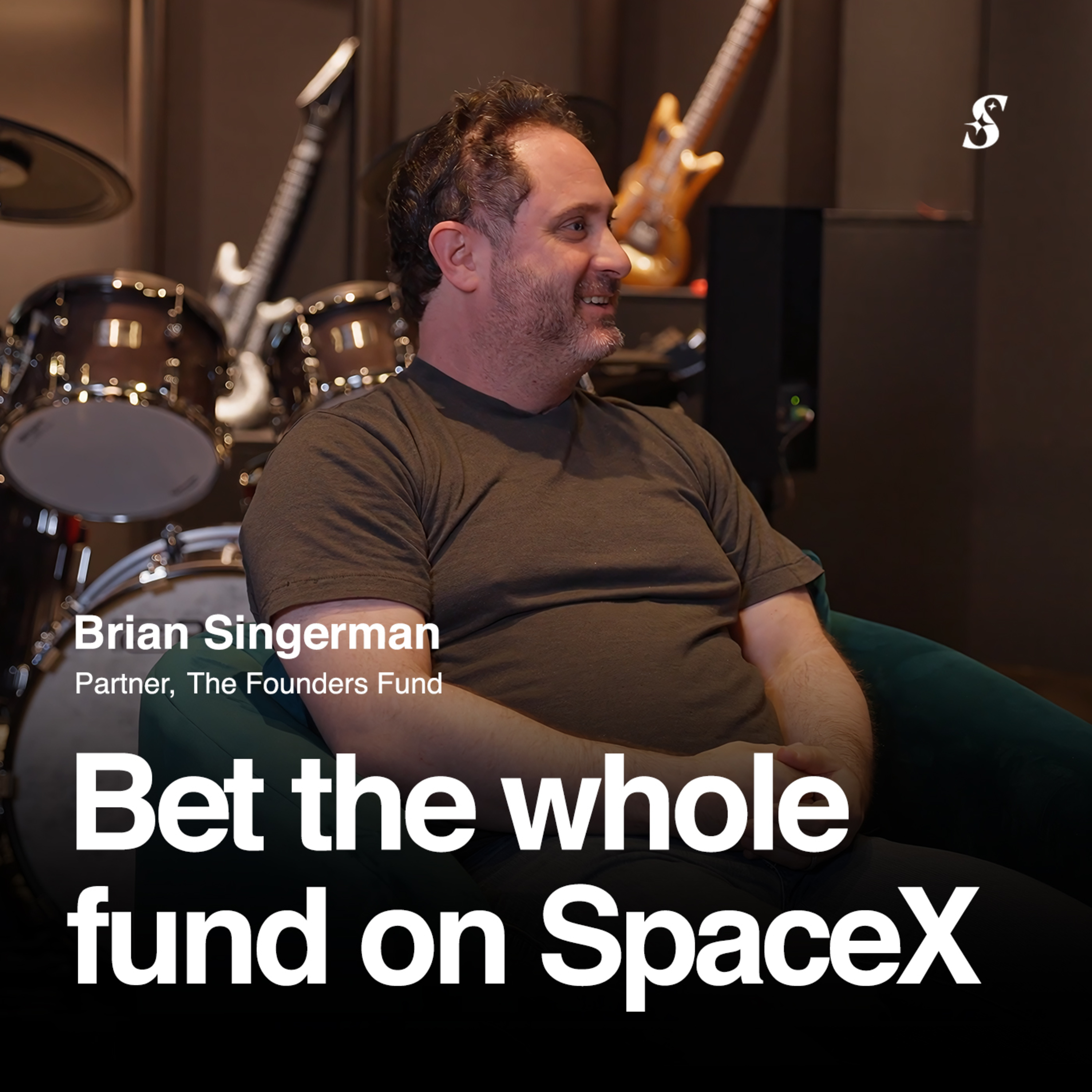

Brian Singerman shares the aggressive investment philosophy he used at Founders Fund to back iconic companies like SpaceX and Palantir. He explains how high-level strategy gaming helps him identify unique founders who are the absolute best in their fields. This approach reveals why making massive, concentrated bets on talent is the key to outperforming the market.
Key takeaways
- Venture capital involves putting the maximum amount of capital into the best companies at the most favorable price.
- Investment decisions should rely almost entirely on the founder's ability to be the best in the world at something novel.
- Competitive mastery in strategy games changed significantly with the advent of online play, which allowed for the volume of practice necessary to reach world-class levels.
- A distinction exists between strategy and tactics; skill in one does not guarantee success in the other, especially in games that demand heavy tactical maneuvering like chess.
- Success in venture capital comes from identifying founders who are the best in the world at something novel.
- A strong organization requires smart people who are comfortable pushing back on leadership instead of being yes-men.
- Wealth taxes and asset seizure policies often end up targeting the middle class once the wealthiest residents leave a jurisdiction.
- The trend of leaving high-tax states is often driven more by the fear of asset seizure than by high income tax rates alone.
- A venture fund that returns 3x over 12 years may still lose to an S&P 500 index fund after accounting for time and opportunity cost.
- To truly outperform the market, venture capitalists should focus on putting as much capital as possible into their highest conviction companies.
- Identifying an A+ founder is often an intuitive process where a team of contrarian investors can reach consensus despite having different perspectives.
- Successful investing does not require being an expert in every industry if you can accurately judge a founder's ability to execute and build a monopoly.
- When evaluating potential investors, look for people who are so talented in their specific niche that they could have outperformed you at your best.
- Authenticity is a filter for talent because it shows a person is operating from their natural strengths rather than posturing to please an audience.
- Unique human artifacts carry emotional significance that algorithms cannot replicate, making them increasingly valuable in an AI dominated world.
- The emotional reaction derived from the creative process is irreplaceable, suggesting that art and music programs are as vital as traditional academics.
Brian Singerman on founder strength and the SpaceX bet
Venture capital is the act of putting the most money into the best companies at the best price. Success often comes down to the strength of the founder. Decisions are almost entirely based on whether a founder is the best in the world at something novel.
Venture capital to me is put the most money into the best companies possible at the best price possible. 98% plus of my decision was based on the strength of the founder. Do I believe that they would just crush at what they are doing? Do I believe that they are the best in the world at something novel?
Founders Fund once bet its collective career on SpaceX. Without that success, the firm might not exist today. Meeting Elon revealed a leader with a unique ability to pull off such a massive undertaking. Brian notes that there has never been anyone else like him in the history of business.
How strategy gaming shapes Brian Singerman's perspective
Brian has been immersed in tabletop gaming since he was six or seven years old. For him, gaming is more than a hobby. It is a core identity that drives his investment strategy. He started by attending local meetups to play classics like Monopoly and Acquire. Eventually, he reached high-level competitive play in games like Settlers of Catan, where he was a US Champion in the mid-1990s. He also ranked globally in games like Ascension, Terraforming Mars, and Caylus.
I'm a gamer. That's what I do. That's what drives my investment strategy and drives everything else. I am a strategy gamer. I love it.
The evolution of online and computer versions of tabletop games changed the level of mastery players could achieve. In the mid-1990s, it was difficult to get truly elite at a game like Settlers because the volume of play was limited to physical meetups. Once gaming moved online, the ability to play dozens of matches a day allowed for a much higher ceiling of skill. Reaching that level of global competitiveness requires an intense time commitment, often involving ten hours of play a day.
Despite his success in many strategy games, Brian admits he is poor at games like poker or chess. He distinguishes between strategy and tactics. He finds that he struggles with games where the tactical component is as important as the strategic one. He prefers a focus on long-term strategy over immediate tactical maneuvers.
I like strategy stuff. Anything where the tactical component is equally as important, if not more important than the strategic component, I'm going to be terrible at. I do not like tactics. I like strategy.
Lessons from the culture of Founders Fund
Brian focuses almost entirely on the strength of a founder when making investment decisions. He looks for someone who is the best in the world at something novel and has the potential to build a massive company. This focus on individual brilliance is what initially drew him to SpaceX and Founders Fund. He realized that angel investing alone could not support projects of that scale.
98% plus of my decision was based on the strength of the founder. Do I believe that they would just crush at what they are doing? Do I believe that they are the best in the world at something novel? And do I think they can leverage that to build one of the world's greatest companies?
The culture at Founders Fund is built on hiring people who are comfortable challenging leadership. Peter Thiel purposefully surrounded himself with smart individuals who would not act as yes-men. This environment requires a high level of mutual respect and the absence of ego. Brian notes that he stays within his own expertise. He excels at identifying A+ founders but does not try to read financial reports or build spreadsheets. He prefers to put his skill points into the things he does best.
When you surround yourself with people who are extremely smart and not scared to use their own individual talents, you build something truly great. One of the things that he and Founders Fund did best was hiring very smart people who could push back whenever they needed to. They use their own specific skill set rather than saying what they think someone wants to hear.
Success comes from letting experts excel in their specific areas. Instead of fitting a standard mold, each partner at the firm plays to their unique strengths. Peter is particularly skilled at understanding global macro trends. By respecting the expertise of others and focusing on individual character, the firm fosters a team of high conviction individuals who are not afraid to be contrarian.
The impact of wealth taxes and the shift to Hawaii
Brian and Molly discuss the political shift in America. Brian notes that politics are becoming more extreme. This makes the idea of moving to places like Argentina more attractive to some people. Brian believes that America is heading in a bad direction. He is particularly concerned about asset seizure and wealth taxes. While many people think these taxes only affect billionaires, Brian argues they will eventually hit the middle class. When the wealthy leave a state, the government will still need revenue. This means they will eventually target the next lower income group.
This is going to impact the middle class way more than it is going to affect mobile billionaires. Once all the billionaires leave, they will need to get the money somehow. They will take from the next lower down and the next lower down.
Leaving the country is difficult, so many people choose to leave high tax states instead. Brian prefers Hawaii. He is not primarily focused on avoiding income tax. He mostly wants to want to avoid asset seizure. Hawaii provides a peaceful place to work with a view of the ocean. Brian also enjoys the warm climate. He prefers wearing shorts because they are less restrictive than jeans. His children also enjoy the island because they do not have to wear shoes.
The simple philosophy of concentrated venture investing
Venture capital should be simple. The goal is to put the most money into the best companies possible at the best price. Many firms get distracted by portfolio management, reserve calculations, and ownership percentages. These details are often nonsense that gets in the way of real returns. If a company has the potential to be one of the greatest of all time, the specific price matters less than the size of the investment.
Venture capital to me is put the most money into the best companies possible at the best price possible. Nowhere in that is portfolio management and reserve calculations and ownership percentages and all that nonsense.
Beating the market is extremely difficult. A venture fund that returns three times its value over twelve years might actually perform worse than a standard index fund. To truly win, investors need a real advantage. Private markets offer the benefit of legal inside information. When an investor has that kind of access and sees a truly great company, the only way to beat the market is to invest every possible penny into it. Everything else just loses to the market over time.
SpaceX is a prime example of this high stakes approach. Founders Fund essentially bet its entire existence on the company in 2008. At the time, SpaceX had suffered three failed rocket launches. Brian admits that the firm was betting its career on the outcome. He loves seeing elite people gamble their careers on their talents. The camaraderie at the office during the first successful Falcon 1 launch was a career highlight.
If SpaceX didn't work, Founders Fund wouldn't exist. We bet our careers essentially on SpaceX. I love elite athletes betting their career on something. Truly elite, talented people betting their career on something. That is what I love.
Elon Musk stands out because he manages both the business and technical sides of his companies. It is rare to find a leader who can be both an effective CEO and a CTO. While many focus on the rockets, the team at Founders Fund knew early on that Starlink was the real business. Global telecom is a massive market, and SpaceX is an N of 1 company in that space. The launch business is impressive, but the applications of those launches are where the most value lies.
Identifying A+ founders and the importance of execution
Founders Fund operates with a team-first mentality where individual credit is less important than collective success. This was evident in early deals for companies like SpaceX, Airbnb, and Palantir. Brian highlights that the firm was incredibly bold with Palantir, investing roughly a third of a 240 million dollar fund into the company at a billion-dollar valuation. Even in fields where Brian lacks expertise, such as biotech, he made successful bets based purely on the caliber of the team and the quality of the CEO.
Identifying top-tier talent is a core part of the investment process, though it is difficult to define the exact traits of a Founders Fund founder. The partners often approach potential deals from different perspectives but usually reach a consensus when they encounter an A+ founder. Brian emphasizes that he does not pretend to be an expert in every industry.
I know what I'm good at and I know what I'm not good at and I don't try and pretend to be good at most things. I don't feel the need to do the whole VC nonsense of knowing about everything.
His personal investment style tends to favor founders who have already demonstrated execution. While some investors can bet on raw potential at the earliest stages, Brian prefers to see that potential paired with real-world results. This preference stems from his own self-awareness about his limitations as an operator. He recognizes his strengths in corporate strategy but admits he never felt he could run a company himself.
I could actually never run a company. It is one of the reasons I wanted to retire from venture capital. When I would talk to these founders, I was always pretty good at corporate strategy and I was really good at figuring out if the person was A+, but there was always some sense of imposter syndrome. I have no idea how to actually run a company.
Identifying authentic talent in venture capital
When evaluating fund investors, Brian looks for a specific kind of excellence. He asks himself if there is any chance the person could have beaten him in his prime while they were playing their own game. He ignores the sense of politeness he might use with founders because he feels more comfortable being direct and skipping the small talk with fellow investors. He wants to get straight to the substance and challenge their strategies immediately.
What I am actually looking for is, is there some chance this person could have beaten me in my prime? As a game, playing their game. Your game is not going to be the same as mine. You are not going to beat me at my game. But playing their game, could they beat me in my prime?
A key part of this evaluation is a bullshit meter. Brian looks for whether someone is operating from their natural strengths or simply saying what they think an investor wants to hear. He finds that many people in the industry try to copy successful strategies like vertical integration or concentrated bets without those strategies being a natural fit for them. He prefers people who are purely themselves, citing Cyan Banister and Palmer Luckey as examples of extreme authenticity.
The media often mischaracterizes successful figures in tech, but Brian notes that many are actually honest and genuine people. For example, Palmer Luckey is a visionary who understands exactly what he is good at and where he needs support. While many people compare founders to Elon Musk, Brian believes the cohesive team at Anduril is even more effective than a single person because the founders complement each other so well.
There is no other founder in history like Elon as one person who could do it all. But the Anduril founding team are all so complementary to each other and different. I do think that the cohesive founding team is better than Elon.
People often posture or play games to win over limited partners or build their careers. However, Brian is most attracted to people who refuse to play those games and remain genuine. He believes that since your customers are not other venture capitalists, it should not matter what other investors think of you.
The enduring value of human creativity
Brian is very bullish on unique human cultural artifacts. He values functional art and items like music memorabilia because they represent specific moments in human history. In a world filled with machine-made content, Brian believes true human artifacts will grow in value. This value is not just about money. It is about emotional connection and mindshare. He prefers a guitar played by a famous musician over an algorithmically generated digital asset.
I don't really care if the algorithm of some NFT made this one thing algorithmically rare. I don't care about that. But do I love a Jerry Garcia guitar that he played for ten years? Hell yeah.
The act of creation remains irreplaceable by machines. Molly shares her background in studio art and explains how artists have an internal drive to create that cannot be stopped. Brian agrees that the emotional reaction someone gets from making art is unique. He argues that being involved in creative pursuits is just as important as academic ones. He suggests that strong music or art programs might even be more vital than math programs in the age of AI.
If you're getting that kind of emotional reaction from doing your art, who is going to replace that?
Brian describes himself as a tech optimist who bets against the end of the world. He believes technology will eventually meet basic human needs, allowing people to focus on what they love. To help this vision, Brian is opening a music studio. He plans to let bands and artists use the space for free. They will keep all their intellectual property while he gets to watch the creative process happen. This allows him to be part of the creativity without needing to make money from it.