
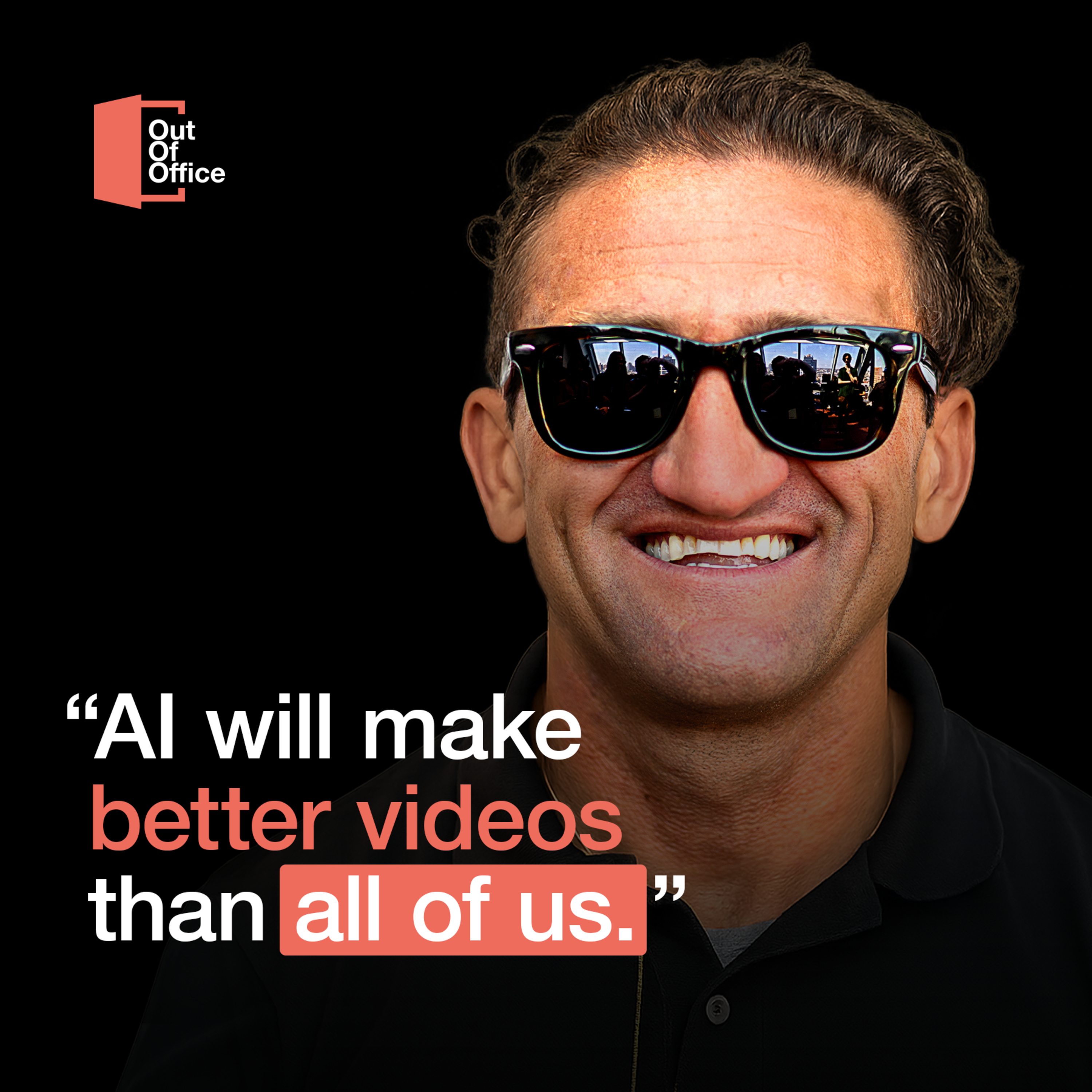

Lightspeed Partner Michael Mignano joins filmmaker and YouTube icon Casey Neistat to discuss New York City's role as his lifelong creative muse.
They explore the tension between raw, human-made videos and the rise of AI-generated content.
Their conversation questions what authenticity means when algorithms can create perfect, infinite media.
Key takeaways
- Personal feelings about AI training on your content don't matter because it's an unstoppable technological shift.
- Your physical environment can be the 'driving DNA' of your creative work. For Casey Neistat, leaving New York City meant his videos lost their essential heart and soul.
- The more technically perfect and polished a video is, the harder it can be for an audience to believe it's authentic. Raw, imperfect footage often feels more human and creates a stronger emotional connection.
- Tools should always serve the story, not be the main focus. The creative process should start with the narrative, then identify the right tools to tell it, rather than finding a story to justify using a cool piece of gear.
- Filmmakers who underestimate AI's impact are like a civilization with blunt instruments, unable to comprehend the guns and cannons that are about to arrive.
- As the volume of content creation explodes, the very concept of 'good' content may become irrelevant. Success might no longer be tied to quality, but simply to what captures and holds attention.
- Attempting to understand how the AI world will be monetized based on today's economic models is a fundamental error. The new paradigm will require entirely new structures, not adaptations of old ones.
- The value of creative work is being redefined. Traditional advice for creators, such as 'be persistent,' breaks down when persistence in AI simply means typing more prompts.
- The success of creators like MrBeast is built on massive effort and resources. The threat of AI is that it could replicate this high-production content with a simple prompt, devaluing the original work.
- Despite AI's potential to create infinite content, there is a counter-trend of people, especially younger generations, gravitating towards older, tangible technologies like vinyl and point-and-shoot cameras.
- Single-purpose devices foster a healthier relationship with technology by promoting focus and concentration, unlike multi-purpose devices like smartphones and tablets which are designed to capture attention indefinitely.
- We have reached 'peak phone,' where the device's detriments now outweigh its benefits. The solution lies in hardware innovation like wearables, which can move us away from app-based operating systems.
- You cannot truly understand the pressures of running a startup until you have felt the anguish of not knowing how you will make payroll.
- The fearlessness of a first-time founder can be an asset, as experience can sometimes lead to a cautious approach that prevents bold, successful moves.
- The exhaustion from managing people and HR can be so consuming for creators and founders that it leads them to seek work with zero employees, allowing them to focus on their core skills.
- A massive budget increase post-acquisition can be a curse. A 10x budget jump can force a startup to focus entirely on rapid hiring, abandoning the organic growth that made it successful.
- As AI technology improves, a key question is whether audiences will still value genuine achievements when they can no longer tell the difference between what's real and what's generated.
- In an era of advancing AI, the most bankable future skills may not be in coding but in manual trades like plumbing, electrical work, and welding.
- A sense of purpose can be powerfully restorative. Shell-shocked WWI soldiers who were largely comatose were revitalized when they were given jobs and a new purpose during WWII.
Podchemy Weekly
Save hours every week! Get hand-picked podcast insights delivered straight to your inbox.
AI is training on your content whether you like it or not
When it comes to AI models training on existing content, personal feelings are largely irrelevant. The reality is that it's already happening and is an unstoppable force. This isn't a matter of not caring, but an acceptance that one's opinion doesn't change the outcome. The focus should shift to the competitive landscape. A video created manually by a person will have to compete with potentially a million AI-generated videos that are just as good. The method of creation will not matter if the quality is comparable.
Living like a grown child in the playground of New York City
Michael notes that New York City feels like a central character in all of Casey Neistat's videos. Casey agrees, calling the city his "museum." He explains that he only fully realized how vital the city was to his work after he moved away to Los Angeles for a year.
Casey felt his videos made in LA "all sucked" because they were missing the "driving DNA" that New York provides. He reflects that as a kid, he never found his footing, but New York was the place he felt he could finally achieve things others considered impossible.
He compares his life to the Tom Hanks movie "Big," in which a child becomes an adult, moves to New York, and succeeds by maintaining his childlike perspective. Casey says he views the film almost as a documentary for his own life.
I've looked at that movie the way one might look at a documentary. I was like this, that's real. And then that's exactly what my life is right now. I'm like a grown ass child that lives in this playground of a city. And I spend all my time in my office, which is just basically like an indoor playground.
He concludes that this unique lifestyle, blending work and play, would not be possible anywhere else.
The lost verite of New York City filmmaking
When asked about favorite things filmed in New York City, Casey Neistat expresses a love for the pulpy cop movies of the 70s and the films of the mid-90s. This era captured the city before it was always made to look beautiful. Many of these films, even romantic comedies like "If Lucy Fell" with Sarah Jessica Parker, would open with sweeping helicopter shots showcasing the city. Casey believes there was a certain "degree of fuckery" from a filmmaking perspective that was possible back then but is no longer the case.
He contrasts this with modern filmmaking. Today, technology allows anything to be made to look perfect, and practicalities require shutting down entire streets, which wasn't as necessary in the past. This resulted in a level of verite, or realism, in that older genre of film that is now largely absent. He does, however, see an exception in the work of Josh and Ben Safdie, whose movies still capture that raw New York City energy.
Choosing humanity over technology in filmmaking
Casey attributes the start of his filmmaking career to the accessibility of new tools. The iMac DV, the first consumer-marketed machine for video editing, made it possible for him to get into the field. Initially, gear enabled his career. However, he notes a shift occurred on YouTube around 2015 when camera equipment became excellent and affordable. This led to a culture where the gear itself became the message, with creators obsessing over their tools.
In response, Casey pushed back against this gear-centric mindset, emphasizing that what you do with the equipment is what truly matters. He now consciously avoids leveraging technology unless it's absolutely necessary, prioritizing the human element in his work. For a recent video about AI, he could have used complex animations but deliberately chose to film himself with markers and paper. He explains that showing the context and embracing imperfection helps viewers connect with the humanity behind the creation.
The more perfect something is, the harder it is to believe what you're seeing. The more raw it is, the more real it feels. And that emotional connection that people have with the esthetic of what they're seeing is something that's often dismissed.
This philosophy extends to his entire toolkit. Whether it's a drone or a Boosted Board, the tool is only used as a narrative device to serve the story. The process starts with the story idea, then he finds the resources to communicate it, rather than finding a story to fit a cool new piece of gear. Casey criticizes the trend of overly polished personal videos, citing an example of a YouTuber's family film that was shot so perfectly it felt unbelievable and disingenuous.
I watched it and I was like, I don't believe this. I don't believe that when your wife gave you that hug that she didn't know that you had a huge camera set up with a 70mm lens. There was a disingenuousness to it.
In contrast, he praises the iPhone camera. Its aesthetic is universally understood to mean someone pulled out their phone and spontaneously captured a real moment, which adds to the authenticity.
The phone's role is defined by the absence of a camera
Casey intentionally uses his phone to capture casual interactions because its aesthetic matches the casual nature of the moment. He rarely used it for his daily YouTube videos in the past, but now relies on it frequently. He uses phone footage when he wants it to feel authentic to the device, never trying to pass it off as if it were shot on a professional camera.
He sees little point in adding numerous attachments to a phone. If a phone setup becomes as bulky as a dedicated camera, he would rather just use the camera.
The phone is for the absence of having a camera. And that's a meaningful role in my set of filmmaking tools.
AI is a coming tidal wave that will consume filmmaking
Casey Neistat does not currently see AI as a tool for his own work. He values an intimate, human approach to filmmaking, which he feels AI undermines. He recalls shooting his HBO show on cheap point-and-shoot cameras to create a sense of closeness with the viewer, similar to how "Jackass" used handycams. For Casey, the joy is in the holistic process of owning every part of the creation: shooting, writing, editing, and starring in his videos.
I made a decision in the early 2010s to no longer pursue feature films, to no longer pursue television... and just do YouTube. Because my favorite style of filmmaking is when I own the whole process. I shoot it, I write it, I edit it, I'm in it.
He compares his approach to that of a painter with a beret, alone in a room creating their art, as opposed to an artist like Jeff Koons who employs a large team. AI filmmaking, in his view, is antithetical to this personal, hands-on style. Despite his personal preference, he believes the question of whether others should use it is irrelevant because its proliferation is inevitable. He compares the current media landscape to the Aztecs, armed with blunt instruments, being warned by a defected conquistador about the coming of guns and cannons. He argues filmmakers are looking at rudimentary AI videos today and failing to grasp the scale of the impending change.
Filmmakers looking at shitty Sora videos, looking at shitty AI clips, being like, how is that going to be a threat to us? But use your imagination. See where this is going, and it is not like a ripple in the process. It is a tidal wave that's going to consume everything.
Casey asserts that trying to stop or regulate this shift is futile. He likens attempts to create AI-free filters on platforms to being handed a tablespoon to bail out the Titanic. The only path forward is to adapt and figure out how to operate within this new reality.
AI's coming 'Gangnam Style' moment in media
The adoption of AI in creative fields like film will likely follow a specific pattern. It will start with a flood of low-quality content, but then a single, audaciously good and different piece will break through, much like "Gangnam Style" did for music. This one hit will open the floodgates. Casey explains, "It's going to be something ironic or unexpected... you don't care where it came from. It's just so audaciously good and different that you fucking love it." After that first success, a few more good examples will appear, then dozens, then hundreds, and eventually millions.
Michael points out that this is already happening in music with platforms like Suno. Initially, the quality wasn't there, but now AI-generated music is topping Spotify charts and AI artists are landing major record contracts. This suggests the tipping point is near for other media as well.
Ultimately, in an attention-based economy, quality is the only thing that will matter to the vast majority of consumers. The idea that people will prefer human-made art simply because of its origin is a losing argument. Casey argues, "Good is good... If someone cares, if it's interesting, it's going to win because the 99% of the world that watches, that consumes... good is all that matters." Platforms like YouTube and Netflix are incentivized to promote whatever captures attention, regardless of whether it was made by a human or an AI.
And if you think that because you made your video by hand, it's going to beat out 1 million videos that are just as good but were made by AI, like, I've got a bridge to sell you.
While there will likely be a niche for human-crafted media, similar to the vinyl record market for music, it will remain a small fraction of the overall landscape. Established creators may retain their audience, but the future will be challenging for new artists competing against a deluge of high-quality AI content.
Movie theaters need to offer more than just the movie
The marketing of new films across many different formats signals a shift in how people watch movies. During the COVID-19 pandemic, Casey Neistat had an exchange with Seth Rogen, who believed theaters would return to their former glory. Casey, however, was skeptical.
I tweeted when Covid hit that I was sad that my kids will never experience movie theaters like I did... And he tweeted back, 'No, it'll go back. It'll be just like it was.' And I was like, I hope to God he's right, but I think that he's wrong.
Time seems to have proven Casey's prediction correct, as box office numbers have not fully recovered. Today, simply showing a movie is not enough to draw audiences. Theaters must provide an enhanced experience. This could be a premium format like IMAX, luxury seating, or unique services. For example, Casey chose to see a film at the Alamo Drafthouse not just for the 70mm film projection, but because he wanted the experience of having dinner served during the movie.
I picked the Alamo Drafthouse because I wanted to be served dinner while I was watching... I needed another reason. Give me more.
This need for an added incentive is a direct response to the competition from high-quality home entertainment systems. As Casey notes, "Everybody has a 60 inch TV at home that's 4K and it's tough to compete with that."
Does good content matter in an age of abundance?
An analogy for the current media landscape is a funnel. The top of the funnel represents the total amount of content being created, while the bottom represents the amount of good content. In the past, there were fewer shows and movies, creating a shared cultural experience where everyone had a strong relationship with the same content, like the movie 'Big' starring Tom Hanks.
Today, the top of the funnel is massive due to the sheer ubiquity of content available. This has radically changed the bottom of the funnel. What is considered 'good' is now subjective and fragmented. This raises a critical question about the future of media.
What role does good content mean in this society when there's just such an abundance of it? Do we end up with a lot more good content? Or does it become harder to find good content because you're just overwhelmed by the junk?
An alternative outcome is that the concept of 'good' content might stop mattering altogether. For example, 'Cocomelon' is one of the most-watched shows on Netflix, not because of its quality, but because it effectively holds children's attention. Its popularity is based purely on consumption, which invalidates the traditional notion of quality.
AI video is becoming indistinguishable from human content
As a filmmaker who has long used manual tools, Casey loves that more people are able to create with AI. He compares the technology to a "nuclear bomb that eviscerates everything," making it impossible to predict what will be left in its ashes.
When asked if prompting a video is true creativity, he says it's too early to tell. He describes an experiment he conducted for a video where he compared Sora's output on one phone to TikTok on another, flipping through them in unison. The content was almost indiscernible, leading him to conclude that Sora was clearly trained on TikTok. While the AI-generated nature of Sora's videos is currently noticeable, he doesn't believe the distinction between human-made and AI-made content will necessarily mean they have different roles in the world long-term.
The fallacy of applying old monetization models to AI
The business model of online video, which revolves around monetizing attention through ads, is being challenged by new AI tools. With a platform like Sora, anyone can invoke a real person, like Casey Neistat, in a video. This raises questions about compensation. OpenAI's Sam Altman has hinted that they will compensate people for their name and likeness, suggesting an effort to build a new economic model for this new structure.
This is a departure from the established systems. YouTube pioneered AdSense, but platforms like TikTok and Instagram have struggled to find their own monetization models, often relying on creator funds that distribute a fixed pool of money. These systems all rely on a simple transaction: the content with the most views gets the most money. When AI removes the friction from creation, this model breaks. If compensation is tied to who makes the most content, the winner will just be whoever can type the fastest.
Casey suggests there is a fundamental flaw in trying to understand this new world through the lens of the old one.
The fault in this thinking is that you and I are trying to make sense of how that world is going to be monetized based on what we understand of the world that we live in. And I think that's a fallacy from the onset.
This same breakdown applies to creator advice. Standard guidance for succeeding on YouTube emphasizes persistence and consistency. However, in an AI-driven world, persistence just means typing more prompts. The two concepts are not analogous. Michael notes this pattern extends to venture capital, where the traditional model of pattern matching to past successes is failing because AI moves too quickly. For AI startups, momentum is now more important than historical parallels, and the threat of being invalidated by a single announcement from a major player like OpenAI is constant.
Fighting AI's progress is a losing battle
Concerns over AI tools like Sora using personal and copyrighted data are valid. Casey Neistat notes that personal data is already widely available on social media platforms, making consent a moot point. He sympathizes with media companies and publishers suing AI firms for using copyrighted material, believing they are right to fight for compensation.
However, he sees this as a losing battle. Casey adopts a realist perspective, arguing that regulation and legislation will struggle to keep up with the rapid pace of technological advancement. He points to the technological gap between lawmakers and the platforms they are meant to regulate as a key reason for this.
I think anything legislative regulation is going to be so far behind the technology... these are the people we're expecting to regulate these platforms that only the most sophisticated people have an understanding of.
He draws a parallel to the retail industry in the 1990s facing the rise of the internet, which ultimately decimated traditional retail over several decades. The disruption from AI, he suggests, will be much faster. Rather than simply resisting, the better approach might be to find a way to work with the new technology. Despite the disruption, he is optimistic that AI will create a new generation of opportunities, much like YouTube did for creators.
The opportunity that YouTube presented was enormous. And because of that, there are millions of creators around the world that are able to make a living by creating... And I hope a decade from now we're looking at AI saying the same thing.
The threat of AI-generated content to creators like MrBeast
MrBeast believes AI could be a real threat to creators. Casey notes that MrBeast's success is built on the immense effort, energy, and resources he and his large team invest in their content. It is a major production that requires a lot of hard work.
What happens when that can be replaced with a prompt? What does it mean for someone like him?
Casey clarifies that he is not broadly anti-AI and is excited about its future potential, though he personally avoids using it in his own videos. He acknowledges that MrBeast likely uses some computer-generated footage. However, the real issue isn't whether individual creators use AI. The fundamental problem is the battle for attention when AI agents can endlessly generate content that mimics a creator's style.
The danger lies in an AI agent that does nothing but generate MrBeast-style scripts and videos, flooding the platform. Young audiences might not be able to distinguish between authentic content and AI-generated versions. As a result, the original, high-effort work risks getting lost in a sea of imitations.
A return to tangible, single-purpose technology
AI is set to flood platforms with infinite content, making them even more effective at capturing and holding our attention. This raises concerns about society, especially children, becoming increasingly glued to devices and losing agency. However, there may be a counter-movement away from this trend. Casey points to a recent study suggesting phone usage may have peaked in 2022 and is now slightly declining.
This potential shift is supported by other market indicators, like the resurgence of older, tangible technology. Vinyl records are popular again, and Canon is even reissuing a 15-year-old point-and-shoot camera—complete with a micro USB port in 2025—to meet demand from Gen Z and Gen Alpha. This generation, having watched their parents constantly on their phones, seems to be seeking a different relationship with technology. Casey suggests the motivation is that they look at their parents and think, "I don't want to be that."
People are craving single-purpose devices again, from wired headphones to retro gaming consoles like the Mod Retro Chromatic. This device, which looks like a Game Boy, requires physical game cartridges, unlike cheaper alternatives pre-loaded with thousands of games. The appeal lies in the relationship it fosters. Casey explains that a single-purpose device encourages focus and a different physical interaction, which is why he allows his kids to use the Game Boy but not an iPad.
The future of mobile is moving beyond peak phone
We have likely reached "peak phone," a point where smartphones bring less benefit than they do detriment. The solution for this is not software, but hardware innovation. Specifically, the future is likely in wearables. This is hinted at by projects from major tech players: Jony Ives and Sam Altman's collaboration, Apple's Vision Pro, Meta's Ray-Bans, Humane's AI Pin, and even Google's early attempt with Google Glass. The goal is to replace the fragmented experience of jumping in and out of apps on a mini TV screen with a singular input device that simply executes commands.
This is not a new idea for Casey Neistat. His startup from nearly a decade ago, Beme, was an early attempt to solve this. Michael Mignano noted that Casey has been thinking about this longer than most. Beme originally started as a Google Glass product. The concept was simple: push a button to capture 10 seconds of what you are seeing and immediately post it to a feed. The core motivation was to bring back authenticity to social media at a time when photo filters were just beginning to create a lack of realness.
The altruistic mission statement was something like, promote empathy by sharing perspective. And the idea was that you could go through this app and just hold down all these cells and you'd see the world from all these people's different eyes.
The name Beme was a play on "be me." It was designed to let people see the raw, unfiltered world through others' perspectives. This original vision is a stark contrast to where social media has landed. Instead of raw perspectives, we see polished, artificial versions of the world, and now, even literal AI-generated artificial realities.
AI-generated content could lead to a Dead Internet
When first using Sora, the AI video generator, a message explicitly states that everything the user is about to see is generated and not real. This serves as both a necessary disclaimer for potential deepfakes and as a kind of mission statement for the platform.
This idea of generated reality is contrasted with apps like Beam, which are about experiencing the world through other people's eyes. The conversation explores a near-future possibility where content platforms like TikTok could evolve. An algorithm could learn a user's interests as they scroll and then use AI to generate videos in real-time to populate their feed.
This concept gets very close to the 'Dead Internet' theory. In this scenario, the algorithm identifies what a user is interested in, and an AI creates that content on the spot. This could lead to a version of the internet where human creators are no longer part of the equation on the supply side of content.
The irreplaceable experience and anguish of a founder
Reflecting on his time as a founder, Casey describes it as an experience he wouldn't repeat if he knew the challenges beforehand, yet he is immensely grateful for it. He believes there's a fundamental difference between those who have been founders and those who haven't. Trying to explain the startup world to a non-founder is like talking to someone wearing camouflage who has never served in the military. Michael agrees, noting the common misconception of a new team being a "startup within a big company."
Until you can appreciate the anguish of not knowing how to make payroll next week, you don't know.
Casey emphasizes that this core emotional struggle is universal across all types of small businesses, whether it's a software company or a coffee shop like his dad's. It's about finding product-market fit, managing people, and building a profitable enterprise. Despite the stress, he wouldn't trade the experience. The relationship with his co-founder, Matt Hackett, taught him more than anything else. Now in his early 40s with a family, he finds it hard to imagine going through that again, but admits that as his kids get older, he feels the "itch" returning.
He also considers the double-edged sword of experience. The fearlessness of a first-time founder often leads to successes that a more cautious, experienced person might have avoided.
The hard lessons from an acquisition and the burden of management
The acquisition of Casey's company by CNN was a tricky and hard experience. He initially saw it as a great opportunity to build amazing technology within CNN. For example, his team built a product for the 2016 election called 'exit polls'. It allowed voters to post a five-second video saying who they voted for. The app displayed these videos, offering a qualitative look at the electorate. Casey recalls that just 20 minutes after the polls opened, he knew Trump would win because of the passion visible in the videos from his supporters, providing access to a type of voter he wasn't exposed to in his daily life.
However, a significant misalignment emerged. While Casey was excited about building technology, CNN was primarily interested in him, his media reach, and bringing his audience to their platform. He admits he was naive and should have been more aware of this. This felt more like a talent deal, even though it wasn't structured as one.
The aftermath was also difficult. While most of his team got jobs, some people who were brought on late were let go after the company moved internally, which was out of his hands. This experience with management, personnel, and HR was so exhausting that his main goal upon returning to New York was to have zero employees. He now works by himself, finding it centering.
I take out my own trash, I mop my own floors. The exhaustion of dealing with management and personnel in HR is so hard that I just, I don't want it. I don't want it anymore.
Michael agreed, reflecting on his time at Spotify with a huge team. He realized he spent about 95% of his day dealing with management issues rather than building, innovating, or exploring his creativity. He recognized that not only was he not good at it, but it was an ineffective way to use his special skill set.
Why the CNN acquisition became a startup cliche
Following the acquisition, Casey Neistat's organization was intentionally kept separate from CNN's main operations. While he had access to their offices, he spent very little time there. He is quick to clarify that his lack of success post-acquisition was not CNN's fault, but his own. The people he worked with at CNN, like Andrew Morse who headed their division, were brilliant. The issue was a personal misalignment for Casey.
A primary challenge was the massive budget increase. His startup, which operated on about a $2.5 to $3 million annual budget, was suddenly given a $20 million budget in its first year with CNN. This tenfold increase forced them to spend all their resources on rapidly bringing in new people and teams, rather than growing organically. This kind of rapid scaling was something Casey acknowledges he was not equipped to handle.
Leave me alone with a small team and we can move mountains. But the minute we have to scale something that rapidly, it was outside of my wheelhouse of understanding of how to do that.
The core struggle became taking something that worked as a startup and making it function within a large corporation. Casey recognizes this as a classic, almost cliche, story that many founders experience after being acquired.
This is a story that I've read about. I have been taught, I've had this conversation a million times with a million founders and they've all said the same words I'm using right now. We became the cliche.
The real threat to news media is independent journalism, not AI
In the face of AI, areas that are intrinsically human, like live sports, are expected to thrive. News media has the potential to be an extension of this because people want to hear perspectives from real people. When watching sports, you want to see real athletes; similarly, news may rely on this human element.
The primary challenge for large news organizations like CNN isn't necessarily AI itself. Instead, the bigger threat comes from real innovators, specifically independent journalists. These individuals, such as those building audiences on platforms like X, are the new competition. Figures like Tucker Carlson, Megyn Kelly, and Barry Weiss have demonstrated the power of building a personal brand and audience outside of traditional structures. The fact that Barry Weiss was brought back into a traditional media organization highlights that these institutions recognize the value and power she built independently. Ultimately, the challenges for established news media are more likely to come from these external innovators rather than from within.
The future of personal devices may be a return to simplicity
While it is difficult for a new company to challenge tech giants like Apple and Meta in the device space due to massive R&D spending, a significant opportunity is emerging in more niche areas. Casey points to the failure of Humane, which had a large budget but couldn't deliver a successful first product. He believes the real potential lies with single-purpose devices, driven by a collective exhaustion with the modern smartphone.
This sentiment is captured in an anecdote about a friend who gets easily distracted on his phone. Casey explains, "When I open my phone, I just want to do one thing, but because it does all these things, I get lost on my way to that one." This frustration is fueling an affinity for older, simpler tech, which Casey argues is less about retro nostalgia and more about a desire for focus. He believes the floodgates for single-purpose devices are about to open.
However, another path of innovation is emerging with AI-powered wearables like the Meta Ray-Ban glasses. While these devices bring technology even closer to our brains, they may offer a more intentional way to interact with technology. Instead of getting lost scrolling, a user can give a direct voice command. There is a greater emphasis on intentionality when you can say, "Text Mike back, I'll be 10 minutes late," versus opening your phone and immediately checking Instagram.
That was like the Apple Vision Pro. You would talk to somebody on FaceTime and Apple Vision Pro and they would have... it's so creepy, man. It just has this weird sort of like zombie face of the person. That's my negative on Apple Vision Pro.
This path also presents significant social challenges. Michael raises the dystopian possibility of someone secretly watching a YouTube video on their glasses during a face-to-face conversation. Casey shares his experience with Meta's full AR prototypes, describing the unsettling "dead eyes" of users. This leads to a critique of the Apple Vision Pro, which he believes is not socially acceptable outside of very niche use cases. Even on an airplane, a promoted use case, seeing someone wear it is still strange. Casey says, "You see somebody on thing, you're like, fucking weirdo."
Does the real thing still matter in an AI world?
New York City serves as a muse for Casey Neistat's work, enabling iconic moments that would not have been as special elsewhere. A classic example is a video where Casey snowboards through Times Square while being pulled by an NYPD vehicle. The unique context of New York City is what made that video so memorable.
However, the rise of AI poses a threat to the impact of such authentic, real-world stunts. A major concern is that as AI technology advances, it will soon be able to generate video that is indistinguishable from reality. This raises a critical question for creators and audiences alike.
In an AI world, that video is just not going to be that special anymore... When AI is so good, which is like a week from now, that you can't tell... to see someone do it for real, does it still matter?
The conversation highlights a shared worry about this future. If an audience cannot differentiate between a genuine, difficult stunt and an AI-generated fake, the value and specialness of the real achievement may be lost.
Raising kids in an age of technological uncertainty
Despite working in technology, both Michael and Casey share a very conservative approach to their children's tech use. They strictly limit screen time, avoiding things like iPads in restaurants, and feel almost hypocritical about their stance. This shared perspective comes from a belief that we will look back on this era with shock. Casey notes the clear dangers of allowing children unfettered access to technology and the internet.
I think we're gonna look back at this time and be like, I cannot believe that people let their kids use the Internet and use tech the way that kids use tech today. Because of how... demonstrably dangerous.
This concern about technology extends to how they think about their children's future education and careers. Casey believes the current 'one-size-fits-all' education system is outdated and will be replaced by AI-driven, personalized learning that caters to individual strengths. This technological shift creates uncertainty about what skills will be valuable. Michael, who majored in computer science, admits he wouldn't know what to advise a college student to study today. Casey shares this sentiment, suggesting a surprising alternative.
I'm encouraging my daughters to be electricians and plumbers... The only bankable skill sets that I can think of right now are ones that involve your hands. Like, I want my kids to learn how to weld and build diesel engines.
He even questions the necessity of college, favoring trades with intrinsic value. The rapid advancement of AI has made it more confusing than ever to guide the next generation, turning previously safe bets like computer science into question marks.
The creative opportunity in AI
When asked what a young creator starting today should focus on, Casey pointed directly to artificial intelligence. He believes there will be immense opportunity in the media landscape within AI. While some people are pushing back or are scared AI will destroy industries, Casey sees only potential.
I just see nothing but opportunity there.
He notes that the young content creators he knows share this excitement. When SORA was released, they were keen to figure out how to incorporate the new technology into their work. This follows a common cycle for new technology. There's often an initial apprehension, but as the technology demonstrates its potential and creates interesting opportunities, people quickly adopt it, just as they did with platforms like TikTok and Vine.
I think there's always an expected apprehension to any sort of new technology at first, and then it, when it starts to yield opportunity and yield interestingness and people run towards it.
Purpose is the core of everything
When asked what he would do with unlimited time and money, Casey Neistat's answer has nothing to do with work. Instead, he would have many children, adopt more, and live on a huge farm surrounded by kids and dogs. This reflects his core belief that purpose is a more fundamental human driver than happiness or success. For him, the ultimate purpose comes from being a parent.
I think purpose is the thing. A lot of purpose comes from careers, for sure. But for me, purpose has come from being a parent. And my career is an extension of that. Everything I've done is an extension of that. But at its core is being a dad.
Casey shares a powerful story to illustrate this point. After World War I, many shell-shocked soldiers were hospitalized and almost comatose. When World War II began, these men were given a new purpose: they were needed as drivers and for other domestic jobs. This new responsibility was enough to give them their lives back. In this light, Michael suggests a utopian outcome of modern technology could be that it gives people more time to focus on their true purposes. Casey agrees, quoting the maxim, "I don't know what World War III will be fought with, but World War IV will be fought with sticks and stones," suggesting a return to a simpler, more purpose-driven life on a farm might be the ideal outcome.