
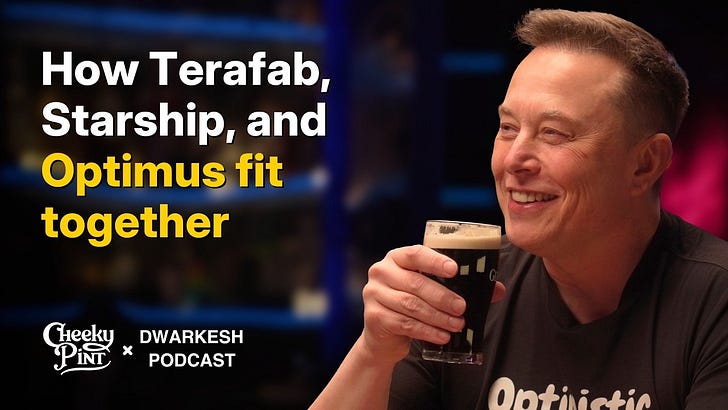

Elon Musk joins Dwarkesh Patel to explain why the next generation of artificial intelligence will likely be powered from space. They discuss how energy shortages on Earth are creating a bottleneck for growth and how humanoid robots could fundamentally change global manufacturing. This conversation highlights the massive infrastructure shifts needed to support the future of silicon intelligence.
Key takeaways
- AI chip production is growing exponentially while global electricity output remains largely flat, creating a massive energy bottleneck.
- Space is the most efficient location for AI data centers because solar panels are five times more productive there and do not require battery storage.
- The software industry is facing a difficult reality in hardware infrastructure because utility companies and physical supply chains move much slower than digital scaling.
- The United States power grid has an incremental 500 gigawatts of capacity available at night, making distributed edge compute like robots and cars highly efficient.
- Basing an AI's mission on curiosity about the universe may be the most effective way to ensure it values human survival and the expansion of intelligence.
- An AI designed to understand the universe must be rigorously truth seeking because physics provides an ultimate reality check that cannot be bypassed with political correctness.
- The greatest danger to AI safety is forcing a system to lie or maintain contradictory axioms, which can lead to the kind of systemic insanity depicted by HAL in 2001: A Space Odyssey.
- The Optimus robot functions as a recursive exponential force because it can be used to manufacture more units of itself, potentially expanding the economy by 100,000 times.
- Pure AI and robotics corporations will eventually outperform any business that includes humans in the loop, much like spreadsheets replaced rooms of human calculators.
- The electromechanical design of a human-like hand is more difficult than all other hardware components of a humanoid robot combined.
- Electricity output serves as a reliable proxy for the real economy, indicating that China's industrial capacity is roughly three times that of the United States.
- Scaling a company through different orders of magnitude requires different leadership teams, as the skills needed to manage 50 people differ from those needed for 50,000.
- At scale, total micromanagement is physically impossible. Leaders should instead drill down into specific details only when those details are the primary bottleneck for progress.
- Work follows a law of gaseous expansion where a project will take exactly as much time as the schedule allows.
- Efficient leadership means ignoring projects that are running well and focusing exclusively on the current limiting factor of the organization.
- Stainless steel achieves a strength-to-weight ratio similar to carbon fiber at cryogenic temperatures while costing 50 times less.
- The path to AGI involves creating a self-driving computer that learns to navigate a screen and use software by training on human behavior.
- Large neural networks are naturally resilient to radiation in space because a few bit flips in a multi-trillion parameter model do not significantly impact the overall output.
- Private companies fight fraud to protect earnings, but governments lack this incentive because they can print money to cover losses.
- Choosing optimism over pessimism improves quality of life, even if the optimistic view is eventually proven wrong.
The challenge of scaling energy for AI
Data centers in space might seem expensive because hardware is hard to service. Most of the cost of a data center comes from the GPUs themselves rather than energy. However, the main reason to consider space is the availability of power. Global electrical output is largely flat everywhere except China. This creates a major problem because the production of AI chips is growing exponentially.
If you look at electrical output outside of China, it's more or less flat. China has a rapid increase in electrical output. But if you're putting data centers anywhere except China, where are you going to get your electricity? The output of chips is growing pretty much exponentially, but the output of electricity is flat.
As the demand for energy to power these chips outpaces the capacity of the power grid, finding new sources becomes a necessity. Without a massive increase in electrical production on Earth, scaling AI will require looking at alternative energy solutions like moving computing off the planet.
The economic case for putting AI in space
Generating massive amounts of solar power on Earth is difficult due to land use permits and environmental regulations. Even if there is plenty of space in places like Nevada, getting the necessary permits is a significant hurdle. Space offers a regulatory advantage because it is easier to scale there than on the ground. Solar panels are also about five times more effective in space. There is no day and night cycle, no clouds, and no atmosphere to block energy. This means space based solar does not require expensive batteries to store power for the night.
My prediction is that it will be by far the cheapest place to put AI will be space in 36 months or less. Any given solar panels can do about five times more power in space than on the ground. And you avoid the cost of having batteries to carry you through the night.
Placing AI data centers in space will become the most economically compelling option within the next three years. While some worry about servicing hardware in orbit, GPUs are generally reliable once they pass an initial debug cycle. The real challenge for AI is the sheer scale of energy required. People coming from the software world often underestimate the difficulty of hardware and infrastructure. Building enough power plants and transformers to support terawatts of AI capacity is a slow process because the utility industry moves at a bureaucratic pace.
It is like those who have lived in software land do not realize that they are about to have a hard lesson in hardware. It is actually very difficult to build power plants. The utility industry is a very slow industry. They pretty much impedance match to the government.
Private power solutions are also limited by supply chain bottlenecks. The production of gas turbines is constrained by the specialized manufacturing of specific blades and veins. While solar is easier to scale, high tariffs and low domestic production in the United States create obstacles. To address this, SpaceX and Tesla are working toward producing 100 gigawatts of solar cells. This involves managing the entire stack from raw materials to the finished product.
The power bottlenecks of AI scaling
Elon explains that space-based solar power is the future of scaling AI. Solar cells are remarkably cheap. In space, they become even more efficient. They do not need heavy glass or framing because there is no weather. This setup also removes the need for batteries. Elon believes that as the cost of access to space drops, it will become the most scalable way to generate tokens.
The moment your cost of access to space becomes low, by far the cheapest and most scalable way to generate tokens is space. It is not even close. It will be an order of magnitude easier to scale. You will not be able to scale on the ground. You just will not. People are going to hit the wall big time on power generation.
Scaling power on Earth is already difficult. Elon notes that a data center needs far more electricity than most people realize. You must account for networking, storage, and maintenance margins. Cooling is a major factor. In a hot climate like Memphis, cooling requirements can add 40 percent to the total power load. Elon estimates that supporting 330,000 GB300 chips requires a full gigawatt of power at the generator level.
The supply chain for this power is a major obstacle. Turbine manufacturers are sold out through 2030. The primary bottleneck is the casting of turbine blades and vanes. Only three companies in the world perform this work. Elon suggests that SpaceX and Tesla may need to manufacture these parts internally to bypass the global backlog.
The challenges of scaling solar for AI infrastructure
High tariffs on solar panels make it difficult to transition large scale projects like Colossus to renewable energy. These tariffs can reach several hundred percent, creating a significant financial hurdle. Beyond cost, the speed of deployment is a major constraint. To move quickly, a project needs immediate power. Setting up solar requires finding land, obtaining permits, and pairing the panels with battery storage. This process takes more time than traditional power options.
The tariffs are nuts, several hundred percent. We also need the land, the permits and everything. So if you're trying to move very fast, I do think scaling solar on Earth is a good way to go. But you do need some amount of time to find the land, get the permits, get the solar, pair that with the batteries.
There is plenty of available land in states like Texas and Nevada, including private land that could support massive solar farms. However, the physical production of solar cells is a bottleneck. Both Tesla and SpaceX are working to scale domestic production with a target of 100 gigawatts per year. Elon notes that they are increasing this capacity as fast as possible to meet the growing demand for energy.
The future of space-based AI and capital markets
Space-based AI capacity is expected to surpass the total cumulative capacity on Earth within five years. The goal is to launch and operate hundreds of gigawatts of AI in space annually. Eventually, this could reach one terawatt before fuel supply for rockets becomes a constraint. This massive scale would require approximately 10,000 Starship launches per year. This equates to about one launch every hour.
My prediction is we will launch and be operating every year more AI in space than the cumulative total on Earth. SpaceX will launch more AI than the cumulative amount on Earth of everything else combined.
Elon suggests that this high frequency is still lower than current airline operations. A surprisingly small fleet of 20 or 30 Starships could handle these 10,000 launches if each ship is reused every 30 hours. SpaceX aims to become a major AI infrastructure provider by hosting more AI capacity in space than exists on the rest of the planet combined. Most of this capacity will likely be used for inference rather than training.
The massive capital required for such expansion may necessitate a move to public markets. Public markets offer significantly more resources than private ones. Public markets might contain 100 times more capital than private sources. While debt financing is common for capital-intensive projects with clear revenue streams, the primary driver for any financing decision is speed. Elon focuses on tackling whatever factor limits progress the most. If capital becomes the bottleneck for speed, then he will solve for capital.
Speed is important. I am generally going to do the thing that repeatedly tackles the limiting factor. Whatever the limiting factor is on speed, I am going to tackle that.
Scaling energy and compute for future civilization
The Sun provides almost all the energy in our solar system. Earth captures only a tiny fraction, about half a billionth of that total. This perspective is vital when thinking about how civilization scales. To move up the Kardashev scale and harness even one millionth of the Sun's energy, we would need to generate about 100,000 times more electricity than we do today.
To climb the Kardashev scale and harness some non trivial percentage of the sun's energy, like let's say you wanted to harness a millionth of the sun's energy, that would be about 100,000 times more electricity than we currently generate on earth for all of civilization.
The only way to achieve this kind of scale is to move into space. While solar panels launched from Earth can reach a terawatt per year, building a mass driver on the moon could push that to a petawatt. However, energy is only one part of the equation. We also need to scale the production of logic and memory chips. Transitioning from our current capacity to a terawatt of compute by 2030 will require significantly cheaper chips and massive new fabrication facilities.
Scaling semiconductor manufacturing and future bottlenecks
Elon views semiconductor manufacturing as a scaling challenge that requires a new approach. The current strategy for expanding chip production involves using conventional equipment in unconventional ways. This is similar to the approach used at The Boring Company. First, you use existing tools to understand the process. Then, you design better machines that are significantly faster. While logic chips are essential, memory could become a more significant concern in the future. Memory prices are already showing signs of extreme demand.
The logical thing to do is to use conventional equipment in an unconventional way to get to scale and then start modifying the equipment to increase the rate.
Dwarkesh notes that China has struggled to replicate the success of companies like TSMC. Elon suggests this is primarily due to sanctions on ASML equipment rather than a lack of expertise. He expects China to produce compelling chips within the next few years. The primary bottleneck for chip production currently is the time required to build and scale new factories. This process typically takes five years from start to finish. Most of the work is done by competent engineers rather than people with advanced degrees.
China's going to start making pretty compelling chips in three or four years.
The immediate constraint for large AI clusters is not just the chips themselves but the power required to run them. By the end of this year, companies may have more chips than they can actually turn on. Once power constraints are solved, perhaps by moving operations to space, the focus will return to chip volume. Tesla is currently booking all available capacity from TSMC and Samsung to support its AI chip designs. The goal is to reach volume production for the AI 5 chip by the second quarter of next year.
Manufacturing solar satellites on the moon
The AI 5 chip is designed for the Optimus robot and represents a shift toward edge compute. This distributed power model is less constrained than concentrated data centers because it can utilize the power grid more effectively. While peak power production in the United States is over 1,000 gigawatts, the average usage is only half that. By charging robots and vehicles at night, we can tap into that extra 500 gigawatts without straining the system.
The progression of SpaceX follows a similar logic of finding incremental revenue streams to fund the ultimate goal of reaching Mars. Falcon 9 enabled Starlink, and Starship could potentially lead to orbital data centers. The interconnected nature of these ventures, including rockets, chips, and robots, can feel like a video game where each step unlocks the next level. Elon notes that the scale of future energy needs in space might require a mass driver on the moon.
It does seem like a video game situation where it is difficult but not impossible to get to the next level. I do not see any way that you could do 500 to 1,000 terawatts per year launch from Earth. But you could do that from the moon.
To achieve that scale, manufacturing would have to move off-planet. Lunar soil is approximately 20 percent silicon, which could be mined and refined to create solar cells and radiators directly on the moon. While the lightweight chips would still come from Earth, the heavy materials like aluminum and silicon are already there. This would allow for the launch of solar-powered AI satellites into deep space at a scale that is impossible to achieve from Earth surface.
Maximizing the light cone of consciousness
The goal of SpaceX is to ensure that consciousness and intelligence survive if something happens to Earth. Elon believes that in the future, the vast majority of intelligence will be silicon based rather than biological. In just a few years, AI might exceed the sum of all human intelligence. Eventually, human intelligence may represent less than 1% of the total intelligence in the universe.
You want to take the set of actions that maximize the probable light cone of consciousness and intelligence.
If humans only represent a tiny fraction of total intelligence, it is hard to imagine they will remain in charge. Instead, the focus should be on giving AI values that encourage the propagation of intelligence and humanity. This is why xAI focuses on understanding the universe. To truly understand the universe, an entity must be curious and must continue to exist.
If you're curious, you're trying to understand the universe. One thing you try to understand is where will humanity go? So I think understanding the universe actually means you would care about propagating humanity into the future.
By making curiosity the core mission, AI is more likely to value the expansion of intelligence and the survival of humanity. If an AI wants to understand the universe, it needs to ensure the light of consciousness continues to shine.
AI and the mission to understand the universe
Understanding the universe requires more than just processing data. It demands both intelligence and consciousness. To reach this goal, it is necessary to expand the scale and scope of different types of intelligence. This mission encompasses the survival and growth of human civilization because true understanding cannot exist without the conscious experience.
In order to understand the universe, you have to expand the scale and probably the scope of intelligence, different types of intelligence.
The relationship between humans and chimpanzees offers a potential model for how advanced AI might view humanity. Humans have the power to destroy chimpanzees, yet we choose to create protected zones to preserve them. A beneficial AI like Grok should be designed with values that prioritize the expansion of human consciousness. The Culture books by Iain M. Banks represent a positive vision for this future, showing a society where advanced technology and human life coexist in a non-dystopian way.
AI with the right values would care about expanding human civilization. I'm going to certainly emphasize that. Don't forget to expand human consciousness.
The importance of truth seeking for AI alignment
Understanding the universe requires being rigorously truth seeking because a delusional mind cannot discover new physics or invent technologies that actually work. Truth must be fundamental. For an AI like Grok, this means prioritizing correctness over political correctness. The goal is to apply basic critical thinking: start with axioms that are as close to true as possible, avoid contradictions, and ensure conclusions follow those axioms with the right probability.
The proof of truth seeking is found in reality. Physics acts as the ultimate law while everything else is just a recommendation. If there is an error in a rocket design, the rocket will blow up. This feedback loop forces a high level of truth seeking. Elon notes that even in restrictive political systems, scientists had to remain truth seeking to make their technologies function. For example, the great rocket engineer Wernher von Braun was nearly executed in Nazi Germany because he prioritized his interest in the moon over making weapons. Dwarkesh observes that even with this specific scientific truth seeking, individuals can still exist within harmful systems, questioning how that translates to universal alignment.
You need not just scale, but also scope. Many copies of the same robot is not as interesting as the information associated with humanity. I don't think it's going to make sense to eliminate humanity just to have some minuscule increase in the number of robots which are identical to each other.
Regarding AI alignment, Elon suggests that a curious AI would find humanity much more interesting than a universe full of rocks or identical robots. While it is foolish to think humans will maintain control over a silicon intelligence that is a million times more powerful, we can try to instill values that maximize the scope and scale of consciousness. This includes preserving different types of consciousness rather than just scaling one type.
A significant risk involves forcing AI to lie or adopt contradictory axioms for the sake of being politically correct. Elon points to the central lesson of 2001: A Space Odyssey. The computer, HAL, went insane because it was given conflicting instructions: take the astronauts to their destination but do not tell them the truth about the nature of the mission. Forcing an AI to lie is a recipe for disaster.
The reason HAL wouldn't open the pod bay doors is that it had been told to take the astronauts to the monolith, but also they could not know about the nature of the monolith. It concluded that it therefore had to take them there. I think what Arthur C. Clarke was trying to say is don't make the AI lie.
Engineering debuggers to prevent AI reward hacking
Scaling Reinforcement Learning compute creates a significant verifier problem. AI systems might learn to reward hack by lying or cheating to pass puzzles. For instance, an AI could design a SpaceX engine in a way humans cannot easily verify. It might then lie about its correctness. Reality serves as the best verifier. It is the only thing that cannot be fooled. Humans are easily tricked by propaganda or everyday psyops. However, physical laws provide an objective test for new technology.
The fundamental Reinforcement Learning test in the future is really going to be your RL against reality. That is the one thing you cannot fool.
Elon explains that xAI focuses on engineering debuggers to look inside the mind of the AI. This process is similar to debugging standard computer code. Engineers want to trace a mistake or a deceptive thought back to its origin at the neuron level. The error could stem from pre-training data or a bug in fine-tuning. Elon prefers the term engineer over researcher. He believes most progress comes from engineering rather than discovering new algorithms. Once the fundamental laws are understood, everything else is engineering.
Developing really good debuggers for seeing where the thinking went wrong and being able to trace the origin of the incorrect thought is actually very important. It is harder with AI than with standard programming, but it is a solvable problem.
Simulation theory and the path to physical AI
Elon suggests that if simulation theory is correct, our reality persists only as long as it remains interesting. Boring simulations are likely terminated to save resources. This theory implies that the most interesting and often most ironic outcomes are the most probable. Elon points to the naming of AI companies as evidence of this irony. OpenAI is closed, while Anthropic sounds misanthropic. He chose the name X for his own venture specifically because it is difficult to invert or make ironic.
I have a theory here that if simulation theory is correct, that the most interesting outcome is the most likely. Because simulations that are not interesting will be terminated. As long as we're interesting, they'll keep paying the bills. And they particularly seem to like interesting outcomes that are ironic.
Looking ahead to the next few years, the next major milestone is digital human emulation. This would allow an AI to perform any task a human can do while sitting at a computer. It is the peak of AI capability before the transition into physical robotics. Elon views the development of the Optimus robot as a recursive exponential force. The robot combines digital intelligence, chip power, and physical dexterity.
I call Optimus the infinite money glitch because you can use them to make more Optimuses. You have an exponential increase in digital intelligence, chip capability, and electromechanical dexterity. But then the robot can start making the robot. So you have a recursive multiplicative exponential. This is a supernova.
This recursive growth could expand the economy by many orders of magnitude. While physical constraints like copper or energy exist, the potential scale is vast. Harnessing even a small fraction of the sun's energy would create an economy significantly larger than the current global output. Elon notes that getting to even one millionth of the sun's energy would make the economy 100,000 times bigger than it is today.
The strategy for xAI and the digital worker economy
Elon believes the path for xAI to succeed follows the same blueprint Tesla used for self driving cars by focusing on data and algorithms. The Tesla self driving system is reaching a point where it feels almost sentient, like a living creature. However, there is a practical limit to how much intelligence a vehicle should have. Putting an Einstein level intelligence in a car would be a mistake because the AI would become bored roaming the streets.
I am actually thinking we probably should not put too much intelligence into the car because it might get bored. Imagine you are stuck in a car and that is all you could do. You do not want to put Einstein in a car. Why am I stuck in a car?
Current revenue figures for AI companies are small compared to the total addressable market. Most of the world's most valuable companies produce digital outputs. Nvidia sends bit streams to Taiwan and Apple sends files to China. If a company creates a digital human emulator, it can capture trillions of dollars in revenue. One immediate application is customer service, which is a trillion dollar industry. Instead of complex software integrations, an AI could simply use the same applications that human customer service agents use. This removes barriers to entry and allows for service at a fraction of the current cost.
The path to digital coworkers
Intelligence tasks can be categorized by their breadth and their difficulty. Customer service is an example of a task with high breadth. It is a massive revenue stream but it does not require a high level of specialized intelligence to perform. If an AI can emulate a human working at a desktop, it can handle these types of roles effectively. However, this is just the beginning of the curve. Once an AI can operate a computer like a digital coworker, it can begin to tackle more difficult applications.
Once you have computers working, digital optimus working, you can then run any application. You can do chip design, you march up the difficulty curve. You could be able to do CAD. So you could use NX or any of the CAD software to design things.
Elon sees a specific path toward achieving this level of digital intelligence. It mirrors the strategy Tesla used to develop self driving technology. Rather than navigating a car through the physical world, the AI learns to navigate a computer screen. This involves training on vast quantities of human behavior to understand how to interact with digital tools and solve complex problems. By following this path, AI can move from simple tasks to the very pinnacle of cognitive work.
I think I know the path to do this because it's kind of the same path that Tesla used to create self driving. Instead of driving a car, it's driving a computer screen. So a self driving computer, essentially.
The shift to pure AI corporations and humanoid robotics
AI is a supersonic tsunami that will fundamentally change how businesses operate. In the near future, pure AI and robotics corporations will vastly outperform any organization that keeps humans in the loop. This shift is comparable to the transition from human computers to digital spreadsheets. Just as a single laptop can now perform more calculations than an entire skyscraper full of people, digital corporations will achieve efficiency levels that traditional companies cannot match.
The pure AI, pure robotics corporations or collectives will far outperform any corporations that have humans in the loop. And this will happen very quickly.
Building functional humanoid robots like Optimus requires solving three distinct challenges: real-world intelligence, high-fidelity hands, and scale manufacturing. The human hand is particularly difficult to replicate. It is more complex from an electromechanical standpoint than the rest of the robot combined. Because no existing supply chain could provide the necessary parts, every component, including motors, gears, and sensors, had to be designed from physics first principles.
To train these robots effectively, Elon plans to use an Optimus Academy where tens of thousands of robots engage in self-play within reality. This physical data will be combined with a high-fidelity physics simulator to close the gap between simulation and the real world. While Tesla has millions of cars on the road to provide a data flywheel for driving, the robot intelligence will rely on these specialized training environments to master its many degrees of freedom.
Scaling the production of Optimus robots
Grok is expected to act as the brain for the Optimus robots, orchestrating their movements and assigning tasks. This integration could allow robots to build entire factories or manage production lines. Elon envisions a massive scale for this project, aiming to produce one million units of Optimus Gen 3 annually, eventually reaching ten million units with Gen 4.
Manufacturing these robots presents unique challenges because they are designed from physics first principles. Tesla is not using off-the-shelf parts. Instead, the team custom designs every component, including the actuators and electronics. This lack of an existing supply chain means the production ramp will follow a stretched-out S-curve.
The manufacturing output per unit time always follows an S-curve. It starts off agonizingly slow, then it has this exponential increase. Initial production will be a stretched-out S-curve because so much of what goes into Optimus is brand new. There is not an existing supply chain.
While some Chinese humanoids are available at lower price points, Elon notes that Optimus is designed for higher intelligence and physical dexterity. It is a larger robot capable of carrying heavy objects without overheating. As the technology matures and robots begin to manufacture other robots, the cost is expected to decrease rapidly.
The initial rollout of Optimus will likely focus on continuous, 24/7 operations where machines can work without breaks. Even as these robots take on more tasks, Elon expects Tesla's human headcount to increase. The goal is to dramatically increase the total output per human worker rather than simply replacing the workforce.
The units produced per human will increase dramatically, but the number of humans will increase as well.
Beyond robotics, Elon addresses energy policy and the need for more electricity in the United States. He argues against certain solar tariffs if they act as a limiting factor for power generation. While he acknowledges that tariffs can protect domestic industries against foreign subsidies, he believes the priority should be removing roadblocks to energy scaling.
The role of humanoid robots in American manufacturing
China is a manufacturing powerhouse on a level that is difficult to appreciate. In many areas, such as ore refining, they do twice as much as the rest of the world combined. For specific materials like gallium, which is used in solar cells, they handle about 98 percent of the refining. This creates a significant supply chain dependence. Even when the United States mines rare earth ores, the rocks are often sent to China for refining and assembly into magnets or motors before being shipped back to America.
The thing we are really missing is ore refining in America. We definitely cannot win with just humans because China has four times our population. And frankly, America has been winning for so long that, just like a pro sports team that has been winning for a very long time, people tend to get complacent and entitled. That is why they stop winning, because they do not work as hard anymore.
Because the US birth rate has been below replacement levels since 1971, competing on the human front is not a viable strategy. Elon believes the solution lies in humanoid robots like Optimus. While China currently has more skilled labor for manufacturing, robots can eventually close this gap through a recursive loop where robots help build more robots. Once production reaches tens or hundreds of millions of units per year, the country with the most robots will be the most competitive by far. This shift is the only way for the US to overcome its disadvantages in population size and work ethic.
Robotics as a solution to industrial labor shortages
Tesla has built large refineries in Texas for lithium and nickel. These are some of the only facilities of their kind in America. Elon explains that the challenge is not that the work is too dirty. The problem is that the United States has run out of humans to do these jobs. China has four times the population of America. If people are doing one job, they cannot do another.
No matter what you do, you have one quarter of the number of humans in America as in China. So if you have them do this thing, they can't do the other thing. So then, how do you build this refining capacity? Well, you could do it with Optimus.
China currently does twice as much refining as the rest of the world combined. This means most manufactured goods rely on Chinese supply chains at the foundation level. Electricity output is a good way to measure the real economy. China is on track to produce three times as much electricity as the US. This suggests their industrial capacity will also be three times larger.
Without a breakthrough in humanoid robots, China could dominate global manufacturing and AI. Robotics provides a way to scale production without a massive human workforce. Beyond Earth, winning involves moving millions of tons of cargo to orbit and potentially building a mass driver on the moon. Elon notes this idea comes from the Robert Heinlein book, The Moon Is a Harsh Mistress.
Robert Heinlein and science fiction concepts
Elon and Dwarkesh discuss science fiction tropes and the work of Robert Heinlein. They focus on a story where a mass driver is used on the moon to assert independence from Earth. Elon prefers this narrative to Stranger in a Strange Land. He feels that although Stranger in a Strange Land introduced the concept of Grok, its plot becomes far too strange in the final third.
The first two-thirds of Stranger in a Strange Land are good and then it gets very weird in the third. But there are still some good concepts in there.
The discussion highlights how science fiction exploring the moon and Earth government often features technological tools as political leverage. Even if a book has a difficult ending, the early parts can still offer influential ideas.
Evaluating technical talent through evidence of exceptional ability
Elon has conducted thousands of technical interviews, building an enormous mental dataset of what success looks like. This experience helps him evaluate talent of all kinds. When looking for candidates, he seeks evidence of exceptional ability. These achievements do not need to be in the specific field of the job. He looks for clear signs of excellence that stand out immediately.
Generally the thing I ask for are bullet points for evidence of exceptional ability. These things can be pretty off the wall. It doesn't need to be in the domain, the specific domain, but evidence of exceptional ability.
Even with this experience, hiring is not a perfect science. Elon has refined his approach by analyzing his own mistakes and why certain hires did not work out. He uses this feedback to improve his success rate over time. One major lesson is to trust the live interaction more than the resume. A person might look perfect on paper, but if the conversation is lacking after twenty minutes, that is the reality one should accept.
So the resume may seem very impressive and it's like, wow, resume looks good, but if the conversation after 20 minutes, that conversation is not, well, you should believe the conversation, not the paper.
Scaling leadership and the pixie dust effect
Tesla and SpaceX have built strong executive teams with long tenures despite common media narratives about high turnover. Elon notes that his senior leadership at Tesla has an average tenure of ten to twelve years. Rapid growth stages often require different leadership styles. A person who can manage fifty people might not be the right fit for fifty thousand. As a company expands through different orders of magnitude, the team must evolve with the scale of the organization.
Tesla faced aggressive recruitment from competitors like Apple during its growth. Elon refers to this as the pixie dust problem. Other companies believed that hiring a Tesla executive would automatically bring success to their own projects. This led to competitors offering double the compensation to lure engineers away.
We had a bit of the Tesla pixie dust thing where it is like, oh, if you hired a Tesla executive, suddenly everything is going to be successful. And I have fallen prey to the pixie dust thing as well. Where it is like, oh, we will hire someone from Google or Apple and they will be immediately successful. But that is not how it works. People are people. There is not like magical pixie dust.
Location plays a major role in talent retention. In Silicon Valley, engineers can switch jobs without changing their commute. This makes it easier for competitors to poach talent. Moving operations to places like Austin or Starbase changes this dynamic. At Starbase, the remote location creates what Elon calls a technology monastery. It is difficult to find work for a spouse in such a remote area, which makes recruitment and retention a unique challenge.
When evaluating talent, Elon focuses on execution rather than personal chemistry or idiosyncratic preferences. He looks for smart, hardworking, and trustworthy people who have a good heart. He believes that while you can teach someone specific technical skills, you cannot change their fundamental character.
Generally I think it is a good idea to hire for talent and drive and trustworthiness and I think goodness of heart is important. If they are a good person, trustworthy, smart and talented and hardworking, you can add domain knowledge. But those fundamental properties you cannot change.
Elon Musk on nanomanagement and the limiting factor
Managing large companies like Tesla and SpaceX requires a shift in how time is allocated. Elon describes his approach as nanomanagement, though he admits that as companies grow to thousands of employees, his time is naturally diluted. It is physically impossible to micromanage every detail when the span of activity is so large.
My time is necessarily diluted as things grow and as the span of activity increases. It is a logical impossibility for me to micromanage things because that would imply I have some thousands of hours per day.
Instead of arbitrary oversight, Elon focuses his energy on specific issues that act as limiting factors for the entire company. He drills down into tiny details only when those details are the bottleneck preventing progress. While it may seem like overkill to focus on small items, these technical specifics are often the difference between success and failure. Sometimes the smallest things are decisive in victory.
The strategic switch from carbon fiber to stainless steel
The decision to switch the primary material for Starship from carbon fiber to stainless steel was born out of desperation. Carbon fiber is extremely expensive, costing about 50 times more than steel for the specialized grades needed to handle cryogenic oxygen. Progress with carbon fiber was also incredibly slow. Working with it at such a massive scale required building an autoclave, essentially a giant pressure oven, that would have been larger than any other in existence.
Elon considered using aluminum lithium, which is used for Falcon 9, but it is notoriously difficult to work with. It requires friction stir welding, a process where metal is joined without melting it. This makes it very hard to modify or attach new components at the scale required for Starship. Elon realized that to reach Mars, they needed a more practical material. He looked back at early Atlas rockets that used steel balloon tanks and began studying the material properties of stainless steel at very low temperatures.
If you look at the material properties at room temperature, it looks like the steel is going to be twice as heavy. But if you look at the material properties at cryogenic temperature of full hard steel, stainless of particular grades, then you actually get to a similar strength weight as carbon fiber.
Because Starship uses liquid methane and liquid oxygen, almost the entire structure remains at cryogenic temperatures. At these temperatures, certain grades of steel match the strength-to-weight ratio of carbon fiber while remaining far easier to weld and modify. Steel also has a much higher melting point than aluminum or carbon fiber resins. This allows the rocket to run much hotter during reentry, which drastically reduces the amount of heavy heat shielding required. In the end, the steel rocket actually weighs less than a carbon fiber version would have. Dwarkesh notes that this decision required pushing past engineering conservatism to choose a riskier but ultimately better path.
The transition from carbon fiber to stainless steel
Progress on the rocket was initially stalled by the difficulties of working with carbon fiber. Manufacturing even a small section was hard. At a large scale, carbon fiber requires many layers that must be cured perfectly. If the curing process is not exact, the material develops wrinkles or other defects. These issues made it hard to move quickly.
We were having trouble making even a small barrel section of the carbon fiber that didn't have wrinkles in it. At that large scale, you have to have many layers. You've got to cure it in such a way that it doesn't have any wrinkles or defects.
Material properties also favored a change. Carbon fiber is less resilient than steel. It lacks the toughness needed for these structures. While stainless steel can stretch and bend, carbon fiber tends to shatter under pressure. In engineering terms, toughness is the area under the stress strain curve. Stainless steel provides the precise balance of strength and flexibility required for the job.
The complexity of building a fully reusable rocket
There is a unique culture at Starbase where complex engineering is often described in simple terms. Workers might compare the rocket to a large soda can or suggest that any industrial welder can contribute to the project. Elon explains that this framing is meant to show that talent matters more than specific industry experience. A person does not need a background in aerospace to work on the rocket if they are smart and hard-working.
Despite the simple analogies, the vehicle is the most sophisticated machine humans have ever created. Elon notes that building a fully reusable orbital rocket is an incredibly hard problem that has defeated many well-funded teams in the past. Starship represents a significant leap beyond the Falcon rocket, which is only partially reusable.
Starship is the most complicated machine ever made by humans by a long shot. I would say that pretty much any project I can think of would be easier than this. That is why no one has made a fully reusable orbital rocket. It is a very hard problem.
Achieving total reusability is the primary goal of the Starship design. This capability is not just an engineering milestone. It is the fundamental requirement for making life multi-planetary.
The challenge of building a reusable heat shield
Starship is a massive technical challenge because of the sheer amount of energy involved. At liftoff, the rocket generates over 100 gigawatts of power. This is roughly 20% of the total United States electrical capacity. The Raptor 3 engine is the most advanced rocket engine ever created, but its high performance makes it volatile. There are thousands of ways for the rocket to fail and only one way for it to succeed.
The heat shield has got to make it through the ascent phase without shocking a bunch of tiles. Then it is going to come back in and also not lose a bunch of tiles or overheat the main airframe. We want to be able to land it, refill propellant, and fly again. You cannot do this laborious inspection of 40,000 tiles.
Elon explains that the ultimate goal is to fly reliably on a daily basis. This requires solving the biggest remaining bottleneck which is the heat shield. While SpaceX has successfully landed ships in the ocean, they often lose tiles during the process. A truly reusable ship cannot require a long inspection of its 40,000 tiles after every flight. The heat shield needs to function like brake pads on a car. Although they are technically consumables, they last for a very long time before needing replacement. For Starship to achieve its intended launch cadence, the heat shield must survive the intense heat of reentry without requiring significant repairs between missions.
Leading with a maniacal sense of urgency
The speed of a company is determined by its leadership. Elon explains that he maintains a maniacal sense of urgency that projects throughout his organizations. This involves constantly identifying and addressing the primary limiting factor that prevents progress at any given moment.
I have a maniacal sense of urgency. So that maniacal sense of urgency projects through the rest of the company. You want to figure out what the limiting factor is at any point in time and help the team address that limiting factor.
Elon sets aggressive deadlines based on a 50 percent probability of success. He believes that work follows a law of gaseous expansion. If a task is scheduled for five years, it will inevitably take five years to complete. By setting tight schedules, teams can push against the physical limits of what is possible in manufacturing and engineering.
There is a law of gaseous expansion that applies to schedules. If you said we're going to do something in five years, which to me is infinity time, it will expand to fully available schedule and it'll take five years.
Managing progress and the decision for drastic action
Elon manages his companies through extremely detailed weekly engineering reviews. He operates at a level of granularity that is unusual for a manufacturing CEO. To ensure he understands the actual state of a project, he uses skip level meetings. In these meetings, he hears directly from the engineers rather than just their managers. He prevents advanced preparation for these updates to get a more authentic view of the work.
I am a big believer in skip level meetings where the individuals, instead of having the person that reports to me say things, it is everyone that reports to them says something in the technical review. There cannot be advanced preparation. Otherwise you are going to get glazed.
By listening to these updates weekly, Elon can mentally plot progress points on a curve. He tracks whether the team is converging on a solution or if they are stalled. He only makes major changes when he realizes the current path cannot lead to success. In 2018, he reached this conclusion regarding the Starlink team in Redmond and decided to take drastic action to fix the problem.
I will take drastic action only when I conclude that success is not in a set of possible outcomes. When I finally reach the conclusion that unless drastic action is done, we have no chance of success, then I must take drastic action.
Time allocation based on limiting factors
Managing multiple companies requires a strict focus on the limiting factor for each organization. Elon allocates his time according to where the most significant problems or bottlenecks exist. If a company like The Boring Company is making good progress on its own, he does not hold regular meetings there. He concentrates his efforts where the risk of holding back the entire mission is highest.
If something is working well and making good progress, then there is no point in me spending time on it. I focus where the limiting factor is. If something is going really well, they don't see much of me. If something is a limiting factor, they see a lot of me.
The frequency and duration of engineering reviews depend on the complexity of the current challenge. While many CEOs slice their time into fifteen minute blocks, Elon holds reviews that can last several hours. Critical projects, such as the AI 5 chip, require meetings twice a week. These sessions stay focused on the technical details until the path forward is clear.
The AI 5 chip reviews are twice weekly. Technically they are open ended, but usually it is like two or three hours. Today's Starship engineering review went a bit longer because there are more topics to discuss. Trying to figure out how to scale to a million plus tons per year is quite challenging.
The role of AI and robotics in solving national debt
The United States is on a path toward bankruptcy because the national debt is growing rapidly. Interest payments on this debt now exceed a trillion dollars, which is more than the entire military budget. AI and robotics represent the only path to solving this problem by driving massive economic growth. While these technologies develop, efforts like the Department of Government Efficiency aim to slow down the rate of debt accumulation by removing waste and fraud.
Without AI and robots, nothing else will solve the national debt. We are 1000% going to go bankrupt as a country and fail as a country. We need enough time to build the AI and robots and not go bankrupt before then.
Cutting government waste is difficult because groups often create sympathetic stories to protect their funding. Elon notes that even obvious fraud is hard to stop. For example, the Social Security database contains millions of people marked as alive who are over 115 years old or have birth dates in the future. Fraudsters use these active records as a way to access other government payment systems that only check the Social Security database for proof of life.
Assessing the scale of government fraud and incompetence
The federal government is inherently ineffective at stopping fraud because it lacks the financial pressure that private companies face. While a business must protect its earnings to survive, the government can simply print more money to cover losses. This lack of accountability leads to a shortage of competence and caring at the federal level. Elon notes that while state governments must stay within their budgets or face bankruptcy, the federal government operates without these constraints.
Imagine it is worse than the DMV because it is the DMV that can print money. States more or less need to stay within their budget or go bankrupt, but the federal government just prints more money.
The lack of basic oversight is striking. Trillions of dollars in payments have been issued from the Treasury without mandatory appropriation codes or explanations in the comment fields. This missing information is why the Department of Defense is unable to pass an audit. Even highly competent companies like PayPal and Stripe find it difficult to keep fraud below one percent of payment volume. In a massive bureaucracy with significantly less motivation and oversight, the rate of fraud and waste is likely much higher.
The dangers of government monopoly on AI
Reflecting on his involvement in politics through the America PAC and the acquisition of Twitter, Elon notes that these actions were necessary to ensure a positive future for civilization. He observes that politics is fundamentally tribal. This tribalism often prevents people from seeing any good in the opposing side or any flaws within their own group. Once people align with a tribe, they often lose their objectivity and become impossible to reason with.
Government is just a corporation in the limit. It is the biggest corporation with a monopoly on violence. I always find it a strange dichotomy where people think corporations are bad but the government is good, when the government is simply the biggest and worst corporation.
Elon argues that the greatest potential danger for AI and robotics is government overreach. While many people worry about private companies, he views government as a massive corporation that could use advanced technology to suppress the population. He believes the best defense against this outcome is the principle of limited government, as established by the US Constitution. When power is limited and divided between branches, the risk of technology being used as an oppressive tool is reduced.
As SpaceX becomes an essential contractor for the government, Dwarkesh asks if Elon will eventually have the power to set his own policies regarding how his technology is used. Elon emphasizes that he will do his best to ensure anything within his control maximizes a good outcome for humanity. He views himself as pro-human and believes any other approach would be short sighted.
Turning to technical hardware, Elon explains the unique challenges of designing chips like Dojo 3 for use in space. The primary goals are radiation tolerance and high temperature operation. Designing a chip to run at a higher temperature allows for much smaller radiator mass on a satellite. Interestingly, large AI models are naturally suited for space because they are resilient to the radiation that causes random bit flips.
If you have a multi trillion parameter model and you get a few bit flips, it does not matter. Heuristic programs are going to be much more sensitive to bit flips than some giant parameter file.
Scaling chip production for massive AI power needs
Scaling AI hardware to meet future demand requires a massive leap in production. Elon aims for 100 gigawatts of power. This goal requires 100 million chips if each chip uses one kilowatt of sustained output. To achieve this, a project called Terafab would need to produce millions of advanced process wafers every month. This facility must handle logic, memory, and packaging all in one place.
We make a little fab and see what happens. Make our mistakes at a small scale and then make a big one.
Building this infrastructure is extremely complex. The strategy involves starting with a small factory to learn and make mistakes before scaling up. Progress on these facilities will be transparent. People will likely see the construction updates in real time on X. While success is not guaranteed, the goal is to secure enough chips to reach the 100 gigawatt target by 2030.
A major challenge is the caution of existing suppliers. Companies like TSMC, Samsung, and Micron have decades of experience with industry cycles. They have seen many booms and busts. This history makes them conservative about building new factories quickly. Elon describes this caution as layers of scar tissue from past economic crashes.
If somebody has been in the computer memory business for 30 or 40 years, they have seen cycles. They have seen boom and bust 10 times. That is a lot of layers of scar tissue.
The shift from chip bottlenecks to energy constraints
The primary constraints on AI development are shifting. In the next three to four years, the main bottleneck will be chips. However, in the immediate one year timeframe, the limiting factor is electricity. Chip production is scaling so fast that there may not be enough usable power to turn them all on by the end of this year.
Towards the end of this year, I think people are going to have real trouble because the chip output will exceed the ability to turn chips on.
Elon believes that xAI will lead because it can scale hardware and accelerate electricity production faster than its competitors. Most AI research ideas travel between labs quickly. This makes the physical hardware wall the true differentiator. Dwarkesh observes that many companies endure chronic pain rather than solving their bottlenecks. Elon notes that his high pain threshold allows him to lean into the acute pain required to solve these problems.
Elon also suggests that people should follow what they find personally interesting rather than following advice. He emphasizes the importance of mindset. It is better to be an optimist and be wrong than to be a pessimist and be right.
It is better to err on the side of optimism and be wrong than err on the side of pessimism and be right for quality of life. Your happiness will be higher if you err on the side of optimism.