
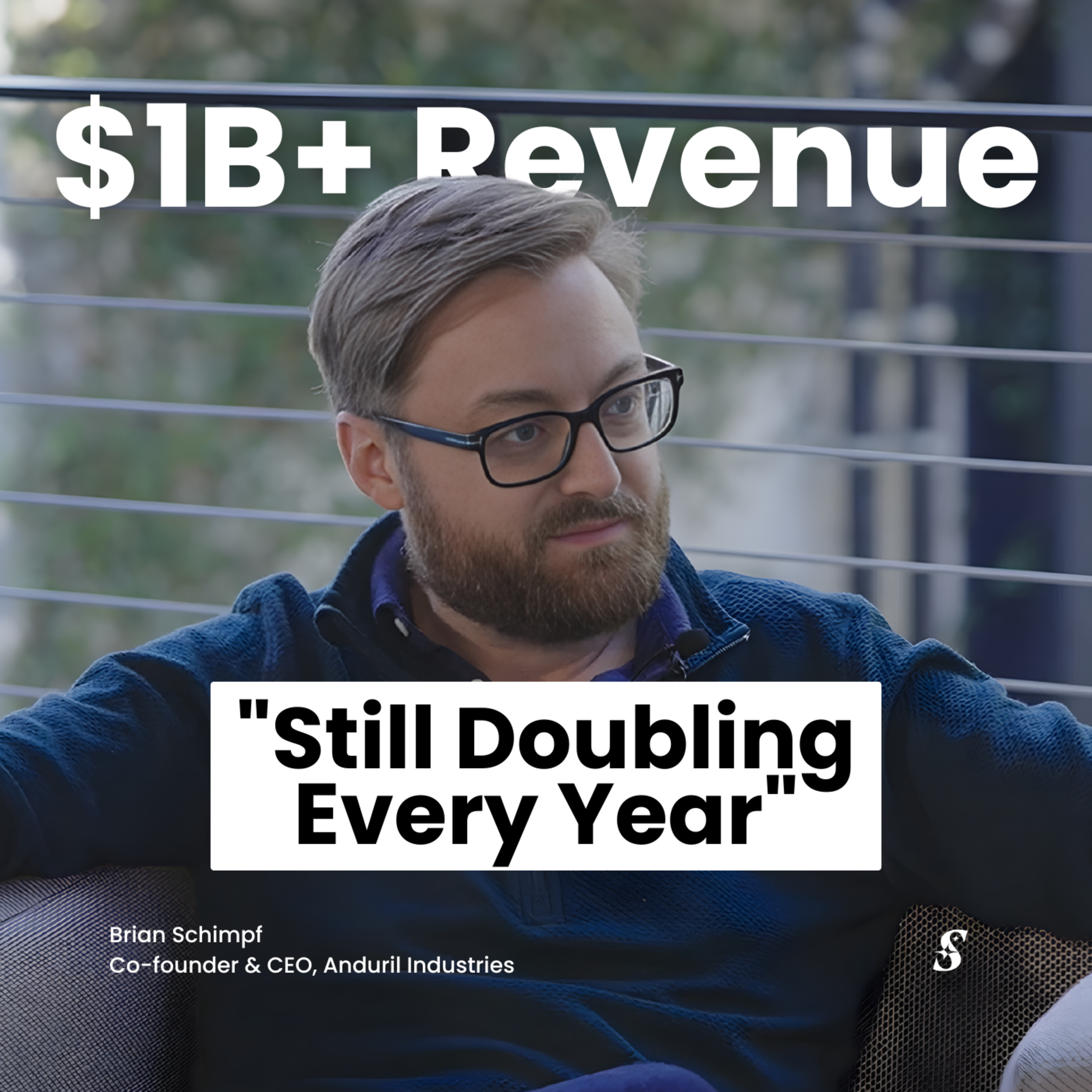

Brian Schimpf, Co-Founder and CEO of defense technology company Anduril, discusses its rapid growth to over $1 billion in annual revenue.
He explains how the company is building autonomous systems for a modern battlefield, addressing critical production gaps in the U.S. defense industry amid growing geopolitical instability.
Key takeaways
- In about eight years, Anduril has grown to 7,000 employees and over a billion in annual revenue by focusing on creating a more disconnected, autonomous battlefield.
- Amidst growing geopolitical instability, Anduril's leadership believes the company is undervalued because the global demand for its defense technology will only increase.
- In about eight years, Anduril has scaled to 7,000 employees and has consistently doubled its revenue each year, even after surpassing the billion-dollar mark.
- The company's rapid growth is attributed to strong execution and the ability to quickly field new products that meet high customer demand.
- The defense industry operates in a unique world of building many different products at relatively low volumes, requiring a manufacturing strategy focused on flexibility rather than optimizing for high-rate production like consumer electronics.
- Accountability drives better outcomes. A pricing model where the company doesn't get paid if the product fails forces better performance and is a win-win for both the company and the government, unlike traditional cost-plus contracts.
- The US defense strategy is shifting from maintaining a long-term, expensive technological edge to prioritizing the ability to produce new capabilities quickly, affordably, and at scale.
- The defense acquisition system is being reoriented to value speed and performance, creating a new competitive landscape where rapid, cost-effective innovation is the key to survival.
- Over half of the nearly trillion-dollar defense budget goes to personnel and facilities, not new technology. The budget for acquiring new systems is actually at a historic low as a percentage of GDP.
- Modernizing the military for greater efficiency will temporarily cost more, as new systems must be brought online while legacy systems are still being maintained and phased out.
- Geopolitical instability and extreme backlogs from US suppliers are forcing allied nations to seek new, faster ways to build their own defense capabilities.
- For decades, defense manufacturing focused on creating the most advanced 'Swiss watch' weapons at any price, making them impossible to mass-produce. The better approach is to design weapons from the start with scalable manufacturing in mind.
- The solution to defense supply chain vulnerabilities is not to create expensive, defense-specific industries, but to foster commercially viable industries that can also serve defense needs.
- Dependence on a foreign nation's supply chain for consumer goods like phones and cars critically weakens a country's ability to act independently and use economic leverage in foreign policy.
- Truly talented people are often opinionated, aggressive, and create a sense of chaos, but empowering them to own problems is essential for innovation.
- As companies scale, they often mistakenly hire talent that optimizes the existing system, which crushes the creative talent needed to adapt and solve new problems.
- Success has led Anduril to be pulled into bigger and more complex problems, accelerating its involvement in nearly every aspect of US and international defense.
- The company was founded to change the trajectory of defense, and it now feels it has reached the scale and size to truly move the needle.
- A company's valuation can be simplified to a core belief: if you think the world will need more of what you're doing, the company is undervalued.
- Intense market demand for a private company's stock, even leading to fake investment vehicles, is a positive signal of having access to nearly unlimited capital for growth.
Podchemy Weekly
Save hours every week! Get hand-picked podcast insights delivered straight to your inbox.
Anduril is building the military of the future
Anduril is focused on building the military of the future. Eight years since its founding, the company has grown to about 7,000 employees and is consistently doubling its revenue annually, which is now over a billion dollars. The company's core thesis revolves around the future of a more disconnected and autonomous battlefield. To support this, Anduril has developed a comprehensive software platform that includes sensors, compute power, and communication systems, allowing them to operate quickly on a global scale.
The current geopolitical landscape is increasingly unstable. Brian Schimpf notes that despite common talk about living in a time of peace, it doesn't feel that way to him. Anduril was founded to have a real-world impact, specifically to change deterrence and the trajectory of defense. Now, at its current scale, he feels the company is truly moving the needle. This success has generated significant financial momentum, leading to IPO rumors and even fake Special Purpose Vehicles (SPVs) where people attempt to sell Anduril stock they don't possess. Brian positions Anduril as one of a handful of successful growth-stage companies in an enormous market, suggesting that given the world's growing needs, the company is currently undervalued.
Anduril's growth has outpaced expectations
In about eight years, Anduril has scaled to approximately 7,000 employees. Brian Schimpf notes that the company has consistently doubled its revenue every year, a trend that has continued even after surpassing a billion dollars in revenue. This rapid growth has also applied to their product pipeline, with dozens of different products currently fielded. The company has demonstrated an ability to quickly get new capabilities out to customers, where there is strong demand.
It's just really grown a lot faster than I anticipated. I thought we'd be five, six years from now at this point. But just the pace that customers have been excited about what we're doing, the uptake, all of that has gone a lot faster than I would have thought.
Brian attributes this accelerated growth to a combination of macro factors, strong execution, and building the right products at the right time. The pace of expansion continues to increase, even beyond their current state.
A modern strategy for building and pricing defense technology
The company's product line has naturally progressed toward greater complexity and scale. Early on, the focus was on smaller drones, a solvable problem given the capital and expertise at the time. Now, the company is developing sophisticated capabilities like low-cost cruise missiles and autonomous fighter jets. Brian Schimpf likens this evolution to Tesla's journey from a hand-built Roadster to mass-produced vehicles. The company is now able to take on harder and harder challenges.
When deciding which products to pursue, several factors are considered. A key criterion is the potential for real adoption within three to five years; the company does not work on projects with a 10-year outlook. They also need a clear technical edge in production, software, or hardware, and the government must be ready to buy. Brian emphasizes that market timing is the most critical component.
A lot of people made small drones 10 years ago and tried to sell them to the government. Not that many of those businesses are around anymore because the government was not ready to move out at any meaningful scale at that time. And so really getting that market timing right is probably the most important part for us.
The defense industry presents unique manufacturing challenges. Unlike consumer tech giants such as Tesla or Apple that produce a high rate of a single product, defense involves building a wide variety of products at relatively low volumes. This requires a strategy centered on flexibility. Central to this strategy is a core thesis about the future of a more disconnected, autonomous battlefield. This has led to the development of a reusable toolkit, including a software platform called Lattice, sensors, and communication systems, which enables rapid development of new capabilities without starting from scratch.
When it comes to pricing, the goal is to be cheaper than the alternatives by using commercial off-the-shelf components and designing with cost in mind. The preferred pricing model is a fixed price with a sustaining fee for ongoing upgrades, creating a rational win-win outcome. Brian also advocates for models where the company takes on more risk.
We really prefer models that hold us accountable to delivery. If it doesn't work, we don't get paid. It's a controversial position in the government, but it just makes us a better company and the government gets a better outcome... versus the traditional approach where the government took all the risk and you get a fixed profit fee. That's a disaster.
The defense industry's pivot to speed and production at scale
The US defense strategy is undergoing a significant shift. For generations, the approach was to maintain a decades-long technological edge, investing heavily in the most advanced and expensive capabilities. However, this model is no longer sufficient. The new focus, as articulated by Secretary Hegseth, is on the industrial base's ability to produce new capabilities quickly, affordably, and at scale. This is now seen as the most determinative aspect of a modern defense department.
This change means that rapid innovation, especially in software, and the ability to adapt capabilities on the fly are paramount. The conflict in Ukraine serves as a prime example of this new reality. Consequently, the entire defense acquisition system is being reoriented around speed, moving away from its prior focus on getting the most expensive technology at any cost. This creates a new environment for the defense industry. Companies that can work in this faster, more cost-effective world will succeed, while those who cannot will fail. While traditional platforms like aircraft carriers will still have a role, the balance is shifting toward a new class of more affordable and scalable capabilities, including autonomous systems.
The reality of the trillion-dollar defense budget
Many assume the nearly trillion-dollar defense budget is spent on buying new equipment each year, but that is not the case. More than half of the budget goes toward fixed costs like personnel, facilities, and military construction. Another significant portion is spent on sustaining legacy technologies. The cost of maintaining existing aircraft and ships is a huge bill, significantly higher than what is spent on procuring new systems.
In fact, the procurement budget for new technology, as a percentage of GDP, is at a historic low. The spending is focused on maintaining old technology and the vast infrastructure required for a global military. This leaves about 30% of the budget for maneuvering and improvements. There's a strong argument that this portion could be spent much more efficiently, potentially doubling the value received on weapons and aircraft by adopting a different mix of systems.
However, transitioning to this more efficient future presents a major challenge. The military cannot simply abandon its current manned ships and aircraft for an autonomous future overnight. This transition period, where old systems are responsibly phased out while new ones are brought in, will actually cost more for a time. Therefore, while there is massive potential for efficiency, the defense budget is unlikely to shrink in the near future.
Manufacturing defense for a new geopolitical era
Brian Schimpf explains that the world is currently in a period of significant geopolitical instability, not peace. He points to numerous global conflicts, including the land war in Europe, disruptions in the Red Sea, and aggressions in the South China Sea. This instability is causing nations everywhere to increase their defense spending. At the same time, the role of the US is shifting. While America remains a global security guarantor, it now expects allied nations to provide more for their own defense. This creates a problem, as the US industrial base is struggling with immense backlogs.
The backlogs on, like, you want to order Patriot missiles, I'm hearing right now, the latest number someone told me over the weekend was 15 years to get a new Patriot system. What does that even mean? I have no idea what that means, but it's like call it even 5 to 7 for a backlog. This is crazy. So the US isn't a dependable producer anymore.
This situation has led countries to rethink their defense strategies. Australia serves as a prime example. Facing a decade-long capability gap while waiting for US nuclear submarines, Australia partnered with Anduril on the Ghost Shark program. They co-funded the development of extra-large autonomous underwater vehicles, building out local engineering and production facilities. The program moved incredibly fast, with the first production unit rolling off the line just 30 days after the contract was signed.
This model addresses a core issue in US defense manufacturing. Brian argues that US capacity isn't the problem; the philosophy is. For 40 years, the industry was asked to build the most advanced weapon possible, regardless of cost or scalability.
What we asked industry to do for nearly the last 40 years was how could you design the most high end Swiss watch of a weapon or an airplane? We just had capability at any price and we're shocked to find out that you can't mass produce Swiss watches.
Instead, he advocates for a World War II-style approach: designing weapons from the outset that can be mass-produced using existing industrial capacity. While there is plenty of domestic capacity for components like composites and circuit boards, national policy issues remain for critical materials like rare earths and semiconductors.
Supply chain dependence on China is a critical national security issue
Defense supply chain issues cannot be solved with defense-specific solutions, as they will always be too expensive and difficult to produce. The solution lies in creating commercially viable industries within the U.S. or allied territories that can also serve defense needs. For example, a specialized magnet factory just for defense is not a workable solution. What is needed is a commercially viable magnet factory that the defense sector can also use.
For decades, the U.S. has been waking up to the reality that China uses its state power to create supply chain dependence. This dependency creates a vulnerability that extends beyond defense into trade and diplomacy. It severely limits the ability to act independently as a nation or to apply pressure when needed.
Imagine we wanted to put economic sanctions on them if they were doing something nefarious. No one would get iPhones, no one would get cars. It completely hamstrings our ability to act independently as a nation, to just basically penalize bad behavior. We just lose all that leverage.
This reality requires a new lens for national policy. While the shift may be uncomfortable and take time, addressing this industrial policy issue is critical for national resilience and security.
Empowering creative talent over systematic talent
The biggest lesson Brian learned from his time at Palantir was the focus on talent. He notes that while many companies say they value talent, it can be an annoying and chaotic practice. Truly talented people are often super opinionated and aggressive, which can feel uncomfortable. However, Palantir's CEO, Alex Karp, recognized the beauty in this, championing the idea of having brilliant people who are highly empowered to own problems.
As companies scale, middle management often becomes locked into systems and stability. They think they are hiring talent, but they are actually hiring people who are good at optimizing the system as it already exists. This is not creative talent. When the world changes or problems get harder, this approach crushes the very talent needed to adapt and innovate.
At Anduril, the work requires constant creativity. The company is always inventing new products, navigating difficult political and geopolitical questions, and developing new forms of warfighting. To succeed, it's essential to have brilliant people and give them the space to have the right ideas and do what they need to do. Brian believes this is the most important and non-obvious lesson that most companies get wrong.
Anduril is accelerating its impact on global defense
The next few years for Anduril are expected to see continued acceleration. As the company has become more successful, it is being pulled into bigger, harder, and more complex problems. This will lead to Anduril becoming deeply involved in nearly every aspect of US and international defense. Brian finds the sheer scale and breadth of their future operations extremely exciting.
It feels like it is really happening now. It feels like we are at the scale and size that this is really moving the needle and that is very exciting for me.
The company was founded with the mission to have a significant impact on the world, to change deterrence, and to alter the trajectory of the defense industry. Brian now feels that they have reached the size and scale to truly make that happen.
Why Anduril is always undervalued
The high demand for Anduril's private stock, which has even led to fake SPVs, is seen as a positive indicator. Brian Schimpf views this as a good problem to have, as it signals that the company has access to nearly unlimited capital to fund its growth. This high demand and interest stem from Anduril being one of the few successful, private growth-stage companies in a very large market.
When asked if Anduril is undervalued amidst the current AI hype, Brian agrees, stating he always believes they are. He shares a lesson learned from Karp: you're always undervalued. His rationale is straightforward: if you believe the world will need more of what Anduril does, then the company is undervalued. Conversely, if you think the world will revert to its old ways, it is overvalued. He and the company's investors are betting that the world will indeed need more, not less, of what they provide.