
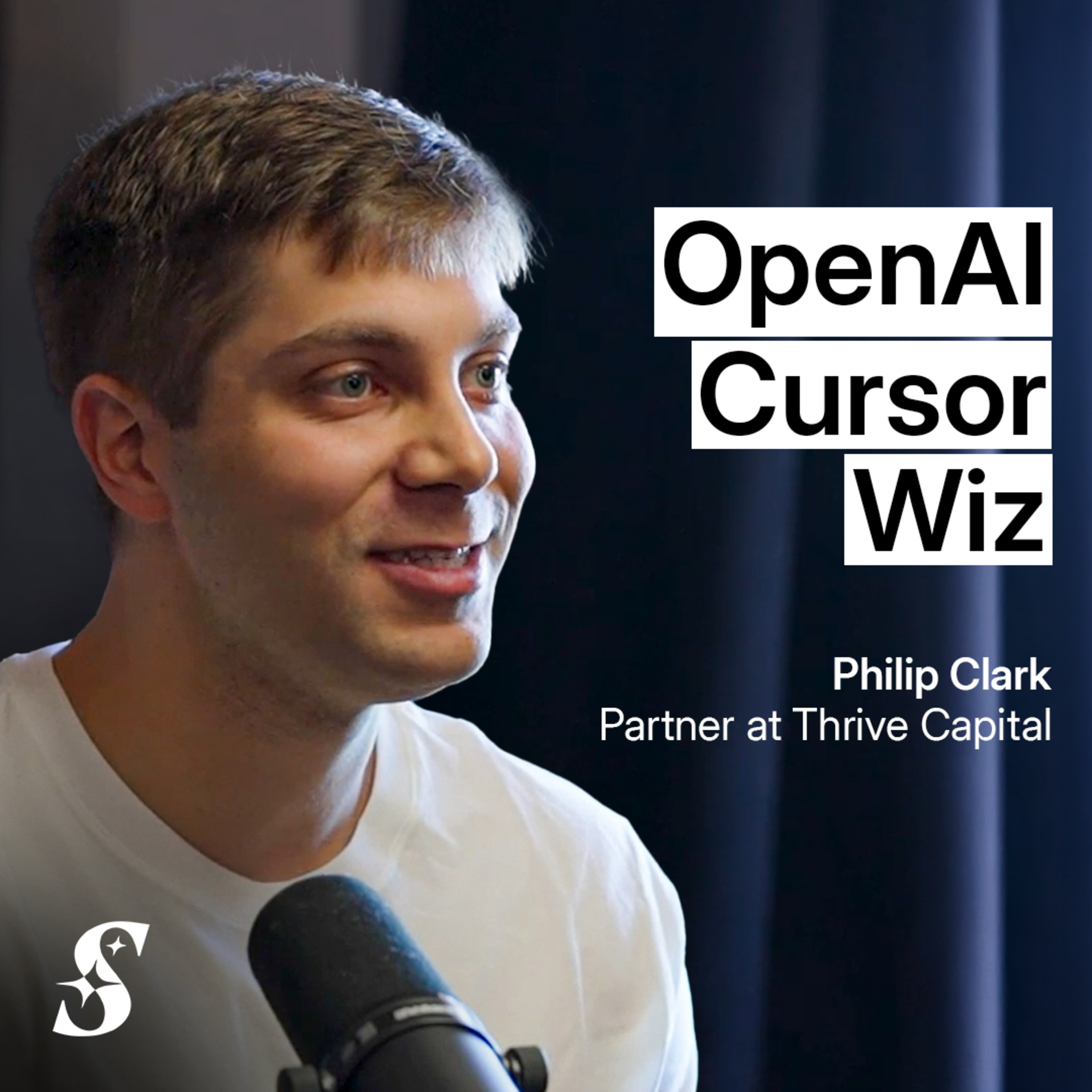

Thrive Capital Partner Philip Clark explains how one of tech's most influential firms evaluates founders and partners with companies that reshape the world.
He shares the inside story on investments in OpenAI, Wiz, and Nudge, and makes the case for a coming renaissance in intelligent hardware.
Key takeaways
- Pursuing niche interests publicly, like writing a Substack on semiconductors, can lead to unexpected career opportunities with leaders tackling ambitious problems.
- The AI era is compressing timelines in a radical way. While the internet era was like playing chess, the AI era is like playing speed chess.
- In early-stage investing, ideas are fluid and change often, so it's more important to focus on the founders, who are the constant.
- A truly great product creates a 'magical one-way door moment' where, after using it, you can't imagine going back to the old way of doing things.
- The investors who win deals are the ones who want to win them the most, which is demonstrated by a 'leave it all on the field' mentality.
- A powerful and often overlooked metric for enterprise software is the ratio of deal size to sales speed. The best companies, like Wiz, break the traditional trade-off and secure large deals with very fast sales cycles.
- A new generation of hardware founders, trained at pioneering companies like SpaceX, is now equipped with the experience to scale complex hardware and software solutions.
- Hardware is harder and more expensive to build than software, but this high barrier to entry creates incredibly durable businesses that are difficult to disrupt once they achieve scale.
- Hardware investing mirrors the venture capital model: the overall market may offer mediocre returns, but the top-performing companies will deliver some of the best returns of any asset class.
- Neurotech companies are approaching the brain in two ways: Neuralink 'reads' brain activity with invasive implants, while Nudge 'writes' to the brain by non-invasively stimulating it with ultrasound.
- A concentrated investment strategy creates deep alignment with founders. When a founder has a portfolio of one, investors should also have enough skin in the game for wins to feel great and losses to truly hurt.
- OpenAI's talent strategy focuses on finding people who could be great, not just those who are already proven. They seek young talent who think natively in AI to push the boundaries of model performance.
- Despite its current dominance, investing in OpenAI at a $29 billion valuation before ChatGPT's launch was a contrarian move requiring deep conviction. Only two firms offered a term sheet at the time.
- The evolution of AI mirrors the progression of semiconductors, moving through distinct waves like pre-training, human feedback, and now reinforcement learning to unlock new capabilities.
- The rise of AI doesn't signal the end of foundational companies like OpenAI. Instead, it marks the beginning of a post-SaaS era, where productized intelligence serves as a new substrate for building an entirely different breed of software.
- AI tools are currently acting as an augmenting technology that enhances productivity, rather than a substituting technology that causes layoffs.
- History shows that great companies like Google and Amazon were successful long-term investments, suggesting that picking the right company is more important than picking the right time.
- When investing, focus on the quality of the decision-making process rather than short-term outcomes. The worst investments are based on momentum, not fundamentals.
- A renaissance in intelligent hardware is coming. To make a real impact on the world, solutions need to move atoms in reality, not just bits in software.
How an amateur physicist's Substack led to a VC career
Philip Clark identifies as a technologist and optimist. He was always inspired by people who worked on large technology projects that positively influenced history, such as Oppenheimer with the Manhattan Project or Elon Musk with SpaceX. This interest initially led him to study physics, but he found the path to impact was too long. He switched to computer science as a more pragmatic route.
After his studies, Philip saw two paths for making a technological impact: start a generational company or partner with one. Without a great startup idea of his own, he chose the latter. His journey to Thrive Capital began through his passion for semiconductors. He maintained a Substack about the topic, which caught the attention of Thrive's founder, Josh. Josh was exploring the ambitious idea of reshoring advanced semiconductor manufacturing to the U.S., a sector that has seen American production drop from 40% in the 1990s to about 10% today.
A former colleague connected the two. While the reshoring project was too capital-intensive for Thrive at the time, Philip was deeply impressed by the boldness of the vision. Later, when he decided to move from quantitative trading into venture capital, he reached out to Josh for advice, which led to a job offer.
And you know what they say, ask for advice, get a job. And now I'm at Thrive, simple as that.
While Thrive has not invested in a semiconductor manufacturer, they did lead the seed round for Mesh Optical. This company operates in the data center space, focusing on the interconnect that moves data between components. The founders, who came from SpaceX's Starlink photonics team, are applying their expertise in using lasers for data transmission to improve data center efficiency.
The AI era is like playing speed chess
One of the great privileges of this job is the opportunity to work on several exciting problems with founders of potentially generational companies. One such company is Cursor, which automates the drudgery of coding and acts as an AI pair programmer for developers. The company experienced incredible growth in just 18 months, going from tens of thousands of users to millions, and from low single-digit million ARR to a run rate revenue in the many hundreds of millions.
This rapid growth highlights how the AI era is radically compressing timelines. Michael Dell, who has lived through both the internet and AI eras, offered a compelling comparison. He described the magnitude of impact as similar, but the pace as vastly different.
Whereas the Internet era was like playing chess, the AI era is like playing speed chess.
Another company experiencing rapid success is Wiz, which focuses on cloud security. The move to cloud services like AWS, GCP, and Azure created new software vulnerabilities. Wiz was founded in 2020 by a team of Israeli entrepreneurs to secure cloud software. The founders had previously built the cloud security business at Microsoft before starting Wiz, which was later acquired by Google for what was reportedly the largest sum ever for a startup.
Investing in people over initial ideas
Philip Clark first met Michael, a founder he would later invest in, back in late 2022. At the time, Michael was working on a completely different idea: an AI tool for mechanical engineers. This experience highlights a key lesson in early-stage investing: ideas change a lot, but the people are the constant to focus on. The very day they met, Michael decided to pivot away from his initial concept.
Their conversation shifted from a specific company to a list of potential new directions. Philip recalls suggesting that Michael might enjoy working on something related to software more than customer support, which was one of the ideas being considered. However, he believes the most significant takeaway from that first meeting was the founder's quality.
With great founders, there's this almost electric energy you can sense in the first meeting.
Soon after, Michael and his co-founder Aman moved to San Francisco and merged with another company, bringing on two more co-founders, Swale and Arvid. They began working on the first AI Integrated Developer Environment (IDE). When Philip tried the product as an early user, he described it as a truly transformative experience.
It was definitely one of those magical one way door moments. Like once you walk through a door like that, you can't go back.
After that, Philip and his partner Miles spent the next year working to partner with the team. They finally succeeded in May 2024, joining the company's cap table. The host noted this persistence, mentioning a story from a profile about Philip flying into a war zone to pursue an investment.
The year-long journey to invest in Wiz
Philip Clark shares the memorable story of how his firm, Thrive, came to invest in the cybersecurity company Wiz. The journey began when Philip was sent to Tel Aviv as part of a firm initiative to explore cities outside the core venture hubs of New York and San Francisco. In 2022, Wiz was the talk of the town, and after some effort, he secured a meeting with the founder, Assaf. The first call was a three-way Zoom spanning New York, Tel Aviv, and Tokyo, and it was immediately clear that Wiz was different.
Unlike typical security companies focused on risk mitigation, Wiz was positioned as a software infrastructure developer platform. This distinction was striking, as it targeted a different user base. Philip recalls a key insight from that initial conversation.
One of the most shocking things I learned on that first call was that 50% of Wiz's users at the time were software developers, not security people, very different than how security is traditionally done.
Convinced of the company's unique product and the founder's brilliant, charismatic, yet humble nature, Thrive spent the next year building a relationship with the company, simulating a partnership long before any money was exchanged. When Assaf shared updated numbers in late 2023, Philip and his partner Josh knew they had to invest. Despite the difficulty of traveling to Israel during the war, they made it to Tel Aviv within 24 hours. A four-hour dinner confirmed the founders' ambitious vision to build a new way to create cloud software, and they shook hands on a deal that night.
The philosophy of playing against yourself in investing
A core philosophy at the investment firm Thrive is that the people who win deals are the ones who want to win them the most. This translates to a "leave it all on the field" mentality. However, the approach is not about outmaneuvering competitors, but rather about focusing inward.
You play against yourself, you don't play against others.
This mindset was central to the decision to fly to Israel to meet the Wiz team during a difficult time. The action was not a competitive tactic to close the deal in a crowded round. Instead, it was a statement about the type of partner Thrive wanted to be. By being physically present with the founders, they demonstrated that what mattered to the founders also mattered to them.
What made the software company Wiz so successful
The enterprise software company Wiz demonstrated exceptional performance, standing out in several key areas. A particularly special aspect was the ratio between the size of their deals and the speed at which they could close them. Typically, a company can have small deals with fast sales cycles or large deals with slow cycles. Wiz managed to achieve both.
If you're a sales rep at Wiz, you can get on a call with a customer, you can ask them for their cloud API keys, you can pull it into their side scanning product, they will scan your environment, they will give you a list within a few minutes of all the vulnerabilities you didn't know you had. And what customer is not going to look at those and say oh my God, I have a bunch of vulnerabilities but I'm not going to buy the product.
This efficiency allowed them to close substantial six-figure deals in just weeks or months, which was unprecedented. Another unique factor was that Wiz felt less like a traditional security tool and more like a software infrastructure tool, similar to Datadog or Cloudflare. It wasn't just a compliance product. It was designed to help engineering teams surface, understand, and fix issues, making it very developer-centric.
Finally, Wiz proved to be a true platform, not just a product claiming to be one. For a company that was only about four years old, it showed healthy adoption rates for multiple products across the entire development stack. They offered code security on one end, cloud infrastructure security in the middle, and runtime security on the other. This end-to-end adoption gave confidence that the company has a long roadmap with many future products to come, building on the success of their first.
The barriers to entry for hardware are falling
Despite working in software, Philip Clark identifies as a "hardware guy," a reputation he attributes to his background as a physicist. He believes we are in a unique moment where the barriers to entry for hardware are significantly decreasing. A key factor is the dramatic drop in input costs. For example, LiDAR sensors have seen a wild decrease in price.
Lidar costs are a couple hundred dollars a sensor. Back in 2014, so barely 10 years ago, there was something like $75,000, $80,000 a sensor.
Simultaneously, software is making it much easier to build hardware tools. The proliferation of self-driving cars, especially in San Francisco, illustrates how a sophisticated software intelligence layer enables the creation of more interesting physical products. Furthermore, a new generation of founders has been trained at the first wave of successful hardware technology companies like SpaceX.
Unlike pioneers such as Elon Musk, who had to build their teams without a large pre-existing talent pool, today's founders can draw from a robust ecosystem. Those early companies have now cultivated a workforce of skilled engineers. As a result, there are now more opportunities than at any point in the last 20 years for companies to create a tangible, physical impact on the world.
Those companies have now trained a lot of really amazing engineers that know what it means to build software and hardware technology that can be scaled to very, very high volumes. And those founders can now look at this host of new problems that are available to them because of the changes that have happened in technology and go chase them.
Why a young Philip Clark wanted to be CEO of Lockheed Martin
Philip Clark discusses his childhood dream of becoming the CEO of Lockheed Martin. As a self-described "hardware nerd and physics nerd" growing up in the late 1990s, companies like SpaceX, Anduril, and Tesla did not yet exist. At that time, Lockheed Martin was the company undertaking the most ambitious technology projects of the 20th century, such as the SR-71 Blackbird and the stealth fighter program.
Probably what I really meant when I was early teens, young kid thinking about that stuff is I just want to be at a place where I can push the envelope on how really great technology gets built.
He explains that his aspiration wasn't about the specific company, but about being involved in creating incredible technology. He imagines that if he were born today, he would likely aspire to be the CEO of a company like SpaceX instead.
The durable and attractive business model of hardware companies
Hardware businesses are fundamentally harder to build than software businesses. They require building more product, which is more expensive because it involves atoms, not easily replicated bits. There is also often a significant operational component, such as manufacturing and deployment lines, that goes beyond simply shipping code. However, this initial difficulty can lead to enormous durability and attractiveness once a company gets off the ground.
When you get over the hump of these really, really hard industries and problems, you actually have built something at scale that is very hard to quickly replicate. Whereas in software, not true for all businesses, but the barriers to building software are probably lower than ever before too.
It's difficult to imagine a competitor easily disrupting a company like SpaceX or Anduril. This durability is coupled with a unique growth pattern. Philip Clark notes that while most tech companies see their growth deteriorate over time, hardware giants like SpaceX, Anduril, and Tesla have actually accelerated their growth at scale. The reason is that as these companies get bigger, they earn more trust and can access larger markets and tackle bigger problems.
For example, Anduril started with contracts worth tens or hundreds of millions of dollars. Now, the company is being considered for major U.S. military technology programs across air, space, and sea, significantly expanding its potential revenue. Similarly, SpaceX's initial launch business, which was crucial for providing U.S. access to space without relying on Russia, created the foundation for Starlink. Starlink is now a massive internet constellation and a primary driver of the company's revenue and free cash flow. These "second stage acts" of hardware companies can become much larger than their original ventures. Of course, they still need to be fundamentally sound businesses with high margins, great products, and strong founders, and they often face bottlenecks like government policy and regulation.
Hardware investing has the worst beta but the best alpha
When looking at the hardware sector, it's helpful to compare it to venture capital as an asset class. The returns in this space consistently go to a small number of companies. Five of the ten most valuable companies in the world right now are hardware companies, including Apple, Nvidia, and Tesla. This highlights the immense potential at the top end of the market.
Venture is the actual asset class with the worst beta and the best alpha of any financial asset class. Which is to say, the best companies are going to give you the best possible return of any possible equity instrument you can invest in and the index is probably going to give you pretty mediocre returns. I think hardware is going to look no different than that.
Building these businesses is inherently difficult. There are few people who are great at combining hardware and software expertise, so many companies will likely fail. The focus is on finding "n of 1 founders" who are pursuing unique missions that are very hard to replicate. An example is Nudge, a company using non-invasive ultrasound to stimulate brain activity to treat neurological illnesses like depression. Companies that can successfully solve these kinds of fundamental problems are positioned to be incredibly valuable, regardless of the broader market conditions.
Nudge uses ultrasound to engineer the brain
The human brain is one of the last frontiers of engineering. For a long time, it has been treated as a science problem studied in labs and clinics. Nudge is a company taking an engineering approach to solve the brain's problems. It was founded by Jeremy, an early leader at Neuralink, and Fred, an early investor in Neuralink and founder of Coinbase. They are described as "life's work founders" who are singularly focused on building a solution to neurological illnesses.
Nudge uses ultrasound waves, which are known to be safe from their use in imaging pregnancies, to stimulate specific points in the brain. By directing these waves, the company can change neurological activity associated with certain problems. The ultimate goal is to offer a treatment for conditions like depression and addiction that is easier than taking a pill. One could imagine wearing a headset on their temples that provides a meaningful cure.
This approach differs from other neurotechnology. Neuralink focuses on the "read side" of the brain, using an invasive implant to help individuals with paralysis control digital devices. Nudge, on the other hand, is on the "stimulation side," not reading brain activity but actively trying to change it. The closest existing treatment is transcranial magnetic stimulation (TMS), a modern form of electric shock therapy. While effective, TMS is unpleasant and requires many inconvenient clinic visits, leading to low adoption rates. Nudge's ultrasound technology could be not only more effective but far easier to use, like wearing a pair of headphones at home.
Looking ahead, the technology could extend beyond treating illnesses. If the brain can be stimulated for desired outputs, it could be used to enhance mood, energy, or focus. There could be a future where everyone uses a Nudge-like device to get dialed in for important tasks.
The philosophy behind a concentrated investment strategy
Recent research from Carta shows that highly concentrated venture funds, with about 20 companies per portfolio, typically outperform "spray and pray" strategies. This aligns with a philosophy of concentration built on two key aspects: founder alignment and market reality.
The first aspect is choosing a strategy that is authentic and aligned with the founders. The speaker's partner, Kareem, often frames it this way:
Mathematically, there are probably a lot of ways we can make money as a venture firm. The question is, what feels really aligned to the founders we partner with?
For a founder, their company is a portfolio of one. A concentrated fund allows the investor to mirror that commitment. It ensures there is real skin in the game, where wins feel great and losses truly hurt. This deep alignment lets founders know that the success or failure of their company genuinely matters to their investors.
The second aspect is the reality of the power law. A small number of companies drive a disproportionate amount of economic and social value. For example, the top seven stocks in the NASDAQ (the MAG7) represent over 50% of its market cap. The concentration strategy simply reflects this reality. The goal is to invest in a small number of companies on the right tail of the power law distribution, those poised to become the most important in the world. Once such a company is identified, the strategy is to concentrate as much capital as possible into it to deliver differentiated returns.
OpenAI's success is built on finding talent with future potential
OpenAI's journey is a case study in concentrating on exceptional businesses. Philip Clark notes that despite its current prominence, the company wasn't always so popular. The team worked for seven or eight years before others recognized its immense value. Philip's firm got a demo of GPT-4 in November 2022, which he describes as one of the most astounding technologies they had ever seen. He believes it definitively passed the Turing Test, a milestone that is often overlooked today.
GPT-4 was that. And we don't talk about it anymore, but that was a really important moment in technological history, and that felt really exciting.
Investing at a $29 billion valuation before ChatGPT had even launched required significant belief. At the time, they were one of only two firms to offer a term sheet. The original investment memo didn't even mention ChatGPT, which now has over a billion users and has become the primary way people access artificial intelligence.
I think it's the front door to AI in many ways.
The team at OpenAI is a key part of its success, with Philip calling the talent density "unprecedented." The project's significance, which he compares to the atomic era, attracts brilliant minds. However, OpenAI's strategy isn't just about hiring established stars. They excel at identifying and nurturing young, emerging talent. Many of their top researchers were not well-known before joining. The company seeks out individuals who think "AI natively," which is crucial for the creative hypothesis testing needed to advance the models. The Sora team, for example, has a median age in the low 20s. This focus on potential has allowed OpenAI to train several generations of great researchers internally.
They've been really risk forward about trying to find people who could be great versus who are already great.
AI's evolution is creating the post-SaaS era
Philip Clark compares the evolution of AI to that of semiconductors. Just as semiconductors progressed through waves of innovation from single-core to multi-core and then to GPUs to improve performance, AI is following a similar path. The initial wave involved pre-training models like GPT-1 through GPT-4. Then, techniques like supervised fine-tuning and reinforcement learning with human feedback (RLHF) were used for products like ChatGPT. These methods made the models less like alien intelligences and more like helpful assistants.
Now that much of the low-hanging fruit from those techniques has been gathered, reinforcement learning has become the next major paradigm shift. However, this is not the end of the story. Philip believes there will be several more shifts in the future as researchers figure out the complex process of creating intelligent machines. He describes this challenge as a kind of modern alchemy.
We are basically figuring out out in real time how to do the alchemy of turning pieces of metals into thinking machines, so to speak.
Philip argues that OpenAI's greatest competitive advantage is its ability to continuously identify the next paradigm while simultaneously productizing the previous one. He credits OpenAI with originating every major successful paradigm in large models to date.
When asked what comes after OpenAI, Philip reframes the question. He suggests a better question is, "What comes after SaaS?" He doesn't foresee an "after OpenAI" in the near future, just as there isn't an "after Meta" or "after Google." Instead, he believes a new technological substrate has emerged: productized intelligence accessible through APIs. This foundation is enabling a completely new generation of software companies. Examples include Cursor for collaborative coding, Harvey for legal work, and even incumbent products like Whiz adding security assistants. The fundamental tech companies will likely remain, but the software built on top of them will look very different.
AI's impact on jobs is augmentation, not substitution
When considering AI's impact on jobs, a bottoms-up analysis shows it's more of an augmenting than a substituting technology. Philip Clark, an investor in many companies using AI, notes he hasn't seen a single one lay off engineers because of these tools. While it might allow companies to grow without adding as much headcount, its primary effect is enabling them to tackle a much broader range of problems.
You can actually make everyone the 10x or proverbial 100x engineer in a really exciting way.
Looking at the bigger picture, powerful AI presents an opportunity to address problems humanity isn't currently focused on. It can free up human intelligence to work on major challenges like finding cures for cancer, sustainably mining natural resources, or becoming a space-faring species. AI will help reallocate human creativity and brainpower to the most significant problems, moving away from tasks that are not the highest use of human potential.
The beauty of AI is that we're going to be able to reallocate a bunch of human brain power, firepower, creativity to these most important problems and away from the things that have been great jobs to date but are not the highest marginal use of humanity's creative and intelligence potential.
Focus on enduring companies rather than timing the AI market
When considering the AI bubble, the focus should be on identifying enduring companies rather than trying to time market cycles. A concentrated investment approach in the right companies can lead to success regardless of market fluctuations. Historical examples like Google, Amazon, Netflix, and Microsoft show this principle in action. Even with variable returns, they were great long-term investments for those who held on.
The key is to select companies you believe in and plan to be a multi-decade holder of them. If you've chosen the right companies, the short-term market noise will eventually wash out. While there is a lot of value being created by AI, the most important factor is being in the right companies for the long haul.
Why most great technology companies will eventually be public
When investing in companies, the intention is almost always that they can eventually become a standalone public company. While OpenAI's specific plans are unknown, the general expectation is that most great technology companies will become public companies over time. The timeline for this may vary, sometimes taking longer than in the past, and sometimes shorter.
The idea of companies going public is seen as a beautiful aspect of American capitalism. It allows everyone to participate in the growth story of these significant economic engines. This is considered both the morally right thing to do and the path most major companies will likely choose for themselves in the long run.
Investing with a long-term view on AI and intelligent hardware
When evaluating performance, the focus should be on the decision-making process rather than near-term outcomes. This approach, inspired by Ray Dalio, prioritizes having the right conversations and being both paranoid and patient. The goal is to have a shot at the most exciting companies, even if they don't show immediate results.
Focus on the swing, not where the ball goes.
For example, early investors in OpenAI might have questioned its potential when it was a non-profit. Now, it's one of the world's most valuable companies. Conversely, many companies that start strong can fade. The strongest investments are based on fundamentals, not momentum. If changing numbers from one quarter to the next make you feel bad about a company, you likely invested in momentum, which rarely captures long-term value.
Looking ahead, several areas show great promise. First, Reinforcement Learning (RL) is expected to move beyond labs and into more software products, automating large amounts of high-value work. Second, a renaissance in intelligent hardware is anticipated. Many real-world problems require moving atoms, not just bits, and a new wave of companies will address the large portion of global GDP tied to the physical world. Finally, AI will be increasingly applied to science. This could transform complex science problems in fields like drug and materials discovery into more manageable engineering problems.