
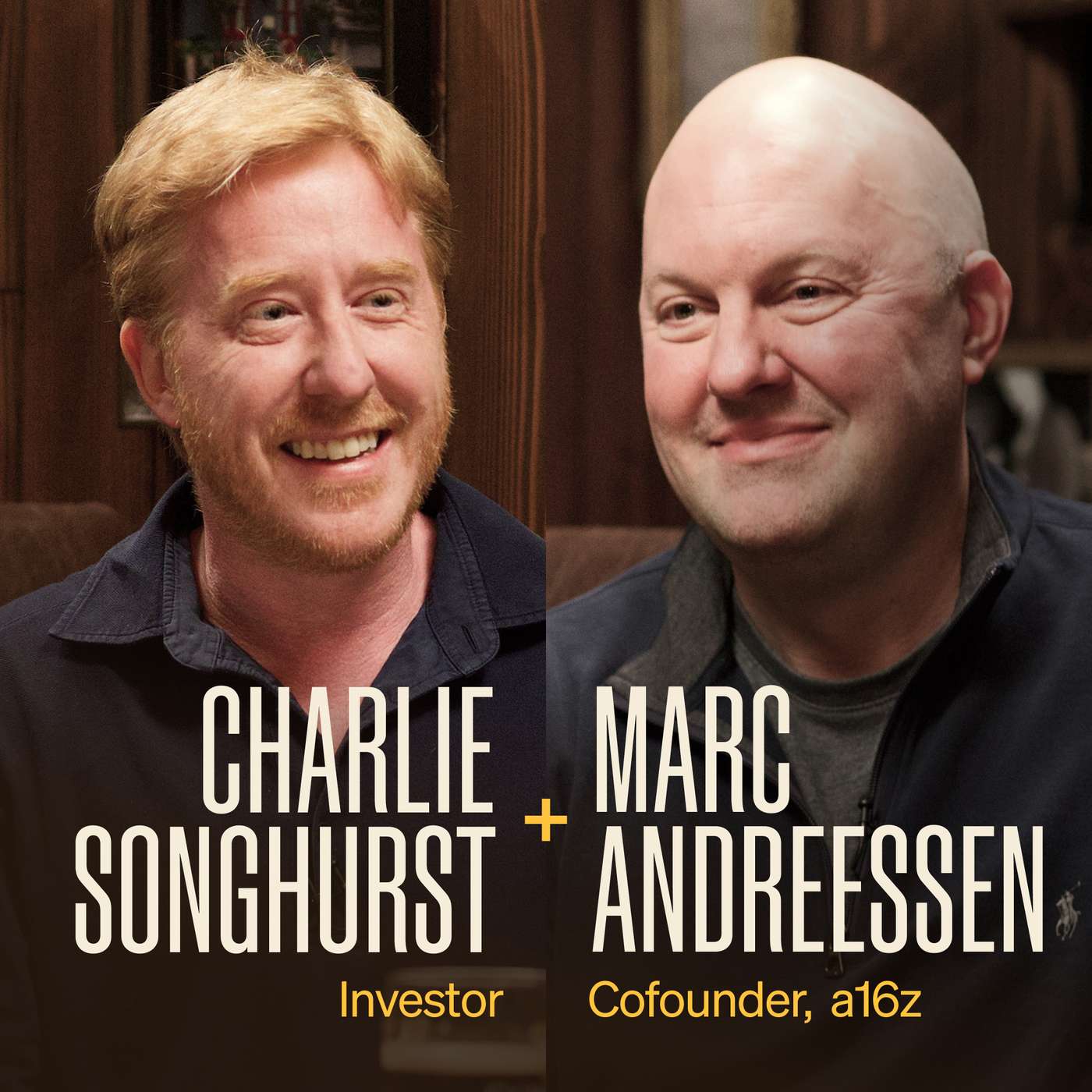

What if the worst business mistake isn't backing a failure, but tolerating a slow decline just to avoid one difficult conversation?
Marc Andreessen, cofounder of Netscape and Andreessen Horowitz, and investor Charlie Songhurst unpack the hidden psychology that drives Silicon Valley. They argue that the defining trait of the world's best investors is an obsession with avoiding "Category 2 errors," the successes you pass on. This is rooted in a fundamental human truth: people will tolerate any level of chronic pain to avoid a moment of acute pain, making inaction the most haunting mistake of all.
Key takeaways
- In venture capital, the costliest mistake isn't backing a failure; it's passing on a massive success. A failed investment is a finite loss, but the regret from a missed opportunity can last for decades.
- Economic downturns serve as a helpful filter for the startup world. They clear out the 'tourists' who are only there for the hype, leaving behind the truly committed founders and investors.
- People will tolerate almost any level of chronic, slow-burning pain just to avoid a moment of acute discomfort. This explains why struggling companies often prefer to lose slowly over years rather than make a single, painful decision to change course.
- The real bottom of a market cycle isn't when everyone is panicking. It's when the sector becomes so unpopular that people stop talking about it entirely.
- A top-tier venture capital firm's greatest value is providing a 'bridge loan of credibility.' This initial stamp of approval helps a new startup attract the best talent and more funding, creating a snowball of momentum.
- Silicon Valley's high-trust culture is fueled by a powerful 'frontier FOMO.' The fear of passing on the next Mark Zuckerberg incentivizes investors to remain incredibly open-minded and take risks on unproven founders.
- Tech has historically been a positive-sum game where the pie gets bigger for everyone, fostering collaboration. This is unlike zero-sum industries like Hollywood, where one movie's success can mean another's failure.
- The secret recipe for an innovation hub is a paradoxical blend of stability and chaos. You need the rule of law and deep capital markets, combined with a 'Wild West' spirit that embraces risk and failure.
- AI is less like the internet and more like the invention of the computer itself. The internet was a network technology that connected things, whereas AI is a fundamental computing technology that reinvents how machines think.
- The AI market is unlikely to be a winner-take-all game. It will probably evolve into a pyramid, with a few giant models at the top and billions of small, specialized, open-source models at the bottom, each optimized for a single task.
- AI is being democratized faster than any technology in history. Instead of trickling down from large institutions, the most powerful AI is available to hundreds of millions of people through simple apps, inverting the traditional power dynamic.
- Our society is split into two economies. Fun, optional things like electronics get cheaper due to technology. Essential things like housing, education, and healthcare get hyper-expensive because the government restricts supply while subsidizing demand.
- Illiquidity is a feature, not a bug, in venture capital. Being locked into an investment for years prevents emotional, short-term decisions driven by market noise, forcing a focus on long-term fundamentals.
- Elon Musk's management playbook is to ruthlessly violate the chain of command to talk directly to line engineers. He believes the CEO's job is to parachute in and personally help solve the company's biggest bottleneck each week.
- Modern media consumption is dominated by 'the clip.' A short, viral segment of a longer show often gets a thousand times more distribution than the original program itself. Understanding this is crucial for anyone creating content.
- Widespread free speech acts as a universal solvent for institutional authority. When peer-to-peer communication exposes every flaw, centralized institutions can no longer project an image of competence, leading to an inevitable collapse in public trust.
People prefer chronic failure to the acute pain of decisive action
Economic downturns can be helpful because they filter people out of the startup ecosystem and back into more traditional fields like banking and consulting. This relates to a broader cultural difference in risk-taking between the US coasts, where the West Coast's "frontier FOMO" is said to lead to higher trust and more willingness to take chances.
When evaluating opportunities, Category 2 errors—missing out on a success—are considered far worse than other mistakes. The successes you pass on can torture you for decades, which serves as a hard lesson to remain extremely open-minded. This ties into a general human tendency to avoid immediate, sharp discomfort. People will often tolerate any level of chronic pain to avoid acute pain.
I have found people willing to tolerate any level of chronic pain in order to avoid acute pain. People would much rather lose slowly over five years than have the conversation that involves a dramatic change to stop losing.
The meaning and tradition of a cheeky pint
The conversation opens with a question from an American about the meaning of the phrase "cheeky pint." A cheeky pint is explained as a drink you are not really supposed to be having. For instance, sneaking away with coworkers for an off-the-books pint after work when you are supposed to be heading home would qualify.
This leads to a follow-up question about why the term "pint" is used for alcohol when the rest of Europe generally uses the metric system. The explanation is that it's a matter of tradition. Alcohol, especially from historic breweries like Guinness which dates back to the 1700s, is part of a rich tradition. These long-standing customs associated with institutions like breweries and universities tend to survive better than standards for things like road signs.
The less-than-glamorous story of a Miller Lite commercial
John brings up a Miller Lite commercial that Marc Andreessen filmed with Norm Macdonald. Marc remembers Norm as naturally funny but not someone who was "always on."
The shoot itself was far from the glamorous nightclub scene portrayed in the ad. The reality was a grueling experience in a hot warehouse in L.A.'s Inland Empire.
It was not as cool as it looked. It was like 110 degrees outside. It was like 130 degrees inside. There was no air conditioning because it would screw up the sound. And then to create the smoky nightclub effect, they spray vegetable oil. Not water. Vegetable oil. Because it has to linger.
To make matters worse, the director, whom Marc compared to Stanley Kubrick, insisted on about 150 takes. Marc humorously concludes the story by noting that a week later, Miller fired their ad agency, joking that he might bear some responsibility.
Recognizing a bubble is impossible in real time
It is nearly impossible to tell when you are in a bubble. There's an old line about economists that also applies to investors and entrepreneurs: they have predicted nine of the last two crashes. It is common for people to call a bubble, and when they are eventually correct, they will claim they saw it coming all along. Often, these are the same people who have been predicting a crash for the previous 20 years.
Even the most sophisticated investors get it wrong. Some hedge fund managers shorted tech stocks in the fall of 1999, thinking it was the top, only to reverse their position and go long in early 2000, right before the crash. A common saying is that the market "climbs a wall of worry." As the market rises, there are constant panic attacks about an imminent collapse. For example, during the dot-com era, many thought the 1998 Asian financial crisis and the collapse of the hedge fund Long Term Capital Management (LTCM) was the end.
When the NASDAQ finally did crack in March 2000, the median view among smart people was that it was just a momentary blip. The crash was not a single event but a series of cascades. Marc recalls that when his company, Loudcloud, went public in September 2000, the NASDAQ fell by half during their three-week roadshow. It wasn't until 2003 or 2004 that everyone knew how bad things really were. The ultimate indicator is when portfolio managers start getting fired. Until that happens, there is still tremendous uncertainty and denial.
The aftermath of the dot-com bust flattened the entrepreneurial ecosystem. By 2003, the idea of starting a company was considered ludicrous due to the pervasive fear. Venture capitalists also panicked. A cardinal sin for a VC is paying too much attention to financial news, as it is very difficult to remain enthusiastic about investing when surrounded by that psychology. Marc cites Fred Wilson's advice for navigating this: have a disciplined, mechanical process for the pace of investment and exits, and do not deviate from it. This ensures you keep investing, even at the bottom of the market.
Everybody says, 'Oh, buy low, sell high.' Everybody's an expert in bubbles. Everybody's read the books, the whole thing.
The long-term discipline of venture capital investing
At the absolute bottom of a market cycle, negativity is overwhelming, but eventually, people stop talking about the sector entirely. It becomes a topic you would never bring up at a dinner party. Marc explains this happened with internet startups in 2003 and 2004, when the social status was at a low point, similar to crypto in 2020.
The great kind of joke of that time was the two great kind of VC trends, startup trends of the late 90s were so called Internet companies, B2C business to consumer and then B2B business to business. And by 2003 the line was B2B meant back to banking and B2C meant back to consulting.
This illustrates why the employment choices of Harvard and Stanford business school graduates are a great counter-indicator. If they are going into tech, the market is likely overblown. If they are going into banking and consulting, it is probably a great time to make venture capital investments.
A sensible strategy is to consistently invest in promising areas over decades, but it's not quite dollar-cost averaging. In venture capital, the amount invested matters less than the investment itself, as a single correct investment can have an immense upside, like Andy Bechtolsheim's 30,000x return on Google. Bargain shopping is a mistake in venture. The key is to simply keep investing.
The danger is not investing too cheap or too dear. The danger is literally stopping.
Venture must be viewed with a time horizon of 20, 30, or even 50 years to smooth out the cycles. Even for top VC firms, the performance volatility between different funds is incredible. Major companies can be founded at market peaks, like Google in 1999, or troughs, like Meta in 2004. The timing appears random, so you just have to keep at it.
This long-term perspective is why having good Limited Partners (LPs) is a huge advantage. Predictably, "tourist LPs" enter during hot markets and pull out during downturns. VCs with stable LPs can continue to invest through these downturns, which is often the best time to do so.
VCs are a bridge loan of credibility
The central question in venture capital is how much VCs themselves influence the outcomes of their portfolio companies. Beyond just providing capital for long R&D cycles, VCs serve a more crucial, often overlooked role. John notes that the real value is not just about the money; it's about building a team quickly.
VCs act as a very efficient matching algorithm between neophyte founders such as myself and experienced executives. It's about putting together a team in a very short order to go do this hard thing.
From an angel investor's perspective, Charlie observes a stark correlation. The status of the VC leading a company's Series A funding round is the single best predictor of its future performance, more so than any other variable. Marc explains this phenomenon through the lens of momentum. A startup is like a snowball rolling downhill, either constantly accruing resources like talent, funding, and brand perception, or it's a snowflake stuck at the top of the hill. This is the Matthew principle from the Bible: those who have, get more. The key is getting the snowball rolling.
When a company gets momentum, what it means is the next resource that you need is preferentially willing to attach to your thing as opposed to somebody else.
A top-tier VC provides the initial push. For example, the best security engineers want to work at top companies. A new startup can signal its potential by securing investment from a respected firm. In this way, a prestigious VC offers a critical resource at the very beginning.
A top tier VC is a bridge loan of credibility at a point in time when the startup maybe deserves it but just doesn't have it yet. And that credibility is harvested in the form of primarily personnel, money and brand.
Silicon Valley operates on a high degree of trust
Silicon Valley operates as a very high-trust ecosystem. A famous example of this is Andy Bechtolsheim's initial investment in Google. He wrote a $100,000 check to "Google Inc." even before the company was formally established. There were no terms or formal agreements at that moment; he simply handed them the check, got in his Porsche, and drove off. This kind of arrangement, where investments are made with a promise to figure out the terms later, is not unusual in the Valley.
The fear of missing out fuels Silicon Valley's high-trust culture
The high-trust culture of Silicon Valley is partly fueled by the fear of missing out (FOMO). Many investors have "scar tissue" from passing on a seemingly crazy idea from a "kid in a T-shirt" who turned out to be the next Mark Zuckerberg. This experience creates a powerful incentive to remain open-minded.
The economics of venture capital heavily penalize passing on a winning company. This is known as a category 2 error, which is considered far worse than a category 1 error (investing in a company that fails). The potential return on a successful investment can be 30,000x, while the loss is capped at the initial investment. This asymmetry means the pain of missing a huge success is immense and long-lasting.
When the company goes bankrupt, at least it ends. The pain is over. When you pass on the company that succeeds, the pain is forever.
As a result, Marc's advice to entrepreneurs is not to convince VCs of their inevitable success, but to create a fear that for the next 20 years, they might regret passing on the opportunity. This dynamic leads to an incredible sense of possibility and optimism.
This high-trust environment extends beyond initial investments. According to John, even complex transactions like company acquisitions are often based on high-level agreements and simple term sheets. This contrasts sharply with what he calls the "East Coast private equity process," which is more adversarial and assumes a lower level of trust between parties.
Silicon Valley's success combines stability with a frontier spirit
The reason Silicon Valley succeeded where other regions failed might be its ability to foster a high-trust ecosystem. This is partly driven by a fear of missing out (FOMO) that encourages trusting bets on new people. It's also a community where reputation is paramount because it's an "ultimate repeating game." A reputation for being helpful and constructive is valuable, as it leads to future opportunities.
Unlike other entrepreneurial hubs like Hollywood, the tech industry is not a zero-sum game. Marc contrasts the two environments starkly.
In Hollywood, they're like, 'Oh my God, this is a shark tank. You're lucky if your friends knife you in the chest. Generally it's in the back.' The reason is because there's a fixed amount of money... If my movie gets green lit, it means yours doesn't.
Tech, on the other hand, has historically been a multiplicative and generative field where the pie keeps expanding. This has led to tech becoming an almost complete West Coast monopoly, a dynamic unseen in any other industry. Many have tried to replicate this success, often mistakenly believing the key lies in infrastructure.
Literally the number where it's like, 'wow, if we just built the right buildings, this would happen.' That's actually fairly common. And anybody who's been to Silicon Valley knows... It is definitely not the buildings.
The actual formula requires a combination of seemingly contradictory elements. On one hand, you need stability, maturity, and rule of law, including absolute contract law and deep capital markets. This is where many developing countries fall short. On the other hand, you need the "Wild West"—a spirit of adventure, craziness, and a willingness to take risks and fail. This is what the East Coast and Europe often lack, as their cultures can be more risk-averse. The West Coast's risk-taking culture is attributed to its "frontier" history. Unlike the East Coast with its established institutions like Goldman Sachs and McKinsey that absorb young talent, the West Coast had fewer prestigious hierarchies, encouraging people to build new things. This environment, combined with a strong talent aggregation effect, created the unique conditions for Silicon Valley to thrive.
The renegade history of Silicon Valley
Silicon Valley's culture is a product of self-selection. Much like Hollywood, it became a destination for people who went west as far as they could, attracting those most oriented toward risk and independence. This started with the Gold Rush and continues today. Marc notes that Hollywood's origins were similarly rebellious. The first entrepreneurs moved there to evade Thomas Edison's patent enforcers for film cameras.
They were trying to evade Thomas Edison's patent enforcers because Thomas Edison owned the patent for the film cameras and the original Hollywood entrepreneurs had no desire at all to pay for that. And then Edison would hire the Pinkertons to come bust up the movie sets. It was rogue, renegade, iconoclastic.
This contrasts with established hubs like New York or London. Silicon Valley is more like a "mining camp" where you have to be willing to move specifically for the opportunity. This environment has a built-in cleansing mechanism. Economic downturns, while painful, are helpful because they flush out the "status seekers" and "tourists," leaving only the committed. This happened in the early 90s and again after the dot-com bust.
It's like fuel management for fire. You clear out the brush.
The history of the area's tech industry goes back further than many realize. While companies like HP are often cited as the start, researcher Steve Blank traces the real origins to defense tech startups in the 1920s and 30s, which innovated in areas like radar and missile guidance. As recently as 1993, Silicon Valley was considered neck-and-neck with Boston's tech corridor, which was home to major companies like Digital Equipment Corporation.
The fateful story of Digital Research and Microsoft's OS deal
Boston was once a major hub for leading tech companies, including Lotus and EMC, and was home to pioneering supercomputing firms like Thinking Machines. A book called Soul of a New Machine captures the story of a Boston startup from that era. However, the ecosystem shifted. Many in Boston believe the final blow came when Mark Zuckerberg couldn't raise venture capital for Facebook and had to move west. That event was a meaningful signal, a chapter marker for the region's changing fortunes. Marc Andreessen suggests that while Boston has stability, it lost its edge because it lacked a certain "frontier spirit." Ultimately, the smartest people from places like MIT were drawn to the West Coast.
This leads to the question of which companies could have become trillion-dollar giants but missed their chance. Marc points to the story of Digital Research as the all-time classic example. In the early days of personal computing, Bill Gates and Paul Allen's company, Microsoft, was primarily making programming tools, not operating systems. When IBM decided to enter the PC business, they needed an OS. Gates directed them to Digital Research, the maker of the standard OS at the time, CPM.
What happened next is a famous story in tech history. Marc recounts how the IBM team, a group of about 20 lawyers in blue suits, flew to California to meet with Digital Research's founder, Gary Kildall. But Kildall, described as a "frontier like person," chose not to attend the meeting.
He decided he'd rather go flying that day.
Instead, his wife, the company's general counsel, met with the IBM team but they couldn't agree on the NDA, and the day ended with no deal. The IBM team flew back to Seattle and told Gates that if he couldn't find them an operating system, their deal for Microsoft's programming tools was off. In response, Gates licensed an OS called QDOS, which stood for "Quick and Dirty Operating System," for a $50,000 flat fee. He then turned around and sold it to IBM, which became the foundation of MS-DOS. The story has a grim postscript: years later, Gary Kildall was knifed to death in a bar fight.
John questions whether Digital Research would have automatically become a trillion-dollar company, arguing that Bill Gates possessed a "killer commercial instinct" that was crucial to Microsoft's success beyond that initial deal. Marc agrees it's not magic, but emphasizes the principle of preferential attachment. Getting the IBM deal was a pivotal moment, as IBM was the absolute gorilla of the industry. The anecdote illustrates a trend: sometimes, the people at the cutting edge of technology are "wilderness people" who lack the commercial conscientiousness to capitalize on their innovations.
Why the first wave of internet companies didn't survive
Some successful companies are built by a second generation of founders who are more conscientious institution builders. Michael Dell is a classic example. Dell Computer was founded in the late 80s during a down cycle when hundreds of other IBM clone companies were failing. Dell succeeded because he was a more systematic thinker than the "wildcatters" who came before him.
This contrasts with the pre-Google internet companies like Lycos, Excite, AltaVista, and Yahoo, none of which survived in a significant way. Marc Andreessen explains that the environment of that era made it incredibly difficult to build an enduring business. The entire internet boom was a very short, four-year cycle, from roughly 1996 to the "nuclear winter" of 2000. Business models that support today's mega-companies simply didn't exist yet; the industry was still dominated by packaged software.
Furthermore, the market was extremely small. In 1999, the total internet market was at most 50 million people, with many on slow dial-up connections. The technology was crude, PCs were slow, and the typical user experience was dialing in for maybe an hour at night. Even businesses with internet access tried to prevent employees from using it. This early, crude environment was a major factor in why those early pioneers didn't last.
The AI boom mirrors the dot-com bubble's infrastructure overbuild
Unlike AI, which has few articulate bear cases beyond dystopian fears, the internet faced significant skepticism during its initial boom. The original arguments against it were that it would never be profitable, it was just for cybercrime and porn, and the technology itself was too clunky. Marc Andreessen recalls the sentiment: people questioned slow image loading times and the security of using credit cards online. It was a period of massive skepticism.
A more sophisticated bear case, which proved correct, was that valuations and infrastructure build-out were far ahead of actual demand. This led to a massive overbuild of fiber optic networks. A similar dynamic may be at play with AI. While the technology itself, like ChatGPT, provides real value, the enormous ramp-up in data center construction could be forming a bubble. John points to Oracle's booming business in building giant data centers for AI companies as evidence. The risk is that capacity will be built far ahead of utilization.
Marc agrees this is precisely what happened during the internet boom, which he clarifies was fundamentally a telecom bubble, not a dot-com bubble. The vast majority of the money and, crucially, the debt, was on the telco side.
The Internet stuff didn't matter. It was a telco infrastructure, it was a telco. It was almost entirely telco bubble and it was almost entirely telco crash.
When a new technology takes off, there is often too much capital trying to participate. Charlie notes that this capital flows not to the new, scarce skillset, but to where established players know how to deploy it. During the internet boom, that meant building physical infrastructure. People knew how to put buildings in the ground and lay fiber. This led to companies like Global Crossing raising huge amounts of debt to build infrastructure that wouldn't be fully utilized for 15 years. The original builders went bankrupt, but the assets eventually became valuable to subsequent owners.
AI is a new computing paradigm 80 years in the making
When comparing AI to previous technology cycles, the internet is a common analogy. However, the internet bubble of the late 90s may have been less a bubble and more a case of being too early. As Marc points out, crucial infrastructure like home broadband wasn't common until after 2005, and the original iPhone in 2007 lacked mobile broadband. The hype simply outpaced the technology's readiness.
A more fundamental distinction is that AI may not be analogous to the internet at all. The internet is a network technology, while AI is a computing technology. This suggests a more accurate comparison is not to the internet, but to the invention of the computer itself.
The Internet was an interconnecting, it was a network technology, whereas AI is a computing technology. And maybe the only comp for AI that you can have is actually the creation of the computer.
AI represents a major reinvention of the computer's fundamental model, shifting from the von Neumann architecture to the neural network. This isn't a new idea; the two paths were known in the 1940s. It just took 80 years for the neural network approach to become viable. We are now unlocking what could be called "computer industry V2," a technology potentially thousands of times more valuable than its predecessor.
John notes that technology hype cycles almost always predate the technology being ready, citing mobile and crypto as recent examples. AI has had perhaps the longest lag time between vision and reality. The concept of an AI like HAL 9000 was depicted in 2001: A Space Odyssey in the 1960s, based on books from the 1950s. The vision was remarkably accurate, but the technology took decades to catch up.
Marc traces these ideas back even further, mentioning discussions in the 1930s. He shares an anecdote about Alan Turing and Claude Shannon during World War II. In a cafeteria, Turing passionately explained his work, shouting that he wasn't trying to build a genius computer, but a mediocre one.
I'm not talking about building a genius computer brain. I'm talking about building a mediocre computer brain, like the president of AT&T.
This illustrates that even early pioneers like Turing understood the limitations of the literal, mathematical path they were on. He knew it wasn't the way to create a machine that could understand language and reason more broadly, but the technology to pursue the other path was not yet available.
The AI market will be a pyramid of specialized models
The market for AI may not follow the winner-take-all model seen in software, where a single best product like Excel dominates. Marc Andreessen suggests a better analogy is the computer industry, which evolved into a giant pyramid structure. At the top are a few powerful mainframes, while at the bottom are billions of small, embedded devices in things like light bulbs and doorknobs.
Marc predicts AI will follow this pyramid model. There will be a few large, incredibly valuable models at the top. However, the vast majority of AI will likely be executed on smaller, specialized, and often open-source models designed for specific tasks. This is driven by practical considerations of cost, performance, and power efficiency for individual devices.
You don't need your doorknob to teach you quantum physics, but you do need it to be really good at knowing that it's you and not somebody else. And so you're going to have all of these kind of hyper-optimized use cases.
This pattern has historical precedent in both databases and operating systems. Proprietary systems like Oracle databases or specific versions of Unix were once dominant, but they were eventually surpassed by open-source alternatives like MySQL, Postgres, and Linux, which started as seeming toys but became superior over time.
The fastest adoption of AI will likely occur in unregulated fields like software development, where developers create tools for themselves in a tight iterative loop. Progress will be slower in regulated sectors such as medicine and law, where AI cannot be licensed. However, its impact will still be felt. Marc argues that ChatGPT is already a better doctor than most human doctors for answering questions. This will create significant tension as the capabilities of AI clash with the regulatory structures of established fields.
AI's democratic distribution empowers the individual first
A common fear is that AI will lead to a few companies controlling everything. However, the opposite appears to be happening. AI is arguably the most democratically distributed technology in history. Tools like ChatGPT reached hundreds of millions of users in just a couple of years, a far faster adoption rate than the internet. The world's most advanced AI is not held by a select few; it's in an app that 600 million people have. This hyper-democratization occurs because companies recognize that the mass market is always the biggest market.
What if this is just like the philosopher's stone, the alchemy of sand into thought in literally everybody's hand right out of the gate.
This rollout is an inversion of how previous technologies were disseminated. Computers, for instance, started as massive mainframes. In the 1950s, the head of IBM, Thomas Watson Sr., famously predicted a world market for only five computers. Over 40 years, the technology cascaded down from mainframes to PCs and eventually to cheap smartphones. AI, like the smartphone, has reversed this pattern. Marc Andreessen likens it to Andy Warhol's observation that the president drinks the same Coke as everyone else.
The adoption sequence for AI starts with individuals, followed by small businesses, then large businesses, and finally, the government. It's not that large organizations can't get the technology; it's that their bureaucracy and rules prevent them from absorbing it quickly. This dynamic could fundamentally shift the balance of power. It pits the power of the individual against the power of the state, potentially turning every citizen into a super-empowered expert, like a "super lawyer," when dealing with officialdom. In the business world, it gives an advantage to small, nimble companies that can adopt new tools much faster than their larger competitors.
AI's potential to boost employment and lower prices
The question of whether AI will be a centralizing or democratizing power is fundamental. Marc Andreessen argues there's a good chance it will be a democratizing force, making younger, less bureaucratic companies more successful against older incumbents. The conventional economic argument refutes the popular idea that AI will eliminate all jobs. Instead, it suggests AI will deliver massive productivity improvements to individuals.
AI just makes every individual a super PhD in every topic. That's the most dramatic increase in what economists call marginal productivity of the worker that has every existed.
This surge in individual productivity means people can do much more, whether as solo entrepreneurs or within an organization. Consequently, AI is likely to drive both employment growth and higher incomes, as companies will want to hire more of these highly productive individuals and will pay them more for the value they create.
Charlie Songhurst notes that people often use intelligence but not imagination when thinking about the future of work. He draws a parallel to the 1950s, when rooms full of people performed manual accounting. The computing revolution would have seemed like a direct threat to their jobs, yet they could not have imagined the new job categories that would emerge, such as the video game industry.
If you described the sort of computing revolution, they would all say I'm going to lose my job. But the jobs that emerge, video gaming, you couldn't imagine, you couldn't describe.
Marc adds that another great economic fallacy is the idea that AI-driven productivity will lead to poverty. He argues the opposite is more likely: a hyper-acceleration of productivity would cause hyper-deflation, where the prices of goods and services collapse. Citing the Star Trek replicator as an example, in a world of extreme abundance, things that are expensive today could become cheap or free, making everyone materially better off even if traditional GDP measures fall. This has historical precedent in the Second Industrial Revolution (1880-1930), a period of deflation that was also a time of massive surges in productivity and prosperity. However, today we see a split economy. There is a deflationary economy in sectors like electronics, software, and media, where prices fall. Then there is an inflationary economy in areas like housing, education, and healthcare, where productivity gains have not translated into lower costs.
Why the American dream is getting more expensive
Our society has split into two different economies. Everything optional and fun is getting cheaper, while everything necessary to raise a family, like housing, healthcare, and education, is getting hyper-expensive. Marc Andreessen explains this is due to heavy government interference in these essential sectors.
In all three cases, the government restricts supply. They limit how many houses can be built, how many doctors can be licensed, and how many universities can be accredited. When restricted supply causes prices to skyrocket, voters get angry. Politicians then respond by subsidizing demand through programs like federal student loans, mortgages, and healthcare subsidies. This combination creates a vicious cycle. Marc notes the core economic principle at play: "If you constrain supply, you cause prices to rise. And if you subsidize demand, you cause prices to rise." The result is an ever-escalating price spiral for the cornerstones of the American dream.
This dynamic creates a bizarre world where it can be cheaper to mask a problem with technology than to fix it traditionally. John mentions a striking example of this:
If there's a hole in your drywall, it's cheaper to put a flat screen TV over it than it is to repair the drywall.
The concern is that this model of restricting supply and creating protected jobs, or sinecures, will expand. Marc points to the dock workers' unions as a micro-example. To preserve jobs against automation, they have negotiated contracts that result in paying people to sit at home. This principle extends to public sector unions and civil service protections, making these sectors less productive.
Meanwhile, in the technology sector, productivity is exploding. The concept of the 10X engineer is being replaced by the 1000X engineer, amplified by AI. The payoff for software and AI is immense because the market size is unprecedented. For the first time in history, five billion people are connected on an interactive network, creating a massive potential customer base for new products and services.
Why venture capitalists were so hesitant about crypto
Many venture capitalists struggled to understand crypto, often reacting emotionally rather than logically. While VCs could be dispassionate about topics like SaaS, crypto elicited strong, almost religious or political responses. Marc suggests this is because people's worldviews are increasingly tied to technology, and crypto's direct connection to money is particularly polarizing. He observed many VCs dismissing it as "evil" or a "scam."
My tentative conclusion was just like money pisses people off. And so making money through tech is usually an indirect process. In this case there was a more direct aspect. People have always built up all kinds of weird religious and political views around money.
Crypto also attracted a cyberpunk, anti-establishment vibe, similar to John Perry Barlow's "Declaration of Independence of Cyberspace." This required a high degree of open-mindedness that many people lack. Furthermore, crypto became coded as right-wing or libertarian, making it politically unpopular during the 2010s. A significant barrier was also its technical complexity. As Marc notes, once you have to explain the "Byzantine generals problem," you've likely lost your audience.
A helpful way to view it is that "crypto contains multitudes." It is a large category that includes scams, serious protocol developers, a store of wealth for emerging markets, speculative trading, and new payment systems. Critics often fixate on one negative aspect, like scams, and fail to see the entire picture. This is compounded by a general desire to see tech entrepreneurs "taken down a notch."
Historically, new forms of financial technology are often associated with bubbles, crashes, and scams. Charlie points to John Law's invention of paper money, which led to the South Sea Bubble. Marc adds the example of Michael Milken and junk bonds, which were discredited in the 1980s but became a massive, respected market a decade later. New kinds of money often lead to new kinds of scams and bubbles before they mature.
Stablecoins are a successful use case for globalizing fintech
Stablecoins are an incredibly successful and obvious use case for crypto. They are used all over the world for many different reasons, and the numbers involved are now very large. Marc notes this idea originated from Vitalik Buterin's early work on "colored coins," which he described as a crypto token wrapping a real-world asset.
Only an ESL speaker would pick that name.
While some crypto purists might view stablecoins as merely a bridge technology to the old financial world, they are a fantastic and successful application. Charlie suggests that stablecoins could enable the global scalability that has traditionally held fintech back. Most fintech companies have been limited to a country-by-country approach, preventing them from becoming super valuable tech giants. Stablecoins could change this.
Marc agrees with this optimistic view, though he acknowledges the significant headwinds that have slowed financial innovation. These challenges include regulation, a general crusade against financial innovation in many Western countries, and the difficulty of working with incumbent banks and credit card companies who are not welcoming to new ideas. There is also the high hurdle of earning consumer trust. Ultimately, stablecoins align with the original crypto philosophy of "programmable money," which would allow financial services to operate more like software and innovate at a much faster pace.
The evolution of crypto from niche interest to mainstream adoption
Chris Dixon was very early in identifying the potential of crypto. Marc Andreessen explains that Chris has a framework for finding major new trends by looking for specific signals. These signals often appear as niche or even strange interests at first.
What nerds do on nights and weekends is one way to look at it. The second way to look at it is good ideas that look like bad ideas. And then his third, most recent version of that is like Internet cults. If it has a thriving subreddit, then something's going on.
This approach focuses on early movements that have passionate communities, similar to the Homebrew Computer Club. John Collison notes that Stripe has taken a pragmatic approach to crypto, viewing it not as a vibe but as a technology to build useful products with. Having been founded a year after the Bitcoin white paper was released, Stripe has been experimenting with crypto for a long time.
However, timing and infrastructure are critical. John explains that early attempts, like supporting Bitcoin for payments, failed because "original Bitcoin was a horrible payment method." The ecosystem wasn't ready. He compares it to trying to launch Facebook in 1998 when not enough people had internet connections. There weren't enough crypto wallets or consumer familiarity for applications to succeed.
This has changed dramatically in the last 18 to 24 months. A critical mass of consumer adoption now allows for mainstream applications, such as Shopify offering stablecoin payments at checkout. With the stablecoin supply growing at 40-50% year over year, the compounding effect means the technology is finally reaching a scale where products built on it can really work.
Illiquidity is a feature, not a bug, in venture capital
While it seems logical to apply a venture capital mindset to public mega-cap stocks, the psychology of public markets is fundamentally different. One of the greatest advantages of venture capital is its illiquidity. Both the firm and its investors are locked in for long periods.
In traditional finance theory, they always tell you illiquidity is a deficit... But human nature is a bigger one. Liquidity would be a feature if we were less messed up.
This lock-up is a feature, not a bug. It prevents investors from getting sucked into the psychology of the moment and making reactive decisions. To insulate the team from short-term market noise, there's a ban on television news in the office.
If it's on CNBC today, it does not matter to us. If it does matter to us, we made some horrible mistake eight years ago that we can't fix now anyway.
The entire point of their work is to focus on developments that will take five to ten years to mature, which requires ignoring the daily chatter of public markets.
The job candidate whose top stock pick was Peloton
Applying a venture capital strategy to public markets presents pragmatic challenges. One major issue is the lockup period. Public investors expect liquidity, like quarterly lockups, but a long-term strategy requires capital to be locked up for longer. This creates a fundamental mismatch.
You're running public money with a venture strategy. All right, what's your lockup? Okay, now you got a quarterly lockup. Congratulations, big guy. The market rips your face off. All your investors redeem so much for your strategy.
Another factor is the opportunity cost. The time spent dealing with the complexities of a public fund could be used to find the next major private company. As Marc explains, he almost started such a fund. During the hiring process for a public markets expert, they asked the final candidate to bring his single best stock idea to dinner. The candidate's pick was Peloton.
Which then proceeded to fall 99.9%. So you missed a bullet. Right. And by the way, at the time, Peloton, you remember, was like, 'Oh, this is a permanent. This isn't just a bike company. You know, this is a movement.'
The experience felt like a "message from God." The hype around Peloton was a classic example of overestimating the permanence of behavioral changes that occurred during COVID. It also ignored that the fitness industry is historically driven by trends and fads.
The tension between VCs and LPs on post-IPO holdings
When a venture-backed company goes public, the firm has to decide whether to hold or distribute the stock. Marc Andreessen explains that his firm tries to make this process as mechanical as possible to remove the psychology from the decision. They use a formula based on factors like the quality of the founders, whether the founders are still running the company, if it's beating its numbers, and its growth rate.
There is a theory, pursued by firms like Sequoia, that venture firms have left enormous amounts of money on the table by distributing stock too soon. The best strategy, looking back over 50 years, might have been to hold everything in perpetuity. However, Limited Partners (LPs) generally don't like this approach. They want their shares and money back, arguing that VCs aren't paid to manage public money. LPs are also under their own financial pressures and need liquidity.
If you ask an LP, they will tell you, 'Yeah, we want you to try to shoot the lights out on as long-dated a horizon as possible.' Having said that, 'As soon as humanly possible, get us some money, please.'
This creates a conflict between holding for a potential doubling in value versus taking the money off the table. As for individual partners, their decisions on what to do with their personal shares vary based on their own life circumstances.
Why companies choose to lose slowly over making painful changes
How much should companies focus on their competitors? Marc suggests it's a double-edged sword. The easiest thing is to focus on competitors because it provides a benchmark. However, this can lead to outsourcing your thinking. For example, many big companies seem to start or stop their VR and AR programs based on whatever Meta is doing. This can lead to what Peter Thiel calls "Girardian kind of spirals."
On the other hand, ignoring the competition can also be a problem. Referencing Andy Grove's idea that "only the paranoid survive," Marc notes that having an intellectual framework to ignore your competition can be a way of letting yourself off the hook, because thinking about a good competitor is painful. Perhaps the best approach is to do whatever is most painful.
Charlie observes that big companies often focus on competitors mainly to copycat them, assuming the competitor has a strong analytical reason for their actions. Yet, he has seen very few true, honest competitive teardowns because admitting someone is beating you is incredibly painful.
John finds the common Jeff Bezos refrain of being "customer focused, not competitor focused" to be a clever bit of misdirection. At Stripe, they believe their customers are smart. If a customer chooses a competitor, that is a strong signal of revealed preference. Therefore, Stripe conducts secret shopping and product teardowns to stay informed, without letting competitors solely define their roadmap.
The conversation highlights that bureaucracies tend to avoid pain. Charlie identifies a key human tendency that explains why companies often fail slowly.
I have found people willing to tolerate any level of chronic pain in order to avoid acute pain. And so people would much rather lose slowly over five years than have the conversation that involves a dramatic change to stop losing.
This aversion to acute pain explains why failing companies often have long, operatic deaths and change less than one might expect. Marc adds that this happens because most people don't want to rock the boat, be the "skunk at the garden party," or get a reputation for being a troublemaker. This creates a dilemma for leaders: you want people to bring you bad news, but if that's all you hear, it's demoralizing. A common management tactic is to ask people to only bring problems with solutions, but this can cause people to hide problems they can't solve themselves.
Big companies often fail because they are too early, not too late
The common narrative for big companies that fail is that they never figured out the next big thing. For example, people say Kodak never figured out digital photography. The backstory is often more nuanced. They actually figured it out, but they did it too soon. They had an active digital camera program, but they got burned, which made them hesitant later on.
Yahoo is another example. They were heavily involved in mobile technology between 2002 and 2006. However, they were burned so badly by early versions of mobile, like WAP, that they were unprepared when the iPhone appeared. Many large tech companies already had key technologies, like TCP/IP, fully deployed internally. They were so used to it that they didn't see its broader potential, leading to a status quo bias.
People are very good at creating intelligent-sounding analytical explanations for why something won't work, often based on a previous failed attempt. This happens even when the circumstances have completely changed.
No man steps in the same river twice.
A board's effectiveness depends on the CEO and the company's success
The quality of a company's board is secondary to more fundamental factors. The primary determinants of success are whether the company itself is successful, if the CEO is great, and if the company is on the right side of history. Practically speaking, boards can't do that much on their own.
Even the classic board responsibility of hiring and firing the CEO is fraught with peril and can easily go wrong. Marc shares his own advice on hiring a professional CEO: don't. He suggests that if a founder needs to hire a professional CEO, they should probably sell the company instead. He acknowledges this might be an overstatement, pointing to successful professional CEOs like John Chambers and Frank Slootman, but maintains that the situation is difficult.
However, boards are still a necessity. They provide essential governance, which is crucial when representing other people's money and facing legal liabilities. A board prevents the company from becoming an absolute dictatorship without any examination. Aspirationally, the hope is that a board can also make a positive contribution.
A board cannot rescue a failing company
John finds the Stripe board very useful. It serves as an accountability mechanism and a source of diverse experience. He notes that many early-stage founders seem to underrate the value of a good board. They worry about governance issues and managing VC personalities, but don't seriously consider that a well-chosen board could meaningfully increase their odds of success.
Marc agrees this is the ideal scenario. However, he emphasizes a crucial point: a board cannot rescue a failing company. While board members might struggle valiantly to keep a struggling company afloat, the most important factor is still the quality of the people and whether the business itself is succeeding or failing. Being on the board of a wildly successful company is easy; the hard part is being on the board of a sinking ship.
This ties into the concept of hiring great CEOs. People with a reputation for being great professional CEOs are often just excellent at picking winners. They understand technology well enough to join a company that is already in a great position.
The people that have a reputation for great professional CEOs are actually great stock pickers. They understand tech deeply enough that they pick the company that's in a great position. Same thing for VC. You can't hire them to turn around a failing company because they self-sucked out of it.
While there are exceptions to every rule, such as the advice to never back a married couple which would have excluded Cisco, this pattern generally holds true.
The understudied Elon method for running companies
People tend to understudy Elon Musk's method for running companies. This is partly because he generates strong emotional reactions. His approach defies the traditional management playbook that has been dominant for 100 years, starting with figures like Alfred Sloan who built General Motors. The conventional model involves a CEO overseeing a machine, getting reports, and managing through established rules.
Elon does none of that. His playbook is completely different and centers on a few key principles. First, for technology companies, the only people who truly matter are the engineers who understand the technical details. The CEO should almost exclusively interact with them.
If you are the CEO, to get the truth, you only talk to the line engineer. And so you just ruthlessly violate the chain of command at all times. And then your job as the CEO is every week to finish whatever is the most important bottleneck to the company's progress.
To solve that bottleneck, the CEO parachutes in, finds the engineers working on the problem, and stays with them until it's fixed. When there is no major bottleneck, the CEO's time is spent in engineering reviews, not product reviews. In these meetings, every engineer presents their work for five minutes. This allows the CEO to know every engineer, understand exactly what they're working on, fire those who aren't performing, and fully support those who are. This approach contrasts sharply with how people misinterpreted leaders like Steve Jobs, where many adopted his superficial style, like wearing turtlenecks, but missed the substance of his methods.
A detailed breakdown of the Elon method
Copying Elon Musk's management style presents a significant danger for entrepreneurs. The approach assumes the founder can hold the entirety of every engineering and business topic in their head at once, and be qualified to intervene on any detail at any time. Marc believes more people are capable of this than is commonly thought, but it's a rare skill. Most successful founders adopt a hybrid model. They start by doing everything out of necessity. Then, often after feedback from their board about micromanaging, they over-delegate. Eventually, they find a balance where they are deep in the details on some things while maintaining a traditional management system for others. This works well but is distinct from the pure Elon method.
The Elon method encompasses more than just deep operational involvement. One key aspect is weaponizing the legal department. The goal is not just to handle legal matters but to proactively file lawsuits and create a fearsome reputation.
Anybody who goes up against us, we are going to terrorize. We are going to declare war. And then of course, as a consequence of declaring war, we're not always going to win all the wars, but we're going to establish massive deterrence and so nobody will screw around with us.
Another component is building a cult of personality, both inside and outside the company. This replaces traditional marketing and investor relations. The founder's persona and narrative become the central driving force for the brand, products, stock, and talent acquisition. The strategy is to "put on the show of all time."
John adds three more observations, drawing from Walter Isaacson's biography of Musk:
- Choosing the right metrics: There's a strong focus on picking a single, critical metric to optimize for at any given time. Examples include SpaceX focusing on "dollars per kilo to orbit" and Tesla focusing on "deliveries per week" during its production ramp-up.
- Creating urgency: This involves shortening time horizons, sometimes by inventing crises. For instance, Musk slept on the factory floor and claimed Tesla was on the brink of bankruptcy to accelerate Model 3 production, even when the company had a $200 billion market cap.
- Capital efficiency: Unlike many hardware companies that become indulgent with capital, Musk's ventures are very efficient. They follow a principle of "build a bad one and then build a good one." The Boring Company bought a commercial boring machine before developing its own, and Tesla's master plan started with a low-volume Roadster to fund later, higher-volume cars. SpaceX has also been remarkably capital-efficient for its achievements.
This raises the question of whether founders can pick and choose elements from this method, adopting useful strategies like capital efficiency without embracing more extreme tactics like the aggressive legal approach.
The relentless pursuit of truth is a rare quality
A rare and often misunderstood quality is the relentless pursuit of truth at all costs. This involves a genuine desire to know the ground truth and to reject anything that is not. It's a ruthless and relentless drive to understand what is actually going on. This trait is especially useful for confronting bad news. Contrary to what one might expect, this characteristic is not common, especially among people in business.
How high-pressure leaders inspire an employee's best work
Elon Musk's leadership style is distinct from that of a typical startup founder. Instead of a constantly optimistic 'brave face', he creates a powerful sense of urgency, often suggesting the company will go bankrupt if a goal is not met. This approach seems designed to weed out non-believers.
Surprisingly, this high-pressure environment doesn't cause a talent exodus. It's a quality he shares with Steve Jobs. People who worked for both leaders often report doing the best work of their lives, regardless of whether the interactions were difficult or their tenure ended poorly. For example, many look back with pride on having worked on the original iPhone.
The people who work for Elon and the people who work for Steve, they often report after the fact that they did the best work of their lives. And they often report that they could have had difficult interactions along the way or... maybe it didn't even end well and they're pushed or something. And literally they'll say like, wow, I got to work on the iPhone.
This effect is visible in the many successful founders who come from companies like SpaceX. They absorb a specific work ethic reminiscent of Goldman Sachs in the 1990s, characterized by working incredibly hard. They also learn to think from first principles, seek the truth, and adopt a nuanced approach to risk: seeking it on the technical side while avoiding it on the business side.
Can you microdose the traits of Elon Musk?
A key question about figures like Elon Musk is whether their traits can be adopted in smaller doses. Marc introduces this idea as the question of the "milliElons." If a full Elon is 1000 milliElons, can a normal person operate at a level of 100, or even 10, milliElons?
If a full Elon is 1000 milliElons, can you microdose? Can you operate at the level of 100 milliElons or at 10 or at 1?
Many people give feedback to such figures suggesting they would be better if they toned it down. The common sentiment is, "If we could just get the 800 milliElon version and you could just not do the other 200, you'd be so much better." However, Marc argues this is a misunderstanding. For individuals like this, their personality is an entire, interconnected system. There is no reduced version; it's an all-or-nothing proposition.
Charlie offers a different perspective. He agrees that Elon himself may be incapable of operating at a reduced capacity. However, he questions whether others could adopt a partial version of his methods. Marc remains skeptical, noting he has not met many people who have successfully implemented a "300 milliElon version."
The discussion then turns to why someone like Elon is so understudied. The reason, Marc suggests, is tribalism. Elon deliberately polarizes the market, which is effective for business and recruiting as it creates strong differentiation. The downside is that this provokes strong emotional responses, preventing many from learning from him.
I believe there are a lot of people who should be learning a lot more from him who cannot bring themselves to do it. To their own detriment.
X and the clip as the next evolution in media
New technologies often spark an explosion in media activity and new companies. The cable boom is a prime example. John mentions an interview with John Malone, who described how they had to invent new programming to fill the new distribution pipe to people's homes. They saw that conservative talk radio was popular and the existing news channels leaned left, which led to the creation of Fox News.
The internet was the next major shift. It famously disrupted traditional media, particularly local newspapers, by providing a new distribution outlet that went "over the top". This raises the question of whether X (formerly Twitter) represents a similar-scale change, becoming a new foundational media platform. John points to an example where the founder of ElevenLabs announced a fundraise on TPBN, a newer platform, instead of a traditional outlet like CNBC.
Marc agrees that X is a big deal, adding a key insight: the rise of "the clip." Clips have become the primary way many people consume content. A single interview, show, or sports game can be broken down into multiple clips that then go viral.
It's very common when you look at the analytics that the clips get like a thousand times the distribution of the actual program itself.
This shift to clips is something many historical television shows never understood about the internet. They didn't grasp that the clip was the internet-native artifact. In contrast, new media entrepreneurs understand this dynamic well. Despite these new formats, the internet's overarching impact remains disintermediation and disaggregation, moving from a world of a few hundred cable channels to one with billions of potential content sources.
The macro trend of short-form video is shaping global culture
Substack is a centralizing platform, but its overall effect is disintermediation. It enables talented individuals to leave legacy media and start their own publications. Marc describes it as a form of "land reform for journalists." However, while Substack is significant, the most powerful force shaping culture is short-form video. Marc notes that the activity on platforms like TikTok and Instagram swamps everything else.
The big macro thing, if you just think about the world changing, the big macro thing is TikTok, Instagram... That's the macro thing. And so where the future of the macro culture goes... 1,000 or 10,000 or 100,000 times more activity is happening on TikTok. And so the macro culture is going to be shaped, I think much more by short form video, at least for the foreseeable future.
This trend is reflected in the move towards a single, global feed on platforms like X. John expresses frustration with the number of random TikTok-style videos appearing in his feed, saying, "I'm reading a newspaper here, I'm not trying to watch TV." This shift highlights how algorithms have evolved. They are no longer just focused on what your friends like. Instead, they connect you with people you don't know but have subtle connections with. The realization is that you are probably more like many people you have never met than you are like the people you already know.
Free speech is dissolving centralized institutional authority
We are entering the first true era of mass free speech in human history. After a period of reversion in the 2010s with the rise of a 'censorship industrial complex,' that project has largely failed in the US. Platforms are liberalizing and the sheer volume of content makes it impossible for censors to keep up, leading to a potential political realignment.
Marc highlights the work of Martin Gurri, whose thesis argues that true transparency and free speech act as a fundamental solvent, dissolving all centralized institutional authority. The reason is that these institutions are never perfect and often have deep problems. In an age of centralized media, they could project an image of competence. That is no longer possible with peer-to-peer communication, as too many examples of their failings come to light for them to retain credibility.
Marc, an enthusiastic proponent of this shift, recounts a debate with Gurri, who is more cautious about the outcome.
Look, it is true that every major institution is much, much more broken than they have been putting on. However, it is also true that we do not know how to run a society without large centralized institutions. And so those of you like me, who cheerlead the collapse of centralized institutions have not yet come up with an answer for what exists on the other side.
The business world offers an analogy: you can no longer push a bad product with strong marketing; product quality is now deterministic. This erosion of trust is reflected in Gallup polls showing cratering faith in institutions. Political leaders see approval ratings plummet as their flaws become transparent. As Charlie notes, the centralized state itself may be an outcome of centralized media, with the nation-state being "downstream from the newspaper."
The current media landscape resembles colonial America, with its pamphleteers and contentious small newspapers. When Marc pointed this out to Martin Gurri, Gurri’s response was pointed:
Yes, and it was a time of revolution.
While the internet has been framed as a fountain of misinformation, the Martin Gurri thesis suggests it is more like an X-ray machine. It reveals every flaw in institutions, and they may not be able to survive that level of scrutiny.
How video clips create a single global front page
A single global feature is emerging in media where a story can become the front page of the internet worldwide for a day or two. As an example, the story of the astronomer CEO caught on video with an HR representative became globally prominent, with people in China discussing it. This level of global virality is a recent phenomenon and was not as common 10 or 20 years ago, even with the internet and cable media.
The shift is largely due to the power of video clips and recommender algorithms. Unlike text, which is limited by language barriers, video clips can easily spread across borders.
Language barriers prevent text from crossing borders, clips can cross borders.
These factors, combined with algorithms that elevate certain content, allow specific stories to capture worldwide attention almost instantly.
Marshall McLuhan's warning about the global village
Marshall McLuhan's concept of the "global village" was not meant positively. He saw electronic media, like television, turning the world into a single village. The problem, he argued, is that villages can be very dysfunctional. They operate like a panopticon where everyone sees everyone else, leading to intense judgment. Social standing is critical, and falling out of line can lead to serious consequences like exile.
Villages are also prone to manias, panics, and witch trials. They are hot-house environments where oral communication dominates, making them highly emotional and de-intellectualized. In contrast, cosmopolitan societies, which are more based on written communication, allow for more dispassionate discussion. McLuhan was writing about TV, but his observations were prescient, accurately describing today's internet culture.
If McLuhan were here today, he would likely say, "Congratulations, guys, you got the global village." He might point to the biblical parable of the Tower of Babel as a cautionary tale against centralizing everyone into one community. The result is the constant, crazed panics of village life playing out on a global scale. However, there is another side to this. Marc Andreessen notes that his own experience growing up in a disconnected small town wasn't great either. The alternative to the global village might be a world where only a few places have access to advanced thinking. Now, everyone on the planet can be a full participant in global society and culture. This reflects a general dispositional optimism on technology and a refusal to romanticize the past.