
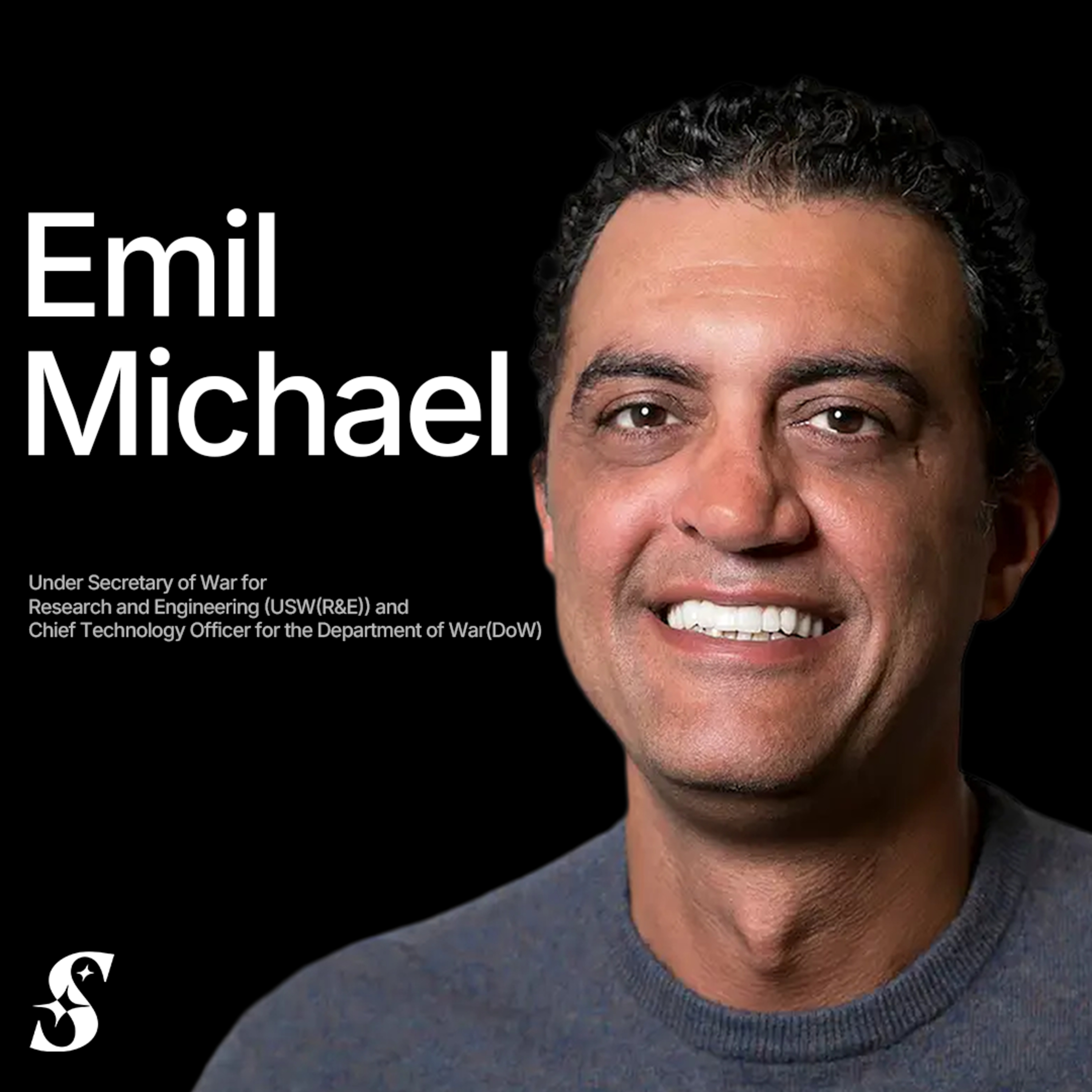

Emil Michael, the Chief Technology Officer for the Department of War, shares an inside look at the truth about modern defense technology.
He explains how the US is competing with adversaries like China, fostering a new wave of challenger companies, and why a strong military is the best way to prevent war.
Key takeaways
- The competitive dynamic in national defense can be understood through the lens of tech rivalries; competing with China is analogous to Uber competing with Lyft.
- A key US defense strategy is to actively cultivate new challenger companies, similar to Anduril and SpaceX, to disrupt the established defense industry and drive innovation.
- The experience of being a tech disruptor can be applied to government. The key is having the authority to look at a massive bureaucracy with a clean slate and question how things should be done differently.
- A key defense strategy is to reallocate budget from bureaucracy to new technologies, such as using AI-powered lasers to counter drone attacks, to stay ahead of adversaries.
- To be effective, a list of strategic priorities must be short enough for people to remember and focus on daily, similar to a phone number.
- The future of defense technology includes biomanufacturing, which uses biological processes to create materials like synthetic blood and offers a cleaner way to extract rare earth metals.
- Over-outsourcing critical supplies like minerals and pharmaceuticals for economic reasons has created a major national security vulnerability.
- The Russia-Ukraine war has transformed modern conflict into a 'robot war,' with drones fighting drones on the front lines, forcing rapid innovation in communication and targeting.
- US military strategy is now focused on achieving 'drone dominance,' which includes building a diverse drone arsenal and developing effective counter-drone technologies.
- The US AI Action Plan is a clear strategy for global AI dominance, focusing on securing chips, power for data centers, and deregulation for top AI companies.
- A primary military capabilities gap between the US and China is in cost-effective, scaled hypersonic missiles, creating a new kind of arms race without the controls of the Cold War.
- Palantir is often misunderstood as a controversial entity, when in reality it's a software company focused on solving practical, 'nuts and bolts' problems for the government, such as managing inventory and logistics.
- The farther people are from the realities of global conflict, the easier it is for them to disdain the companies and technologies required to keep a country safe.
- The next generation of defense technology is focused on hard problems involving hardware, not just software, with many frontier AI companies eager to assist the Department of Defense.
Podchemy Weekly
Save hours every week! Get hand-picked podcast insights delivered straight to your inbox.
The Uber vs. Lyft model for national defense competition
The Under Secretary of War for research and engineering highlights how companies like Anduril, Palantir, and SpaceX have successfully challenged established defense primes like Lockheed Martin in the last decade. The department's current goal is to create five more such companies to introduce new capabilities.
Executive orders, such as an AI Action Plan, are viewed positively because they set a clear marker for the world that the United States intends to be dominant in AI. A direct parallel is drawn between this national competition and the rivalries seen in the tech industry.
This is exactly like Uber. Competition with Lyft, like competition with China, same thing.
Emil Michael on his role as a disruptor in the Department of War
Emil Michael outlines his various roles within the Department of War. His primary position is Under Secretary of War for Research and Engineering. This department includes several key agencies, such as DARPA, which invented the internet, and the Missile Defense Agency, which was responsible for the Strategic Defense Initiative from the Reagan era. He also oversees core research functions that collaborate with top scientific labs. In addition, Emil serves as the Chief AI Officer for the department, heading an organization called the Chief Digital and AI Office. He also leads the Defense Innovation Unit, based in Mountain View, California, which helps defense tech startups navigate business with the Department of War.
Emil explains that his journey into this position began around 2017 while he was at Uber in San Francisco. After leaving Uber and moving to Miami, he met President Trump, worked on his campaign and transition team, and pursued his long-standing interest in defense. He feels he's in the most exciting part of the department, dealing with cutting-edge technology like space lasers.
While jokingly comparing his role to Uber, he clarifies the genuine similarity lies in being a disruptor. Working under a president and secretary who also embrace a disruptive mindset gives him the authority to challenge the status quo within the world's largest bureaucracy.
I could come in and look at what's literally the biggest bureaucracy in the world, three million people at the Department of War and say, what should we be doing differently? Clean sheet of paper. And that's pretty empowering. It's kind of awesome. So in that way, it's like Uber.
Shifting the defense budget to counter new threats
Emil Michael expresses surprise at the quality and camaraderie among the top officials in the new administration, mentioning individuals like Scott Bessant, Howard Lutnick, and Marco Rubio. He finds a strong sense of teamwork and a lack of political infighting, which he didn't expect. The conversation then shifts to the nearly trillion-dollar budget for the Department of War. Emil explains that while the US was focused on the war on terror, fighting terrorists with improvised explosive devices, China was investing in highly sophisticated capabilities. This has created a need for the US to catch up in areas like space and hypersonic missiles.
As a result, the budget strategy is to reduce spending on bureaucracy and redirect those funds toward new technologies, weapons, and defense systems. This involves looking ahead to future threats and developing innovative solutions, rather than only investing in existing technologies.
Think about a drone attack. How do you counter that? Well, maybe you could use high energy lasers to pop drones out of the sky if they're coming at you at a military base. You could do that with using AI in an automated way. So trying to step forward ahead of the adversary as opposed to sort of investing only in the stuff we know.
The six critical technology areas shaping defense
Emil Michael explains the rationale behind slimming down the Department of Defense's list of critical technology areas from 14 to six. The previous list was nearly a decade old, and if something remains critical for that long, it implies a lack of progress. Furthermore, a list of 14 priorities is simply too long for people to internalize and act upon daily.
When you look at corporate values, a phone number is not 14. People have to keep it in their head so they wake up every morning knowing what's the priority, right?
The six focused areas are:
1. Applied AI: Instead of building foundational AI models, the focus is on adapting the powerful infrastructure developed by companies like OpenAI and Anthropic for departmental use.
2. Scaled Hypersonic Weapons: These are missiles that can travel over five times the speed of sound, capable of reaching the US from China in 30 minutes. While the technology exists, the current challenge is to scale production and reduce costs.
3. Scaled Directed Energy: This involves using energy-based weapons, like lasers, to shoot down threats from space or at the border, such as drug-carrying drones.
4. Continuous Tested Logistics: This addresses the challenge of supplying troops with essentials like food, water, and munitions in faraway conflict zones, overcoming the "tyranny of distance."
5. Battlefield Information Dominance: With the proliferation of advanced sensors, everyone can see everything. The goal is to dominate the information landscape to gain a decisive advantage in a conflict.
6. Biomanufacturing: This field uses biological mechanisms to create new materials. Applications include creating synthetic blood, developing new metals, and using biology to separate rare earth metals, which is a cleaner alternative to traditional mining.
The US is in a 1938 moment to rebuild its industrial base for deterrence
Many in the defense sector believe the US is in a 1938 moment, a time to catch up its industrial base. The country over-outsourced critical supplies, such as minerals and pharmaceuticals, for economic reasons. This created a significant vulnerability, as a hostile supplier could cut off access to these essential goods. The solution is to redomesticate these industries and bring manufacturing back home.
This rebuilding effort also applies to the defense industrial base, which has been focused on outdated weapons and methods. The new focus should be on combining modern hardware with software to create effective deterrents against adversaries. The ultimate goal is not to fight a war, but to prevent one through strength. This rethinking of the nation's war-making capability is essential for keeping the peace.
The goal is deterrence. You don't want to fight a war, you want to prevent war. And you can only do that by being strong.
Emil Michael notes that this realization came into focus after COVID exposed supply chain weaknesses. The decline of the industrial base in regions like the Midwest has also led to devastated communities and an influx of drugs. He feels this sense of urgency every day, believing it's a critical moment to restructure the country's capabilities to maintain peace.
The critical importance of preparing soldiers for war
Looking back, the second war in Iraq and the war in Afghanistan were long, expensive conflicts with negative outcomes for the United States. Many lives were lost, and in Afghanistan, the Taliban has taken over again. This history provides a crucial lesson about sending soldiers into conflict.
If we ever have to send them to war again, it better be for the right reasons, and it better be that they're equipped with the right stuff.
Emil Michael recalls working on a project at the Pentagon to build a tank that could withstand roadside bombs. The effort was severely hampered by the slow procurement process and bureaucracy. This experience reinforces the idea that if people are sent to war, the country must be fully prepared to support them and provide them with the best equipment possible.
The Russia-Ukraine conflict accelerated the shift to drone warfare
The Russia-Ukraine war has revealed that the future of warfare is centered on drones. This conflict quickly evolved into a robot war, with drones fighting against other drones on the front lines, which is a completely new way of thinking about combat. This environment has spurred unbelievable innovation in drone technology. For example, developers are creating ways to use fiber optic cables for communication when satellites are jammed and designing software for automatic target recognition.
From these learnings, it's clear the US must have its own robust drone arsenal, featuring both big and small drones. The large drones are for major offensive actions, while the smaller ones are for reconnaissance and tactical use from military bases. Beyond building an offensive arsenal, there is a critical need to develop counter-drone capabilities. Drones are already a present threat, such as drug-carrying drones on the southern border. The ultimate goal for the Department of War is to achieve complete drone dominance.
Driving tech innovation in defense with new partnerships
Emil Michael highlights several recent technology partnerships. He is most proud of securing three deals for critical minerals in just 45 days, a move intended to reduce dependency on China. This demonstrates a serious and rapid approach to the issue.
Additionally, he has been actively engaging with the technology sector. Over the last six months, he has met with 100 to 200 tech companies that have defense applications. To foster innovation, his department is awarding contracts and holding contests to find the best solutions for various challenges. The goal is to remove barriers and encourage continued investment in these companies so they can succeed.
Looking ahead, he anticipates an announcement regarding the first-ever department-wide launch of AI, signaling a significant new initiative.
The US plan for AI dominance and the hypersonic missile gap
The AI Action Plan and its associated executive orders send a clear message to the world: the United States intends to be dominant in AI. According to Emil Michael, the plan focuses on several key components to achieve this goal. These include securing the best chips, increasing power generation for data centers, and ensuring AI companies are free from restrictive state regulations. The ultimate aim is to foster what could be the biggest industry ever created, right here in the US, where the four leading AI companies are already based.
Emil explains that this plan is already being put into action. Efforts are underway to speed up permitting for data centers and to develop nuclear power for them, a practice that had been dormant for decades. The US is also securing its semiconductor supply chain by keeping top Nvidia chips here and opening new factories, like the TSMC facility in Arizona. The country is even developing its own lithography capabilities.
Within his own work, Emil is focused on applying this technology for enterprise, intelligence, and warfighting purposes. He gives the example of training an AI model on 50 years of satellite imagery to detect new things. AI is also being used for logistics, combat modeling that resembles a video game, and upfront design of new technologies based on physics.
When asked about the biggest capability gap for the US military, Emil points to the difference between the old arms race with the Soviet Union and the current situation with China. The US and the Soviet Union had a treaty and the concept of mutually assured destruction. However, no such agreement exists with China. This has allowed China to develop certain hypersonic missile capabilities at a scale and cost the US has not yet achieved. Emil identifies this as a critical area of focus, calling it "scaled hypersonics at cost," and says it's the gap he thinks about the most.
The public misconception of Palantir and defense tech
Emil Michael addresses the biggest misconception about Palantir, explaining that it is fundamentally a software company that pioneered big data. It provides practical, useful software to the government for everyday problems. For example, Palantir helps the Department of Defense manage basic logistics like inventory. The government was spending trillions of dollars but didn't know where its own equipment, like tanks and munitions, was located. Palantir helps track these assets, understand their life cycles, and manage repairs.
While protesters often focus on more controversial applications, Emil emphasizes that Palantir is largely a "nuts and bolts" software company. He finds the perception that Palantir is "evil" for helping the American government with lawful activities to be strange. He compares this to a time when Google employees protested selling cloud software to the US government, a stance he calls crazy since the company would sell to private companies and foreign countries. He believes those days are mostly over.
The conversation broadens to why defense tech companies are often automatically labeled as evil. Emil suggests this perception comes from being disconnected from the realities of conflict.
The farther you are removed from the problems that a conflict can cause, the easier it is to disdain what it costs to keep the country safe. So if you're in a bubble of privilege and freedom and you don't know anyone who's been to the battlefield or you haven't read enough to understand what the risks are and threats of the world, it's easy to say, well, companies who are in that business are bad.
He concludes that people who think the world is a "Kumbaya world" are triggered by the realities of defense, but when a country is fighting a war, it needs to be prepared to use force against those who intend to cause harm.
Contrasting the leadership styles of Pete Hegseth and Travis Kalanick
Emil Michael praises Pete Hegseth's leadership, suggesting he could be the greatest secretary of war in our lifetimes. Hegseth's effectiveness stems from his fresh perspective, as he did not come from the defense industry, the military's top ranks, or politics. This allows him to approach his role without preconceived biases, asking fundamental questions about what is and isn't working. Emil describes him as an extraordinary leader who is open to any idea and has built a cohesive team.
This style contrasts with working with Travis Kalanick at Uber. Travis, coming from the tech industry, had a strong vision and opinions from the start. Since both he and Emil had tech backgrounds, their partnership involved more debate over who had the best idea. Emil approached things from a business standpoint, while Travis had a hardcore engineering perspective.
I was like, we should buy Lyft. He's like, we should crush Lyft. So we had those kinds of debates.
The relationship with Hegseth is different. It is less about clashing over deeply held beliefs and more about collaboratively looking at problems with a clean sheet of paper to determine if things should work differently.
Exciting new companies in the defense tech sector
When asked about exciting companies in the defense tech sector, Emil Michael points to Anduril, Palantir, and SpaceX as the three companies that have successfully broken into the industry over the last decade, challenging established players like Lockheed Martin and Northrop Grumman. His job, as he sees it, is to help create the next five companies that can bring new capabilities to the Department of Defense.
Emil shares his excitement for a range of companies tackling difficult problems with hardware, not just software. He mentions Planet Labs for commercial satellite imagery, a drone company called Neros, and Hadrian, which is working on AI manufacturing. He also notes that frontier AI companies are eager to help the Department of Defense explore new possibilities. He concludes that this is the best job of his life.