
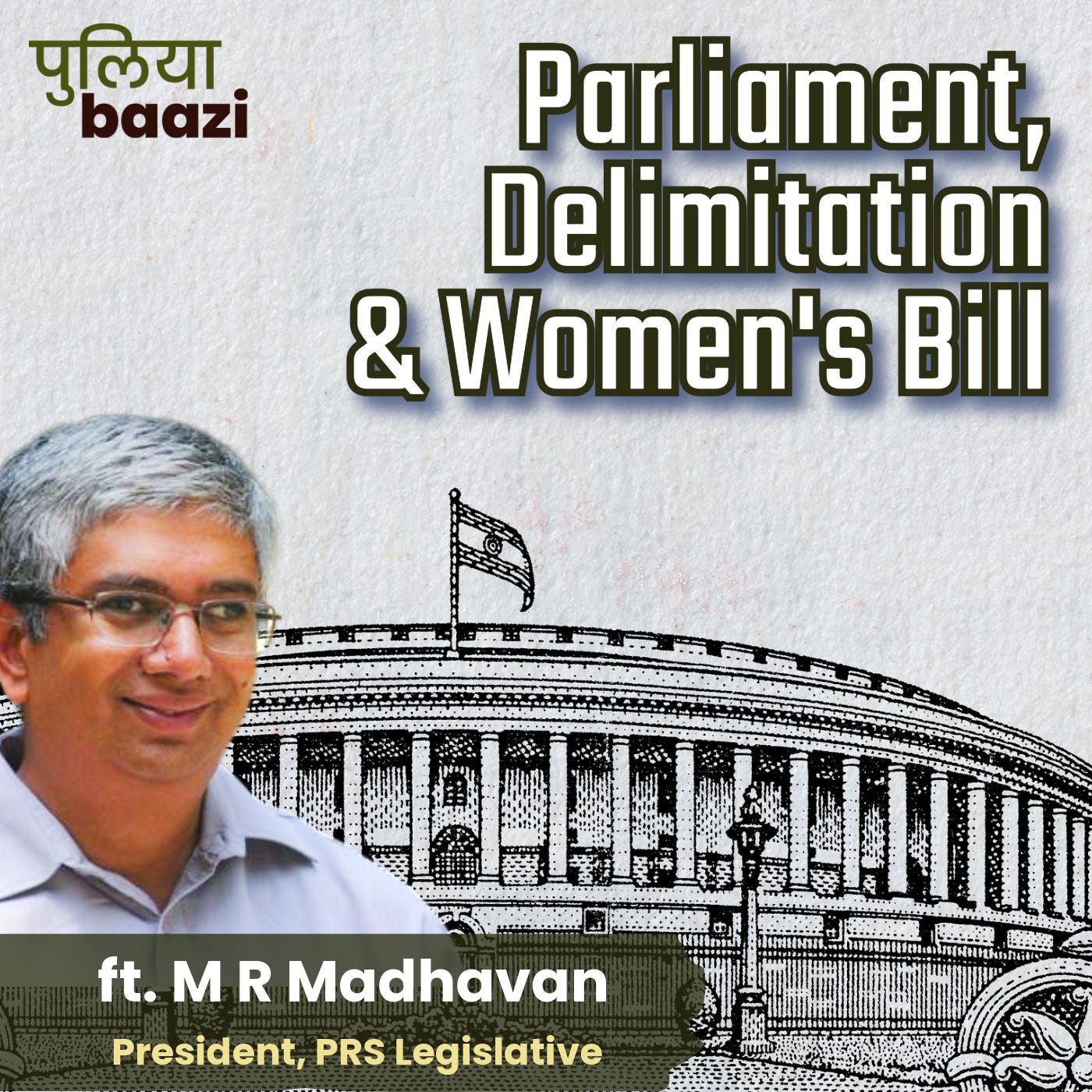

M. R. Madhavan from PRS Legislative Research explains the complex constitutional amendments recently passed by the Indian Parliament.
He breaks down the controversial links between women's reservation, the national census, and the redrawing of constituency boundaries.
This analysis clarifies how these legal shifts will reshape political representation and the balance of power across the country.
Key takeaways
- PRS Legislative Research is an expert body that has advised Indian parliamentarians for 25 years, similar to the Congressional Research Service in the US.
- Public confusion regarding the outcomes of Parliamentary sessions often stems from the complexity of the legislative process and the specific details of the bills introduced.
- The original constitutional goal of delimitation was to ensure that every citizen's vote carries equal weight regardless of where they live.
- Parliament froze seat counts in 1976 to prevent states with successful population control from losing political representation.
- India's parliamentary seat allocation has been frozen since 1971 to prevent penalizing states that successfully managed population growth.
- The implementation of women's reservation in the Lok Sabha is legally tied to the completion of the next census and the subsequent redrawing of constituency boundaries.
- Delimitation is a lengthy legal and administrative process that historically took six years because it requires public hearings in every single constituency.
- Linking women's reservation to an increase in total seats serves as a political compromise that preserves the current seats held by male politicians.
- An MP's job is to create national policy rather than manage local development, making the exact size of their constituency less relevant.
- Increasing the number of seats in parliament can reduce efficiency. The focus should be on how many members are needed for productive debate.
- Increasing Lok Sabha seats without adjusting the Rajya Sabha dilutes the upper house's power, allowing the government to easily override it during joint sessions.
- The 15-year sunset clause for the Women's Reservation Bill started in 2024, meaning it might only apply to two election cycles if implementation is delayed until 2034.
- The role of an MP should be limited to national policy and government oversight rather than local infrastructure projects.
- Reorganizing large states into smaller units can prevent a few regions from unfairly dominating national politics.
- Rotating reserved seats can reduce political accountability because MPs know they cannot run for re-election in the same constituency next term.
- Mandating that parties nominate a percentage of women may be more effective than reserving specific seats by encouraging women to compete as strong, independent players.
- The Delimitation Commission is an independent body led by a Supreme Court judge where state representatives serve only as non-voting observers.
- While seat allocation follows a strict mathematical formula, the actual implementation often triggers intense political negotiation outside of formal constitutional channels.
Understanding the special session of Parliament
A recent special session of the Indian Parliament has created significant confusion among the public. Many people are unsure about which bills were passed, which were defeated, and the general impact of these legislative changes. Madhavan from PRS Legislative Research joins the discussion to help clarify these issues. PRS is an organization that provides research and advice to members of Parliament and has been operating for over 25 years. Saurabh compares the role of PRS to that of the Congressional Research Service in the United States.
The recent special session in Parliament has left people confused about what was passed and what was defeated. We invited Madhavan to help untangle this puzzle and understand the impact of these bills.
The discussion focuses on the Women's Reservation Bill and the process of delimitation. These are complex constitutional issues that require careful explanation. By breaking down the first constitutional amendment and other legislative moves, the goal is to provide a clearer understanding of the current political and legal landscape in India.
The history and proposed changes to Lok Sabha seats
A constitutional amendment proposal focuses on three main areas. It seeks to increase the size of the Lok Sabha, enable delimitation, and advance women's reservation. Specifically, the amendment proposes raising the upper limit of the Lok Sabha from 550 to 850 seats. While this does not mean the number of seats will immediately jump to 850, it creates the legal room to expand the house in the future.
To understand these changes, Madhavan points back to the 1950 Constitution. The original rules for seat distribution followed a two-step process. First, seats are distributed among states according to their population share. A state with more people gets more seats. Second, each constituency within a state must be made roughly equal in population. This ensures the principle of one person, one vote, and one value.
The original purpose was that after these two steps, every constituency in the whole country should have roughly the same population. This was the principle of one person, one vote, and one value so that everyone's vote has equal weight.
The Constitution originally required this process to happen after every census. This was followed after the 1951, 1961, and 1971 censuses. However, a conflict arose in the 1970s. States that were successful in family planning feared they would lose parliamentary representation because their population growth was lower than others. They argued that they should not be penalized for meeting national goals. To address this, the 42nd Amendment in 1976 froze the number of seats for 25 years. Saurabh notes that this amendment is often called the mini constitution because of how many changes it introduced during the Emergency.
The impact of population growth on parliamentary representation
In 1976, India decided to freeze the number of parliamentary seats for twenty-five years based on the 1971 census. This meant the number of seats assigned to each state stayed the same regardless of how much their populations grew. When that period ended in 2001, a new agreement was reached. While the total number of seats for each state remained frozen for another twenty-five years, internal boundaries within states were redrawn. This accounted for population shifts, such as people moving from small towns to big cities.
The seats for each state did not change. For example, Karnataka stayed at 28 and Tamil Nadu at 39. But boundaries were redrawn within the states based on the 2001 census to account for urbanization. This was used for the 2009, 2014, 2019, and 2024 elections.
Madhavan explains that the Constitution currently states this freeze will last until the first census after 2026. Once that happens, the original formula returns and seats will be allocated based strictly on population. This transition is also tied to the Women's Reservation Bill, which is the 106th Amendment. The bill reserves one-third of seats for women. However, it specifies that this will only happen after the next census and the delimitation process.
The Women's Reservation Bill passed in 2023 is actually the Constitution 106th Amendment Act. It reserves one-third of seats in the Lok Sabha and Assemblies for women, but it states this will happen after the delimitation following the next census.
There is a major debate about the impact of these changes. Since 1971, population growth has not been uniform across India. Northern and Central states like Uttar Pradesh, Bihar, and Rajasthan have seen much higher growth than states in South India or Punjab. If India returns to the principle of one person, one vote, these high-growth states will gain many more seats. States that successfully controlled their population growth will lose their proportional share of power.
The complexities of delimitation and women's reservation
The implementation of the Women's Reservation Act passed in 2023 is closely tied to the next census and the subsequent delimitation process. Madhavan explains that if there were a genuine push to implement the reservation sooner, a simple amendment could have allowed it to be applied to the current 543 seats. However, the current law requires waiting for the redrawing of constituency boundaries based on new population data. This redrawing, known as delimitation, is a massive administrative task. Madhavan notes that the previous Delimitation Commission took six years to complete its work between 2002 and 2008.
The previous Delimitation Commission act passed in 2002 and was finalized only in 2008. It takes so much time because they must go state by state. They create a preliminary order and then hold public hearings in every constituency to decide the boundaries.
The timeline for the 2029 elections is extremely tight because of these procedural requirements. Even if the process is accelerated, it involves multiple steps: gathering detailed census data, holding hearings, issuing final orders, and amending the Representation of the People Act. Saurabh points out that the 2023 agreement was a political compromise. By linking reservation to an increase in the total number of seats, existing male representatives feel less threatened about losing their positions. Madhavan observes that because the plan focuses on preserving current seats while adding new ones, it could almost be called a Men's Seat Preservation Bill.
The role of constituency size in parliamentary efficiency
Madhavan argues that the physical size of a constituency or the number of people in it should not dictate the size of the Parliament. Currently, an MP might represent over two million people. Whether that number is 1.6 million or 2.3 million, it is impossible for one person to know everyone. If the goal were to have a representative for every 100,000 people, the Lok Sabha would need 14,000 members. This would require the Parliament to meet in a stadium rather than a building.
If we had one MP per hundred thousand people, we would have 14,000 members in the Lok Sabha. You would need a stadium like Feroz Shah Kotla for Parliament to meet. Increasing the size of the Parliament is a major issue people have thought about, but in my view, the current Parliament is already very large.
An MP's primary role is to shape national policy, not to focus on local development. Because of this, the exact number of people they represent should not matter as much as the efficiency of the legislative body. Madhavan points to the United States as an example. The House of Representatives has remained at 435 members for a century, even though the population has tripled. In the US Senate, every state gets two representatives regardless of its population size.
The focus should remain on how many MPs are needed to run a Parliament efficiently. It is important to give everyone a chance to discuss issues and debate. Madhavan suggests that the Parliament should meet for 150 to 200 days a year to properly debate issues, but this does not happen. Instead, the focus remains only on increasing the number of seats.
The shifting power balance between parliamentary houses
The balance of power between the Lok Sabha and the Rajya Sabha is shifting. Currently, the Lok Sabha has more than twice the members of the Rajya Sabha. During a joint session of Parliament, every member gets one vote. This means the Lok Sabha already has more influence. If the number of Lok Sabha seats increases to over 800 while the Rajya Sabha stays the same, the upper house will lose its ability to act as a check on legislation.
If the Lok Sabha becomes three times the size of the Rajya Sabha, the upper house ceases to matter in a joint session. Even if the opposition has a strong majority in the Rajya Sabha, the government can simply override them by using their numbers in the Lok Sabha.
India's federal structure differs significantly from the United States. In the US, every state has two senators regardless of its size. This was a compromise to convince smaller states to join the union. In contrast, India is a union that can redraw its own states. Madhavan suggests that if we want the Rajya Sabha to remain relevant, we could remove the joint session provision. This would force both houses to agree on a bill independently before it becomes law.
The timeline for these changes is tied to the census. If the current laws remain, a new delimitation commission will be formed after the 2027 census. This would likely change the seat distribution for the 2034 elections. This timing also impacts the Women's Reservation Bill. The bill has a 15-year limit that started when it was notified in 2024. If the reservation is only implemented after the 2034 delimitation, it may only cover two national elections before the time limit runs out.
Redesigning India's parliamentary and state structure
Madhavan suggests that we should not focus solely on creating a new administrative system. Instead, we should preserve the existing three-level structure of national, state, and local governance while ensuring each level performs its intended role. Currently, citizens often take local problems like garbage collection or road repairs to their Member of Parliament. This is a design flaw because MPs lack the power to fix these issues and their constituencies are too large. Madhavan argues that the core principle of governance has been diluted over time.
The job of an MP is to see if the central government is doing its job correctly. The job is not to take money and build roads. If the implementing body and the oversight body are the same person, then you have a problem with the design.
A significant issue is the power dynamic between MPs and their political parties. The anti-defection law gives parties too much control. While a party should be able to take internal action against a member who ignores a whip, they should not be able to remove them from Parliament. Only the voters who elected the representative should have that authority. Madhavan believes we need to return to the basic principle where MPs focus on national laws, policies, and the budget. This requires stronger committees and more time dedicated to these tasks.
Regarding the concerns about delimitation and the dominance of northern states, Madhavan proposes reorganizing large states. States like Uttar Pradesh and Bihar have overriding power because of their size. A party can form a national government by winning in a few large states even if it has no presence in smaller ones. Breaking large states into smaller units would help solve this imbalance and reduce the fear that a single state will dominate the country. Madhavan also suggests that a smaller Parliament, perhaps around 300 members, could be more effective.
The challenges of women's reservation in politics
There are several ways to think about women's representation in politics beyond just reserving specific seats. One alternative is requiring political parties to nominate women for a certain percentage of their total candidates. Madhavan explains that while this is possible, it would need careful rules. Without strict conditions, a party might fulfill its quota by fielding women only in states where it has no chance of winning.
One way is to mandate a 33 percent quota for parties. But you would need conditions. Otherwise, a state-recognized party might field women in regions where they aren't competitive just to meet the requirement.
History provides other models, such as the dual member constituencies used before 1962. These seats had both a general and a reserved candidate. However, voters often viewed the reserved candidate as an add-on rather than an equal. In modern local government, this dynamic sometimes leads to the problem of proxies, where a woman is elected but her husband holds the actual power.
Khyati suggests that a nomination quota might be more effective than reserving seats. In reserved seats, a powerful local leader might simply field his wife to keep the seat in the family. This makes it difficult for deserving or independent women to compete. Madhavan also points out that reservation limits voter choice. If a seat is reserved, a citizen cannot vote for the person they believe is the best candidate if that person does not meet the reservation criteria.
The rotation of reserved seats creates another issue regarding accountability. If an MP knows they cannot stand for election in the same seat next time because it will rotate, they have less incentive to work for that constituency. Madhavan notes that this effectively breaks the link between the representative and the citizen. Additionally, the idea that only women can represent women's interests is often a misconception. Data shows that female MPs tend to ask the same types of questions as male MPs. This is a positive sign because it shows they are acting as national representatives for the whole society.
The structure and politics of the Delimitation Commission
The delimitation process follows a structured two-step sequence. First, a mathematical formula determines how many seats each state will receive. Then, an independent Delimitation Commission is formed to carry out the work. This commission typically consists of three main members, including a sitting or former Supreme Court judge and a representative from the Election Commission. To provide local context, the commission includes ten associate members, comprising five Members of Parliament and five Members of the Legislative Assembly from the specific state. These associate members participate in the process but act primarily as observers because they do not have voting rights.
The Delimitation Commission is an independent body. It includes a Supreme Court judge and members of the Election Commission. While there are ten associate members from the state, they are more or less observers because they do not have voting power.
The process generally involves public hearings to gather feedback before the final boundaries are set. While the constitutional framework for these changes is rigid, the political landscape is much more fluid. Madhavan points out that states may not have a formal constitutional path to negotiate the seat allocation formula, but significant political negotiations are likely to occur. Even for experts closely following Parliament, the timing and introduction of such bills can be unexpected, making the future political impact difficult to predict with certainty.