
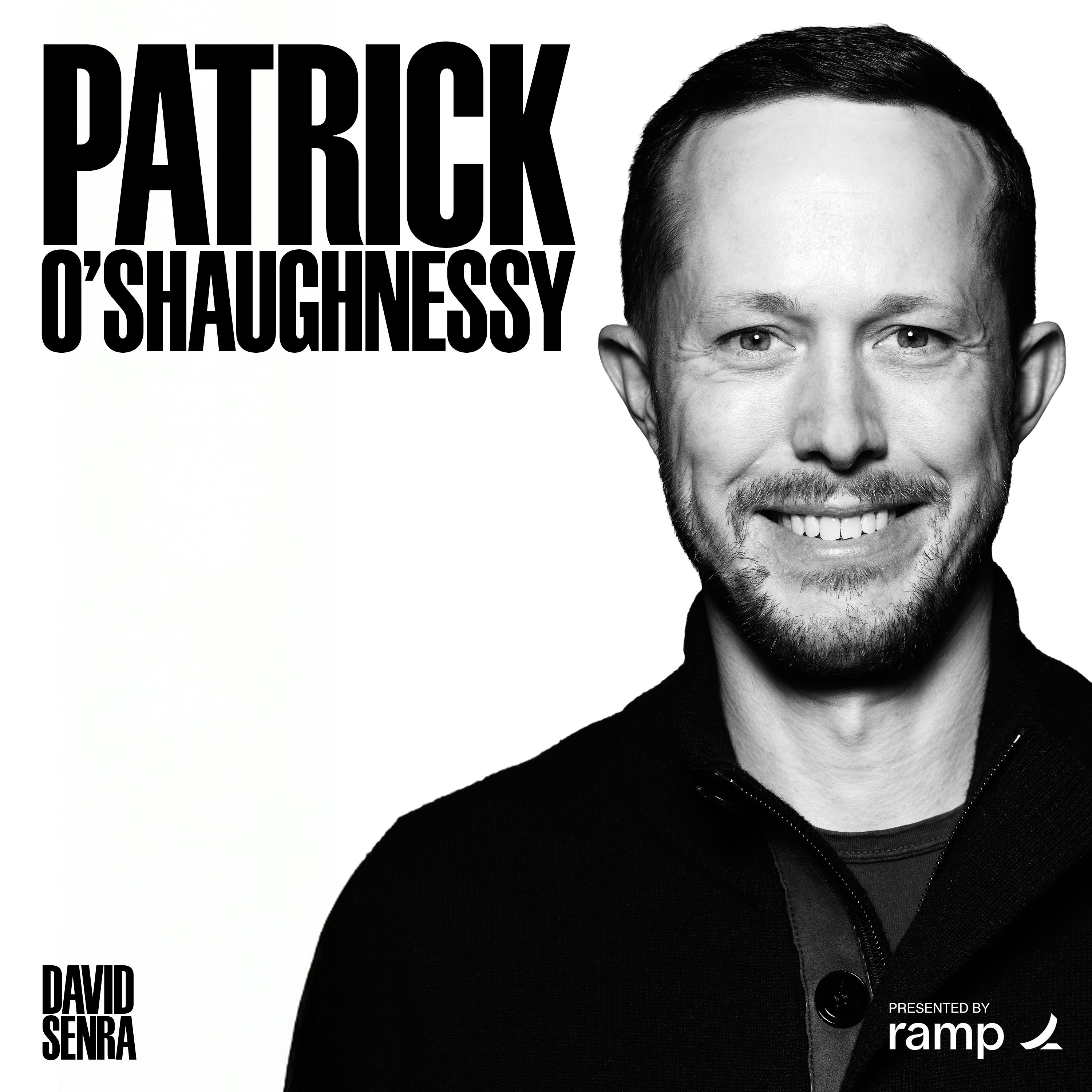

Patrick O'Shaughnessy, founder of Colossus and Positive Sum, joins David Senra to share the personal principles that guide his work and life.
They discuss why the most profound success comes from championing others and how finding a singular mission can create more meaning than chasing traditional goals.
Key takeaways
- Personal accomplishments can feel hollow, while the success of others you've championed can be the most deeply gratifying feeling in the world.
- The kindest thing you can do for someone is to bet on them before they deserve it. This simple act of belief can change a person's trajectory.
- Setting rigid goals can put blinders on, causing you to miss opportunities. A more effective approach is to live by an organizing principle that keeps you open to unexpected successes from the periphery.
- Instead of searching for the meaning of life, chase the feeling of being alive. This feeling can serve as a compass, guiding you toward your personal principles and the right path for you.
- Learn from the lives of others as if they are ingredients, but you are responsible for creating your own unique recipe for life.
- The three pillars of life are often considered to be health, work, and relationships. While health seems like the logical priority, getting your work and relationships right can be the foundation for better physical health.
- The true value of having your work become known is not fame, but the high-quality relationships you can build with like-minded people who understand you through it.
- The ambition for external success can be a lie we tell ourselves. It often masks deeper, unfulfilled personal needs, and we may be incapable of achieving what we truly want without addressing our inner demons.
- "Dirty fuel" can drive immense success, but it often consumes the individual. A preferable alternative is to be fueled by a desire for loyalty and dependability.
- To succeed in an area you know nothing about, combine specific expertise from different masters. For example, learn how to build from one person, design principles from another, and how to sell from a third.
- The best ideas are often those that sound dumb but are not. If an idea sounds good to everyone, it is likely in a more competitive and difficult space.
- In a world saturated with cheap, fast 'junk food' content, people are desperate for carefully created, high-quality work that is difficult and time-consuming to make.
- A simple rule for assessing creators or founders is: If the invention is good, the inventor is probably good.
- To get ahead, put 'breadcrumbs' out into the world. Focus on creating one amazing thing that people will notice, and the internet will help amplify and share it.
- Identify the activity you naturally engage in with a high number of repetitions. This is a powerful clue for where you can build a compounding career.
- Apply the concept of 'progressive overload' from weightlifting to life: focus on consistently pushing yourself in an area of passion, without a fixed destination, and see where it takes you.
- Your greatest strength can also be your greatest weakness. An intense, aggressive focus can make things happen, but its abrupt shifts can create a jarring 'whiplash' effect for those around you.
- The best leaders act like teachers, understanding that repetition is persuasive. They spend the majority of their time repeating the company's philosophy, purpose, and methods to ensure everyone is aligned.
- A life devoted to deeply helping a few people can be as successful, if not more so, than achieving widespread fame or building a massive company.
- A single decision made today can ripple through generations, profoundly shaping the lives of descendants you may never meet.
The joy of championing other people
Patrick O'Shaughnessy explains his fascination with finding and backing talented but relatively unknown people. This pursuit is deeply wired into his personality, as it allows him to learn about new things at the frontier before they become widely known. As a lifelong learner, he finds discovering something fresh and new exciting.
The core motivation, however, is the profound joy he gets from championing other people. He finds that his own personal accomplishments or accolades don't provide him with any real emotional satisfaction. In contrast, when someone he has supported achieves success, he feels it on a deep, visceral level.
But when your success happens or when many other people that I and my team have championed have a win, I feel that deep in my soul and heart and gut in a way that is just more gratifying to me than anything else in the world.
This feeling extends to his family, friends, and the CEOs of companies he's invested in. He also enjoys the act of 'picking sides'—publicly declaring his support for one person over the other available options in a given field. Because of this deep satisfaction, he is now architecting his life to do as much of this as possible.
The worldview that the point of life is to help others
David Senra recounts one of the craziest days of his life, which directly involved Patrick O'Shaughnessy. For five and a half years, David was struggling with his podcast, Founders. He was obsessed with it, but the external world seemed indifferent. Drawing inspiration from mutual friend Sam Hinkey, who said, "people are power law, and the best ones change everything," David was ruthless with who he gave access to while trying to build his project.
One day, despite having no Twitter followers, David saw a flood of notifications. Patrick, who has an incredibly valuable audience, had tweeted about him. The tweet said, "I never find new podcasts to listen to. I think David Senra's founder's podcast is excellent. You should listen to it," and linked to an episode on Estée Lauder. At the time, David's podcast was behind a paywall and he had very few subscribers. The next day, his inbox was filled with new subscriber emails. David notes how unusual this instinct was, as Patrick didn't see him as competition.
Patrick explains his motivation, which is rooted in a core life philosophy. He mentions that on his own show, he asks guests about the kindest thing anyone has ever done for them. About two-thirds of the time, the answer is the same: someone bet on them before they deserved it. They saw something in the person that they might not have even seen in themselves.
The kindest thing was some person made a bet on me first... before I deserved it. Or like, they saw something in me that maybe I didn't even see in myself. They bet on me before others would.
This idea connects to a pivotal moment in Patrick's life. In his mid-20s, while searching for purpose, he was studying the world's religious texts and came across a passage in the Upanishads that felt like being hit with a hammer. The line was, "those who feed the hungry protect me, those who don't are consumed by me." This passage awakened him to the idea that the entire point of existence is to help other people. That realization has been his worldview ever since.
Inventing your life on principle
Patrick explains his driving motivation is seeing potential in someone before others do and then helping the world see it too. He contrasts this with traditional goal-setting, noting he is not a "goals person" and has even written an essay titled "Growth Without Goals." He finds goals unexciting for talented people who will likely achieve them.
The second you set some big goal, you kind of know what's going to happen because you go do it and you know the road in front of you and you have blinders on. And I don't actually like having blinders on. I like to go. Everything that's ever worked for me has come out of the periphery.
Instead of goals, Patrick champions finding an organizing principle for your life, a concept he draws from a talk by computer scientist Brett Victor called "Inventing on Principle." Victor's principle was to give digital creators instant feedback. Patrick’s principle is to identify and foster undiscovered talent.
When I see undiscovered talent, it is my obligation to do this thing to get to know them, to learn from them, to start introducing them to people... I don't need to get anything out of it. What I get out of it is the thing. That's the point.
David observes that Patrick has successfully built his business around this single principle, integrating media and investing. Patrick acknowledges it took him a decade to articulate his principle, but once found, a good principle can be applied universally to investing, friendships, and team-building. This approach keeps him open to opportunities, noting that everything interesting in his life has come "out of left field," not from pursuing a pre-defined goal.
Use the feeling of being alive as your guide
At age 28, while expecting his first son, Patrick O'Shaughnessy reflected on what makes a good parent. Inspired by a book of letters his own father had written him, he wanted to write a letter to his son. This led him to a core belief: showing, not telling. Children don't do what their parents say; they do what their parents do. How you behave is how you parent. The question then became what example he wanted to set.
However, articulating his own organizing principle for life took a long time. Interestingly, before he could define his own, he borrowed one from computer scientist Bret Victor. Patrick applied Victor's principle of "instant feedback" to a software product he built, which worked incredibly well and fueled his business's growth. This experience demonstrated the power of having a strong principle, even if it's someone else's.
The search for a personal principle is less about intellectual understanding and more about feeling. It is often said that life is meant to be experienced, not just understood. This connects to an idea Patrick finds powerful, which might be from Joseph Campbell.
We're not searching for the meaning of life, but for the feeling of being alive.
This feeling can serve as a guide. Patrick suggests using it as a "red light, green light" system on your personal journey. If something makes you feel more alive, you are likely on the right path. Yet, there's a common human paradox: people often know what makes them feel most alive but spend most of their lives not doing it. The primary reason for this, Patrick believes, is fear. People are afraid of pursuing an original path because it means leaving a comfortable existence for the unknown. A truly original path is hard because, by definition, it's all on you.
Introspection is a tool you use until the job is done
Patrick described a past phase where he was a "masochist for introspection." This period was sparked by a crippling fear of death he experienced since he was five years old. The idea of someday not existing was terrifying and would cause him to spiral.
Someday I would not exist. And that just freaked me out and did for decades. So that probably kicked off this introspective period of my life where I was very curious about philosophical traditions and religious traditions and metaphysics and all this kind of stuff, because I wanted to know what the hell is the point of all this?
This fear drove him to search for meaning and purpose, ensuring he did not live a dull, "train track existence." He became obsessed with personality tests, psychology, and other methods of self-understanding. However, once he found his organizing principle and understood what he wanted to do with his life, the intense introspection stopped. He lost most of his interest in those tools for self-analysis. The conclusion is that introspection served as a tool to solve a problem. Once the job was done, the tool was no longer needed.
Patrick's organizing principle for fostering potential
David asks Patrick for his interpretation of David's own organizing principle. This comes after Patrick clarifies his own personal philosophy. Patrick explains that his principle is not simply to help as many people as possible. Instead, it is to identify enormous, unrealized potential in others. When he sees this potential, he feels it is his obligation to tell people about it and to help foster it into existence. This obligation exists whether or not he benefits from it personally, for instance, through an investment.
The power of stories to break family patterns
Patrick observes that David possesses a unique single-mindedness, unlike many successful people who tend to branch out. He contrasts their backgrounds, noting he came from a long line of successful entrepreneurs, while David came from different circumstances. Patrick's great-grandfather, Ignatius Aloysius O'Shaughnessy, was an oil wildcatter who made a fortune but gave most of it away anonymously.
Drawing on this contrast, Patrick suggests that David is a "founder of his family." He broke from his family's tradition to forge a new path. This drive to change his family's trajectory might be his underlying motivation. Because he lacked mentors in his life, he found them in books and has been sharing those lessons ever since.
David resonates with this idea, explaining his deep desire for understanding. He intentionally consumes content slowly, listening to podcasts on 1x speed and reading only about 25 pages an hour. His goal is to understand humanity and the world as they truly are, not just as people portray them. He finds biographies and autobiographies particularly valuable because they offer unfiltered accounts of life's struggles, showing that no experience is unique.
When you watch a great movie, you hear a great story, you hear a great song, you're not thinking about, 'oh, this happened to Taylor Swift.' You're like, 'oh, I had that same experience in this relationship.' It's like a form of understanding.
David shares a recent example of Bruce Springsteen's autobiography, which deeply affected him. Despite not being a fan of his music, he felt the book was written for him, describing his own mindset and view of his work with uncanny accuracy. He describes this feeling of profound connection and understanding as being "insanely powerful" and "like a drug."
Making your own recipe from the ingredients of others
David recounts how a spontaneous conversation with Patrick became a huge inflection point in his life. For years, Patrick encouraged him to record his own conversations, but David resisted, viewing it as a distraction. The real turning point was a four-hour dinner David and Patrick had with Daniel Ek. This highlights David's preference for long, in-depth conversations over superficial interactions. He believes it takes time to warm up and truly understand someone, which is why he values fewer, deeper relationships.
I have no interest in the superficial. And I think you have to talk for a long time because it takes a little while to get warmed up and feel the person out.
Patrick suggests that David's work provides people with a "set of ingredients" through the stories of others, but it's crucial for individuals to create their own recipe. He cautions against trying to simply live like the people studied, especially since many of them share common pitfalls. Patrick dismisses the idea that these pitfalls are inevitable byproducts of success.
I hate that kind of thinking. I think, screw base rates. I don't care what the base rate is. The most interesting stuff is outliers by definition. So I don't care what happened to everybody else.
David agrees that his work is a personal search, driven by a desire to figure out how to live a good life and avoid plateauing. His main motivation is to maximize his own capabilities.
I don't want to tap dance on a giant reservoir of potential. I want to figure out how to get the most out of that.
Finding your purpose and embracing the inherent hardship
Biographies and stories often serve to remind people of truths they already know. Patrick compares this to a Bruce Springsteen concert, where people come to be reminded of things they know are true, not necessarily to learn something new. While a 400-page biography contains creative ideas, its main value can be in reinforcing what you already know but may have forgotten or haven't applied.
Patrick describes the Founders podcast as "church for entrepreneurs." He believes its power lies in inspiring people to find their unique purpose, or their "thing." He argues that everyone has something special based on their life experiences, natural gifts, and how they're wired. The podcast provides examples of people who went through the difficult process of finding their thing and then dedicated their lives to fostering it.
Everyone's got something, I guarantee it. It's my favorite thing to search for in conversation, especially if someone's not yet doing it. Everyone has a thing that for whatever set of reasons, their life experiences, how they're wired, their naturally endowed gifts, and searching for that thing is really interesting and really hard.
Once you find your purpose, the next step is to embrace hardship. Patrick emphasizes that nothing meaningful is supposed to be easy. He gets uncomfortable when things feel too simple and he's just going through the motions. David adds his own organizing principle, which is the desire to understand people. He believes this requires long, deep conversations, estimating it takes at least 100 hours to truly know someone.
Sustainable success is found by chasing abiding joy, not fame
The principle behind creating something new should be an act of service. It is an obligation to correct something for others, not for yourself. The most interesting and sustainable creations are a reflection of the creator. Patrick references Joseph Campbell's idea on this matter.
The privilege of a lifetime is being who you are.
When you can pour yourself into the thing you are making and it benefits others, it creates an amazing feeling. Patrick has never met anyone who has had that experience and gone back to their old ways. It is what we are all after. David is obsessed with the idea of 'sane success'. He wants a slow build, getting better decade after decade, rather than a huge spike followed by a flameout. He often asks older, more successful people what he should worry about that could cause him to stop doing what he loves.
Patrick identifies a common trap: chasing traditional proxies for success like money, power, and fame. These are intoxicating but different from chasing the feeling of being alive. He points to a concept from the Upanishads called 'abiding joy,' which is a resource that grows as you use it. Chasing this feeling of being alive will always guide you well, whereas money, power, and fame will not. Patrick admits he's been intoxicated by these things at various points but notes he is now over fame. He wishes he could do his work and then, like in the movie 'Men in Black,' flash a light so people would forget who he was.
How meaningful work and relationships can improve your health
You have limited time each day, which can be focused on three main areas: health, work, and relationships. David believes health must come first, as you cannot do anything else if you are sick or have no energy. After health, he focuses on creating meaningful work and building strong relationships, something he didn't prioritize a decade ago.
Patrick disagrees with this order based on his personal experience. He suffered from severe health problems for a long time, despite doing everything right. He ate well, exercised daily, and explored every possible solution, but nothing worked. He felt resigned to being sick for life.
I'm certain that the reason is that I finally got my work and my relationships correct and that when you are doing something you love and have great core relationships, all of a sudden, magically, your health gets way better.
It wasn't a coincidence that his health improved only after he found work he was meant to do and focused on his core relationships. He still invests in his health, but he learned that work and relationships can be the foundation for physical well-being. As the saying goes, the body keeps the score.
Bruce Springsteen's realization that life is more important than work
Fame should not be sought for its own sake. Instead, the goal is to create work so good that it becomes known and shared because people find value in it. As David notes, it's human nature to share things we like, whether it's a song, a book, or a restaurant.
The real benefit of being known is the relationships you can build as a result. When your work clearly expresses your interests, it makes you easy to understand for other people. This allows like-minded individuals to find and connect with you. David believes the most fundamentally important thing in life is choosing who is around you, from friends to colleagues.
David shares how Bruce Springsteen's biography has been impacting him. Springsteen had an insane work ethic, channeled into a singular goal since he was 15 years old. He was psychopathically obsessed with professional achievement and stardom.
He takes all that pain, channels it into a work ethic that gets him exactly what he wanted... he's worldwide famous, he's rich, everything. And then immediately drops in his mid-30s into the deepest depression of his life. And what he realizes is that's not what I actually wanted.
Coming from a terrible environment, Springsteen developed a maniacal will to change his circumstances. He achieved everything he set out to do, only to find it unfulfilling. His ultimate realization was profound: work is only a part of life, not the entirety of it.
The lie we tell ourselves about what matters most
A fascinating question to ask is, "What is the lie that you're telling yourself?" David shares Bruce Springsteen's story as an example. The lie Bruce told himself was that work and fame were the most important things. The reality was that his upbringing left him emotionally damaged and incapable of achieving what he truly wanted: to have a family and break the cycle of his own childhood. This created a jarring juxtaposition where he was loved by 40,000 people on stage but felt unworthy of love in his personal life.
When he would get close to a woman, he'd immediately go, 'Why do you love me? I am so fucked up and undeserving. So the fact that you love me means there's something wrong with you and I'm going to hurt you because you love me.'
He sabotaged relationships repeatedly because he didn't realize the source of his depression was a disconnect from what he truly wanted and a lack of the emotional skills to get it. It took him 25 years of therapy to begin to heal. David relates this to his own life, acknowledging that his difficulty in building a team stems from a fundamental lack of trust. Patrick suggests that the path out of such personal demons is through service to others, a lesson from his grandmother who always asked, "What are you doing for other people?" David agrees, adding that it's crucial to ensure your ambition is generative and not negative. He's learning to be kinder to himself and to push himself out of love for the work. This creates a positive cycle: if you love it, you'll do it constantly, you'll get good at it, and success will follow as a byproduct because it's an act of service.
Clean versus dirty fuel and the ambition of Springsteen and LBJ
The debate between being driven by "clean fuel" versus "dirty fuel" is a significant one. Dirty fuel, while effective for achieving success, often consumes the person. An alternative is to prioritize a life where people can count on you, where you are faithful and loyal, even without worldly success. A useful heuristic is to work backward from what you hope will be true at the end of your life to determine your actions today.
Dirty Fuel works really well, but it consumes the person in a way that I would far rather die nobody knowing who I am with no worldly success, but having people that could count on me, rely on me.
Examples of immense ambition can be found in figures like Bruce Springsteen and Lyndon B. Johnson (LBJ). Both had a superhero-like work ethic and drive. An anecdote about LBJ illustrates this: when he first arrived in Washington D.C., he was seen running everywhere. People assumed it was to stay warm since he had no money for a coat. But he continued running even in the summer, driven by the fact that he had finally reached the city where he could chase his long-held presidential dreams. Despite their similar drives, Springsteen's ambition became generative, while LBJ's was manipulative. This highlights the value of learning from powerful examples, not just what to emulate, but also what to avoid.
The process of creating a podcast itself becomes a powerful learning tool. Many ideas come as a byproduct of making the show. Hosts become professional learners, gaining an unfair advantage by studying people in-depth, having long conversations, and then integrating those new ideas into their own thinking.
Relationships are the key to unlocking powerful ideas
Patrick explains that he gets his ideas from many different people. He provides a practical example from the early days of building his software company, Canvas. Despite knowing nothing about software, he successfully built the business by combining ideas from three key people. He took insights on how to build software from Daniel Ek of Spotify, principles for great software from Brett Victor, and lessons on how to sell software from Chetan Putagunta of Benchmark.
Patrick emphasizes that he simply stole their ideas, applied them to his situation, and it worked spectacularly well. He notes that this valuable guidance often came from offline conversations, not just the podcast interviews themselves. This demonstrates the power of building genuine relationships. Chetan, for example, gave him feedback on demos out of goodwill, not as an investor.
David agrees, highlighting how personal connections are essential. He gives the example of being able to film the podcast at the IMAN in New York, which would be impossible through a formal request. It only happened because of a personal relationship he had cultivated.
This is why I would say relationships run the world. And our jobs are essentially like learning and then taking what we learned and packaging it for the consumption of somebody else.
Their work, in essence, is to learn and then package that learning in an easily consumable way for others, whether through a conversation or a book review.
The impact of uncompromising individuals
Patrick O'Shaughnessy reflects on the people who have had an outsized impact on his life. One was Herb Allen of Allen & Company, whom he doesn't know well but had one incredibly impactful conversation with. He views Allen as the apex predator of picking and supporting people, something he has done with unbelievable success. The key lesson from him was the importance of being uncompromising in your values, even being willing to walk away from huge commercial opportunities if a person isn't someone you want to support. This validated Patrick's own approach.
Another influential figure is Reese Duka, a very private person who has been impactful on a philosophical level. His life revolves around the beauty of simplicity. Patrick shares a line from him that was particularly meaningful.
Simplify your life with rhythm and harmony.
This philosophy translates to fewer, deeper relationships, doing fewer things better, and aligning everything with what gives you energy and a feeling of aliveness. Patrick also mentions Jesse Beiruti, with whom he spends a lot of time. He describes Jesse as one of the great investors ever, someone who is completely uncompromising and principled, refusing to get sucked into the game.
Ultimately, Patrick feels constantly inspired by the many people he interacts with daily, not just for his podcast. David adds that Charlie Munger advised learning from outliers by asking, "what the hell is going on with this person?" and reverse-engineering what makes them successful.
The contrarian bet on long-form written profiles
Patrick O'Shaughnessy explains his move into long-form written profiles on his platform, Colossus, even as he continues his successful podcast. His goal is to create and control scarce, valuable units of attention and direct them toward people he admires. While many considered starting a magazine-style publication a stupid idea, Patrick saw it as a beautiful way to shine a light on compelling founders, investors, and artists.
The inspiration came from David Remnick, the editor of The New Yorker. Patrick was struck by a line from Remnick's writing that defined the best profiles.
The best profiles over the last hundred years are defined by somebody doing a thing they're obsessed with, and a writer that is as obsessed with the person as the person is with a thing.
This principle guided the Colossus project. An example is a profile on Josh Kushner of Thrive, which delved deeply into his family's history with the Holocaust to provide essential context. This risky approach paid off, resonating widely because the writer, who was also a descendant of Holocaust survivors, shared a profound connection to the story.
Patrick believes in pursuing ideas that initially seem foolish. He notes that when he started his podcast, everyone also said it was a stupid idea. Getting nervous when people think an idea is good, he believes the key is to find things that sound dumb but are not, as this often indicates a less competitive space.
If people say something's a good idea, I always get a little nervous because if it sounds like a good idea, it just feels you're in a more competitive space. It's going to be harder. I think the key is stuff that sounds dumb but isn't. And starting a magazine in 2025, I think falls in that category.
Ultimately, Patrick hopes the written profiles and other future projects, like documentaries, will become bigger than his podcast. This isn't because he wants to stop podcasting, but because he wants to build something that isn't limited by his own time and energy. His greatest joy comes from seeing his talented team create these works. A world where he is not needed means more incredible stories can be told, and more talented people can be supported.
People are more interested in personalities than companies
People are fundamentally more interested in other people than they are in companies or technologies. Larry Ellison of Oracle understood this well. He disliked that Oracle was only compared to other database companies and wanted to elevate its status to be seen alongside the world's best, like IBM and Microsoft. He called this strategy a "constant refinement of association."
To achieve this, Ellison decided to pick a public fight with Bill Gates and Microsoft. He initially thought the narrative would be Microsoft versus Oracle. However, he quickly realized that the story would be more compelling if it was framed as a personal rivalry. It became Billionaire A versus Billionaire B. This personal conflict greatly elevated Ellison's public profile, and Oracle's brand and products rose along with it.
This historical example highlights an enduring truth: people are fascinated with profiles of other people. This fascination is an opportunity, especially since it feels like great profiles are harder to find these days.
The value of creating difficult and original work
When pursuing originality, it's not enough for something to just be different; it should also be really hard to do. Patrick O'Shaughnessy explains this using the example of writing in-depth profiles. The difficulty isn't just the time and writing talent required, but also navigating sensitive parts of a person's life, which demands time and trust. This commitment to difficulty is what makes the final product valuable.
To illustrate this long-term approach, Patrick has started asking people if he can have lunch with them once a year, with the goal of potentially writing something in a decade. This kind of deep, slow work is the opposite of most modern content. People have largely stopped doing profiles because they're hard, time-consuming, and the business model is challenging; the pay is terrible.
The media landscape has shifted towards cheaper, faster content, like a 'stupid TikTok.' This is often compared to junk food, which is optimized for consumption but is ultimately bad for us. Patrick believes the world is sick of this 'crap' and is desperate for more carefully created material. Profiles, or perhaps even documentaries, might be the ultimate expression of this high-quality, singular work that can't be easily copied.
The specific idea for his project came from observing a magazine he'd never heard of that consistently featured incredible people on its cover. He realized that a cover is the ultimate form of spotlight and attention, an offer that prominent people find hard to refuse. This insight made him want a 'cover' of his own that he could offer to others.
To find great people, look at what they've made
When you want to hire someone for a specific role, a simple approach is to consume as much of that type of work as possible from many different people. Then, you hire the person who made the best version. Patrick O'Shaughnessy shared a story about a Zoom conversation with a great retired investor during COVID. The topic was the attributes of great founders, which later shifted to the attributes of great inventors.
As people listed various characteristics, the investor grew visibly frustrated. Finally, he interjected with a simple, powerful idea.
Morons, who cares? Did they make a good invention? If the invention is good, the inventor is probably good.
This perspective directly informs Patrick's approach to finding people. For example, he hired a writer named Jeremy because he had written the best profile Patrick had read. The quality of the output was the only signal that mattered.
There is always room for great
People often underestimate the importance of volume. If you are passionate about something, you should engage with it more than anyone else. This intense engagement helps refine your taste and distinguish between good and bad ideas. David mentions Rick Rubin as a prime example. Rubin started his record company in his dorm room in 1984 and has been in the same business for decades, working with countless musicians. His deep experience is evident. David points out that after a three-hour conversation with Rubin, a 45-second clip can emerge that makes perfect sense, but the entire conversation was necessary to reach that single insight. Rubin once said the most obsessive artist he ever worked with was Eminem, a surprising claim given his four-decade career working with numerous legends.
Patrick shares a story from Brent Bayshore, who once asked Charlie Munger for advice on finding great CEOs. Munger's response was brutally simple. When Brent asked about hiring for potential, Munger replied:
We don't do that.
Munger's philosophy is just to find someone who is already a great CEO and ask them to do the same job for his company. This simple idea can be inverted to offer great advice for those trying to get ahead. You should put your work out into the world for people to find, what Sam Hinkie would call leaving 'breadcrumbs'.
If you create a single thing, not 10 things, just one thing that people are amazed by, pour a year of your life into making one amazing thing that people are amazed by, and amazing things will happen, I promise you. The Internet is amazing at sharing something that is great.
This connects to David's maxim: "There's always room for great." When people claimed we don't need another podcast, his response was that we don't need more bad things, but there is always a place for excellence. It is not always about creating something entirely new. Sometimes, the best opportunity is taking an idea that is hiding in plain sight but not being done well, and simply executing it without making it 'shitty'.
The daisy chain effect of following your passion
Towards the end of his life, Walt Disney was asked what he was most proud of. He named two things: keeping control of his company and Disneyland. Disneyland was his obsession. At the time, amusement parks were low-quality and scammy, like traveling carnivals with rigged games. When he was trying to raise money, people dismissed the idea, saying amusement parks were trashy. Disney’s response was, “That’s the point. Mine won’t be.” This illustrates a powerful idea: mediocrity is often invisible until passion shows up to expose it. Disney's approach was to improve every single part of the amusement park experience.
Patrick shared how a similar dedication to a passion shaped his own life. He spent his twenties reading thousands of books. This reading was initially an isolated activity, but he felt a need to share what he was learning. This led to a book email, which built the initial audience for his podcast. His governing principle became a simple loop: “Learn, build, share, repeat.”
This decade of reading gave him an incredibly high number of repetitions, which prepared him to be a good producer of profiles. He had seen countless examples of great, good, and bad work. Patrick advises young people to find the thing they naturally do with high reps, because that's where a compounding curve can be built.
What is the thing where you naturally have a lot of reps because you just like it? Find some build off that. You get better at something just through being prolific in the thing. Most people have a thing for which they are naturally prolific. That's a good clue to where you could go build one of these compounding curves for yourself.
Patrick's entire career has been a daisy chain of unpredictable events that started with his love for reading. Reading led to an email list, which led to a podcast. The podcast helped him build and sell a business, which led to investing, which then led to creating a new investment firm. The entire journey was unpredictable, stemming from one simple passion he decided to act on and share with others.
The case for growth without goals
Setting rigid goals can be limiting. If you were asked to list your goals at the start of a journey, you would likely fail to imagine the most significant opportunities that will eventually arise. Personal experience often shows that a better approach is growth without goals. This concept is similar to progressive overload in weightlifting, where the focus is on consistently pushing a little harder and going to failure, without a specific endpoint in mind.
The beauty of this approach is that you don't know where it will take you. Life's most exciting developments are often unpredictable. This journey starts by finding something you genuinely love to do. For instance, a simple, natural love for reading books can evolve into something far greater than ever anticipated.
Of course, it's important to acknowledge that privilege and luck can play a significant role. Having the time and resources to explore a passion without the immediate pressure of just getting by is a fortunate position. Nonetheless, the core advice remains: everyone has a passion, and the key is to find it and pursue it with relentless repetition.
Patrick is described as red on the color wheel by Sam Hinkey
David and Patrick recall a five-hour walk they took with Sam Hinkey in Columbia, Missouri. David describes Patrick's relentless questioning style as a compulsion, comparing the walk to a private, extended episode of Patrick's podcast, "Invest Like the Best." He humorously refers to Patrick as a "billy goat" for his tendency to walk straight over obstacles rather than around them.
During this walk, Patrick interviewed both David and Sam, even asking them questions about each other. David found this experience impactful for his own self-understanding. He reflects on the importance of accepting criticism from someone you trust and know has your best interests at heart. Even if you disagree with the feedback initially, it's worth considering. It was during this conversation that Sam Hinkey described Patrick as "red on the color wheel."
The double-edged sword of intense focus
Patrick O'Shaughnessy describes the profound influence his friend Sam has on him. He values Sam's character and judgment so much that he often finds himself thinking about what Sam's perspective would be when making a decision.
I have more conversations with Sam when he's not there than when he is. What I mean by that is I'm often finding myself wondering in a situation like, what would Sam think about what I'm going to do here?
Sam once described Patrick as being "red on the color wheel." This means when he's interested in something, he is intense, voracious, and skilled at making things happen. However, the other side of this is a tendency to create a whiplash effect. When his attention shifts, he can abruptly change his opinion or focus, which can be jarring for others. David Senra refers to this trait as Patrick's "Eye of Sauron": if Patrick is focused on you, he will make things happen, but if his attention is elsewhere, you are forgotten.
A prime example of this occurred when Sam was raising his first fund. Patrick agreed to invest, but a month later, he had to reduce his commitment. The reason? In that one-month span, he had not only decided to start his own fund but had already raised it. Sam was astonished, noting that a month prior, Patrick had never even mentioned having a fund.
Patrick connects this trait to his recent discovery that he has aphantasia, the inability to visualize things in his mind's eye. While this initially freaked him out, he now sees it as a double-edged sword. It may contribute to his poor memory of past events, but it also allows him to be intensely focused on the present moment without distraction. This can lead him to rally people around an idea, only to completely forget about it a week later, which he recognizes is jarring for his team. Acknowledging this weakness, he has worked to simplify his life, focus on fewer things, and avoid getting snared by the "flavor of the month club."
Why great leaders over-communicate and repeat their message
Unspoken assumptions can create significant problems in professional relationships. When people look at a situation differently but fail to communicate, misunderstandings can arise. The solution, as practiced by figures like Ari Emanuel, is to over-communicate, especially when navigating important deals or collaborations. This ensures there are no unspoken assumptions that can fester and complicate the relationship. The ideal working relationship is built on trust, where a handshake is more meaningful than a contract because both parties have communicated clearly and given their word.
Patrick finds this principle central to leadership. His work involves backing people, making the quality of their leadership paramount. He sought to define a good leader and found the best answer from Ravi Gupta, who offered a simple definition.
A great leader is someone that other people want to follow. That's it.
Patrick observes that people who others want to follow share common traits. They are hyper-communicative, consistent, and lead from the front. They take risks and absorb criticism for their team. If something changes, they over-communicate it honestly. Patrick reflects that he used to be poor at this, often getting excited and rushing ahead of his team without bringing them along. This has been a significant lesson for him.
David adds that the greatest entrepreneurs are essentially teachers who understand the power of repetition. He references Jim Sinegal, the founder of Costco, who learned from his mentor Sol Price.
If you're not spending 90% of your time teaching, you're not doing your job as the leader of the company.
This teaching involves constantly repeating the company's philosophy, purpose, and methods. Even someone as singular as Elon Musk exemplifies this. He repeats his core principles so frequently that his executives can mouth the words along with him. The goal of this over-communication isn't to be annoying; it's to ensure everyone is on the same page and understands the direction and methodology of the company.
Your life's work is a lifelong quest that expresses who you are
Patrick shares a favorite maxim used with his team: the reward for great work is more work. For the right kind of person, this idea resonates deeply. The real prize isn't money or fame, but the chance to keep doing something you love. This connects to the concept of one's "life's work," a term Patrick feels is often overused and stripped of meaning.
A life's work is a lifelong quest to build something for others that expresses who you are.
He points to Thomas Jefferson's tombstone as an example. It lists authoring the Declaration of Independence and founding the University of Virginia, but not being President of the United States. This highlights the difference between a prestigious role and what a person considers their true legacy. To determine if a founder is on this path, Patrick asks to hear their entire life story. He looks for a unique path, hardship, and transformation for the customer. Success in startups is often path-dependent; a unique set of experiences makes someone the right person for the job.
Ultimately, to continue doing great work, individual talent or "heroics" isn't enough. You must evolve into a strong leader. Patrick explains that becoming a great leader is the most important way to secure the opportunity to do more great work.
Finding new purpose in different life chapters
Many admirable people don't stop working, but rather change what they do, moving from one chapter of life to another. Patrick is drawn to people who want to make things and finds the idea of prolific creators simply stopping to be sad. He gives the example of investor John Pfeffer, who successfully transitioned from KKR to cryptocurrency to building a grocery store chain. Pfeffer takes glee in abandoning his old network and starting from scratch with each new venture.
A useful exercise to identify your core identity is to write down 10 roles you play in life, like 'father' or 'podcaster,' and then discard them one by one until only the most important one remains. Patrick shares a personal story of doing this with his family. His father-in-law, Dan, a very successful healthcare executive, chose 'grandfather' as his final, most important role.
He is an unbelievable grandpa, like the Michael Jordan of grandfathers. He is unbelievably good at being a grandfather. It makes me emotional thinking about it... Dan is no longer a major healthcare executive. He's still an entrepreneur. He's not given it up completely, but he definitely devotes himself more to something like that, which in some sense is much smaller and in other sense is the biggest possible thing you could do.
Even when people step away from their commercial careers, they often find something new to pour themselves into. In Dan's case, he applies the same dedication and sense of service to being a grandfather. This inspires Patrick to think about his own future, where he might do something completely different but approach it with the same committed attitude.
The profound impact of devotion to a few people
The people most admired are those who pour themselves into what they are doing, regardless of the role. This is the opposite of being "casual." Patrick shares a story about a man named Dan who shifted from a high-powered career to focusing entirely on his grandchildren. This illustrates a beautiful shrinking of ambition to a narrow, deep focus. Another example is Bill Campbell, the "trillion dollar coach," who had a transformative impact by working with just a handful of executives, not for money or fame, but simply to help.
This prompts a thought exercise: What if you were only allowed to help three people in your life? Who would they be? This kind of focused devotion is a powerful form of success, perhaps even more so than building a massive company.
That sort of devotion, even if it's to one person, to your wife, to your kids, whatever, is every bit as successful and if not more so because that shit will ripple through history. My son and my daughter will now behave differently because of the experience that Dan... gave to my kids.
David agrees, noting how unusual it is to contemplate the generational ripple effects of our decisions. He recounts the story of his grandfather, who, at 30 years old in Cuba with no money or English skills, made the pivotal choice to move to the United States. This single decision by a man David barely remembers completely changed the trajectory for his entire family.
That one decision by somebody I don't remember ripples through the entire generations. This is a very interesting thing to contemplate when you were trying to make your decisions.
The conversation concludes on the profound depth available in core relationships, like those with a spouse or children. Patrick emphasizes that his most prized possession is the small set of people for whom he would do anything without question. While you can't have this relationship with a thousand people, you can for ten or fifteen, and that is where immense rewards are found.
Two acts of kindness that changed a life
Patrick O'Shaughnessy shares two related stories about the kindest things anyone has ever done for him. The first involves his cousin, Tim. After being a poor high school student, Patrick was rejected from every college he initially applied to. He eventually worked his way into Notre Dame as a transfer student but knew no one and felt socially isolated.
His cousin Tim, whom he barely knew, took it upon himself to integrate him into his social circle. This was not a minor effort. Tim went far beyond any familial obligation to welcome him.
He went so out of his way for the first six months to organ transplant me into his social circle... he would call ahead to his friends saying, 'I'm sick, I can't go out, but Patrick's coming out. Can you just show him a good time?' Just over and over and over again.
Tim's kindness was foundational, setting Patrick up for the rest of his life. Through this introduction, he met his wife, his best man, and his only other groomsman who wasn't a family member.
The second story of kindness stems directly from the first. On his very first night at Notre Dame, Tim took him to a bar where he met his future wife, Lauren. She was the first girl he talked to. He describes this as a "crazy stroke of divine luck." They have now been together for over 20 years, since he was 19. He views their shared life and the thousands of things she has done for him over two decades as the ultimate act of kindness.
We just crossed the point of our lives where I've been with her more than I haven't in my life... to have grown up as an adult with her where I didn't even have a fully developed brain. It's by far the number one blessing.