
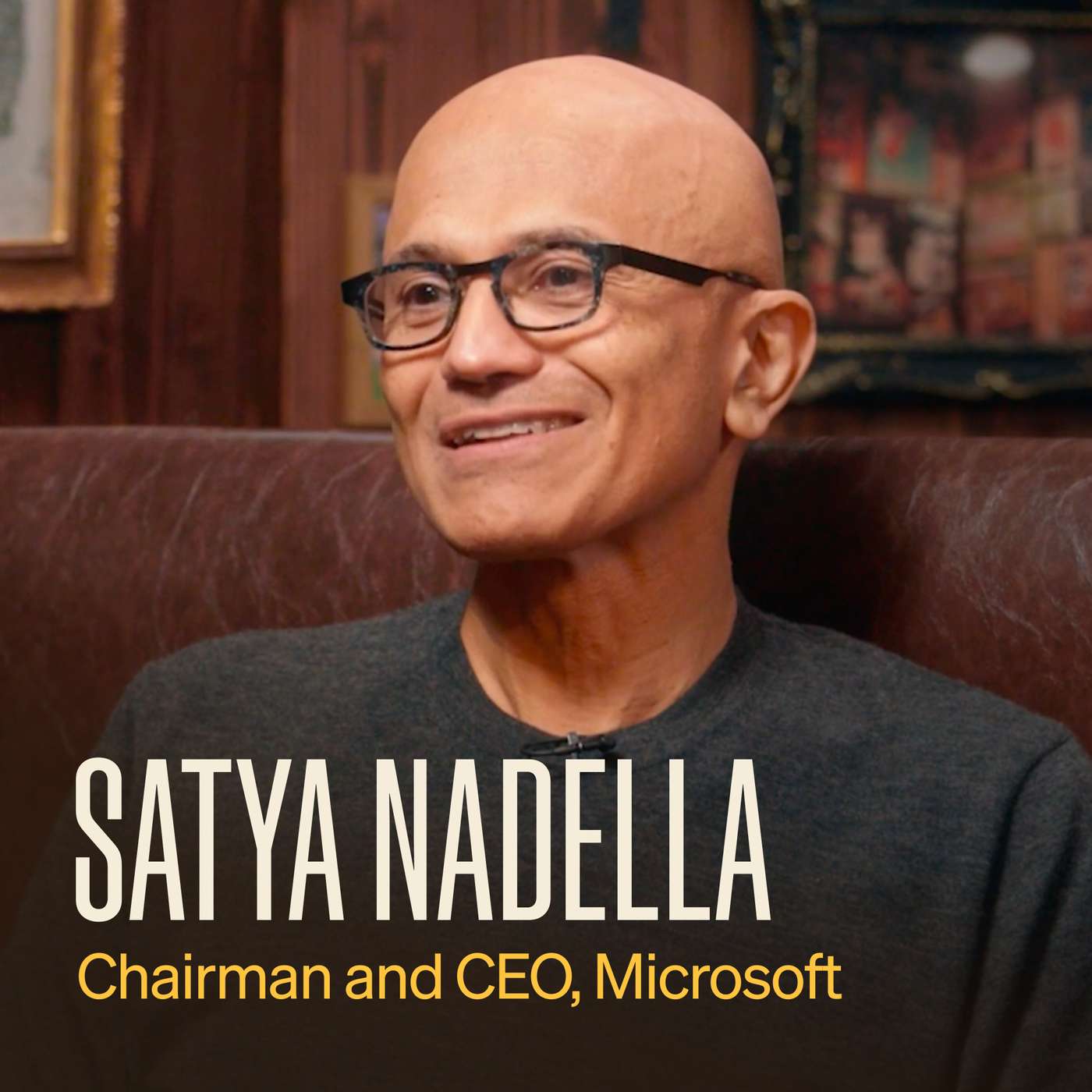

Microsoft CEO Satya Nadella sits down with John to discuss how lessons from the company's past apply to the current AI boom.
He explains why this investment cycle is different from the dot-com bubble and shares his vision for a future driven by autonomous AI agents and "agentic commerce."
Key takeaways
- The long-held dream of 'information at your fingertips' wasn't achieved by forcing data into a perfectly structured model, but by using AI to find patterns within the inherent messiness of how people actually work.
- For AI to be truly effective in an enterprise, it needs more than just raw intelligence. It requires a system built around it that can handle memory, user permissions, and the ability to take action.
- The modern equivalent of 'managing by walking around' is lingering in virtual spaces like Teams channels, which can be the most effective way to learn and connect with employees.
- Building products that meet the demands of startups is a leading indicator for what enterprises will want in the future, as startups often require more innovative and frictionless product experiences first.
- The future of working with AI can be described as 'macro delegation, micro steering.' We will delegate large tasks to thousands of autonomous agents and then provide small course corrections as they report back.
- Instead of becoming obsolete, sophisticated applications like IDEs will become more crucial. As AI generates vast amounts of output, we will need powerful editors to make sense of the work done by AI agents.
- Even in open ecosystems, new aggregation points will always arise. In the last paradigm, it was search engines; today, it might be AI chatbots.
- The current AI boom is fundamentally different from the dot-com bubble. The dot-com era involved building speculative infrastructure like 'dark fiber' that went unused, whereas today's challenge is a supply constraint where demand far outpaces available capacity.
- The primary bottleneck in the AI build-out is physical infrastructure, not technology. The long lead times for acquiring land, permits, and power for new data centers are the main constraints on growth.
- In the AI age, a company's sovereignty will be defined by its ability to create and own a proprietary foundation model that captures its unique tacit knowledge and intellectual property.
- The spreadsheet's durability comes from its simple, malleable format and the fact that it is the world's most approachable programming environment, allowing users to code without realizing it.
- A new infrastructure for 'agentic commerce' is being built, allowing AI agents to discover and purchase products from any merchant's catalog without users needing to visit the website, which could finally unlock the potential of social commerce.
- The distinctions between roles like customer service and sales are often arbitrary byproducts of software and organizational charts, and these boundaries will likely be dissolved by AI.
- User loyalty in AI is not just about the brand; people become attached to the specific personality and style of a particular model, making model updates a sensitive issue.
- The scientific method can be accelerated by 'outer loop orchestration', using AI to manage the cycle of creating hypotheses, running digital experiments, and refining results.
- Over-bundling products can severely limit your total addressable market. To compete in a large market like the cloud, a platform must offer first-class support for other ecosystems, as Azure did for Linux.
- For some products, the bundle itself is the core value proposition. Teams combined chat, channels, and video because that specific integration was designed to get a particular job done for the user.
- A company can lose its own belief system when it loses control of its narrative. External perceptions, like a cartoon, can become so powerful that people inside the company start identifying with them.
- Internal tension between divisions is not always a sign of a broken culture. The ultimate goal is winning in the marketplace, not perfect social cohesion, and some internal competition can be by design.
- People don't leave companies, they leave managers. This highlights the importance of micro-cultures, where individual leaders are responsible for creating environments where people can thrive.
Podchemy Weekly
Save hours every week! Get hand-picked podcast insights delivered straight to your inbox.
AI finally delivers on the dream of information at your fingertips
The primary goal for enterprise AI is to diffuse it throughout organizations, enabling them to build their own "AI factories" rather than just admiring others'. The most significant challenge in this process is organizing the company's data layer so that AI can effectively interact with it. Tools like Microsoft's Copilot aim to address this by tapping into the underlying graph of information in emails, documents, and calls.
That semantic connection is in people's heads and it's lost. And for the first time, there's much better recall of that.
While adoption of these tools is happening quickly, full enterprise integration is complex. It requires significant change management and must work with existing data governance and security systems. This connects to a decades-old vision of having a company's data readily accessible, a pitch made by leaders like Larry Ellison and Bill Gates since the 1990s. The challenge has always been that companies struggle with their data infrastructure.
Companies do not eat their data infrastructure vegetables.
Satya Nadella recalls that Bill Gates's dream was for all information to be neatly structured, essentially like one giant SQL database. Gates disliked messy, unstructured file systems. However, the reality is that people and their data are messy. The unexpected breakthrough came not from perfecting data schemas, but from AI's ability to find patterns in this unstructured information.
Looking forward, the next frontier for enterprise AI involves building an environment around the models. Satya identifies three critical components that must function at runtime: memory (both short and long-term), entitlements (respecting user permissions and roles), and a defined action space. These elements, working in concert, are what will allow AI systems to become truly integrated and effective within an organization.
Wandering the virtual corridors of Microsoft
Satya Nadella structures his day around two key areas: customer engagement and internal meetings. He has at least one or two customer calls every day, often remotely via Teams, finding it the most helpful way to stay grounded. Internally, he categorizes meetings into two types. The first type is for convening, where his role is simply to be present and quiet, allowing the work to happen before or after the meeting. The second type requires his active participation to learn, make a decision, or communicate something important.
One meeting is where I'm just supposed to convene and keep my mouth shut because convening was the real thing. It is like don't over perform, just sit.
To replicate the classic management practice of "managing by walking around," Satya wanders the virtual corridors of Microsoft Teams channels. He finds this is where he learns the most and meets the most people. By lingering in these channels, he can connect with individuals working on specific projects, such as the person working on an "Excel Agent," and see their evaluations in real-time. He wishes he had even more access, feeling the culture can sometimes be too permissioned, but enjoys the ability to drop in and normalize his presence. He also notes that today's workforce is not shy about sharing their opinions directly with him.
Following developers is the key to building relevant tech platforms
Satya Nadella recalls visiting Stripe's office back when he was running Azure, even before becoming Microsoft's CEO and when Stripe was a much smaller company. He explains that his drive to connect with startups stems from his background in developer relations. He believes that to be relevant in tech, you must follow where developers are going and understand the new workloads they are creating.
If you don't follow where developers are going, it's hard to be relevant in terms of tech platforms. And then you really need to understand the new workload in order to build a tech platform... if you're not following startups, it's very hard to know what is either the platform or the workload.
He also finds personal energy in meeting founders, whom he considers magical people for creating something from nothing. John agrees, noting that Stripe's strategy has always been to build for startups. They believed that what startups wanted—like better product experiences, stablecoins, or usage-based billing—would eventually be what enterprises would adopt. Satya acknowledges Stripe as a "gold standard" in this approach, which helped Microsoft rediscover its own roots in following developers. This philosophy ultimately led to the acquisition of GitHub, a central hub for startups, to stay in the loop, learn, and build better, more frictionless products.
The future of work is macro delegation and micro steering
Software is moving beyond the old paradigm where a static user interface (UI) is delivered to everyone. The future involves personalized UIs that can be rendered in real time for each user. Satya Nadella explains that with AI's ability to generate code, it can also create custom UX scaffolding for any purpose. This blurs the lines between what constitutes a document, a website, or an application, as any of these can be generated on demand depending on the need.
Interestingly, this shift doesn't make sophisticated applications obsolete. In fact, Integrated Development Environments (IDEs) like Excel or VS Code are becoming more important. As AI generates output, humans need powerful tools to make sense of it, perform diffs, and iterate. Satya envisions new classes of highly refined IDEs that act as heads-up displays for managing thousands of autonomous agents.
The new working model with AI can be described as "macro delegation, micro steering." A user delegates large tasks to many agents, which then work for hours or days. These agents check back in for course correction. This creates a new challenge: how to provide this micro-steering without creating "notification hell." The solution will likely involve familiar interfaces like inboxes, messaging tools, and canvases, but their purpose will change. They will become control centers for managing agent workflows. For example, a feature in GitHub Copilot called "mission control" allows a user to deploy agents on different branches and then triage their completed work, making the IDE a central hub for managing AI-driven development.
I had interactive television switched ATM, I think, to my home, in my apartment. So I had, I remember doing this demo. One of the high stakes things I did as a young guy at Microsoft was a demo of our first redundant file system, which was the video server where John Malone was the one who came and Bill was sort of saying, hey, here is the future of interactive television. And guess what? It's even great because the disk can go haywire and it'll still stream. And so my job was to remove the disk drive and have the stream continue.
This pattern of a technological vision arriving long before its practical implementation is common. AI with tool-use capabilities was depicted in the 1960s film "2001: A Space Odyssey," and the idea of speaking to computers has been around since the 80s, but only now is it becoming truly effective. Satya recalls working on interactive television in 1994, a project that had a massive amount of brainpower behind it but ultimately missed the rise of the internet.
The open web was just a moment in history
In the 1990s, Microsoft correctly identified the internet as a crucial future trend, as highlighted by Bill Gates' famous "Internet Tidal Wave" memo. However, their initial vision was for an "information superhighway" delivered through TV set-top boxes. This strategy was based on the sensible observation that more homes had TVs with high-bandwidth cable than computers with internet access.
Satya Nadella, who was an entry-level employee at the time, recalls that the company didn't fully believe in the open internet's underlying technology. There was skepticism that TCP/IP could provide a sufficient quality of service. As a result, Microsoft built its own proprietary network, MSN, to compete with services like AOL. However, by 1995, it became clear that the open web stack was winning, and Bill Gates pivoted the entire company to embrace it.
A key lesson from this era is that even when an open platform wins, new forms of control and aggregation emerge. The open web that replaced proprietary services like AOL and MSN was itself quickly dominated by a new organizing layer: search engines. The web became, in effect, the "Google Web." This pattern repeated with the mobile web, which is organized by app stores.
The open web was a moment in history. The meta thing for me is organizing layers will always emerge even in an open ecosystem. And a lot of the category power moves to that organizing layer.
This insight applies directly to the current AI landscape. Today, chatbots like ChatGPT are acting as a new aggregation point. It remains uncertain how long this will last or what will come next, but the emergence of these powerful organizing layers is a recurring theme in technological shifts.
Why today's AI build-out is different from the dot-com bubble
A common comparison is made between the current AI boom and the dot-com bubble of the late 90s. Satya Nadella, who was at Microsoft during that period, finds the comparison reasonable but highlights a crucial difference. During the dot-com era, the financial cycle was driven by what could be called "irrational exuberance." A lot of capital was spent on infrastructure, like dark fiber, that was not immediately utilized. The correction washed away many things, but the underlying technological trends persisted.
Today's situation is fundamentally different. The infrastructure being built now is meeting immediate and massive demand. Satya notes that Microsoft is supply-constrained, a stark contrast to the speculative build-out of the past. The problem isn't a lack of use for the technology being deployed; it's a race to build enough capacity.
It's not like any one of us is sitting there and saying, 'Hey, I have all the GPUs wired up and nobody's using them.' I don't have a utilization problem... there is not a thing that I have that's not sold out. In fact, my problem is I gotta bring more supply.
The primary bottleneck today is having enough "powered up shells"—data centers with the necessary land, permits, and power connections ready to be filled with server racks. This process has long lead times. Furthermore, this build-out must be global, as more countries are implementing data sovereignty regulations, requiring data to be stored locally. This adds another layer of complexity to matching supply with worldwide demand.
A company's foundation model is its future sovereignty
In the age of AI, the very nature of a corporation is being re-examined. The traditional idea of a company, based on the Coase theorem, is that it exists because the transaction costs are lower inside the organization than in the open market, largely due to tacit knowledge held by its people. Satya Nadella suggests that this concept of corporate sovereignty is evolving. The key to a company's future sovereignty will be its own proprietary foundation model.
The future of a company is that company has its own foundation model that captures essentially that asset knowledge that makes the transactional costs of how knowledge gets accrued and diffused inside the organization faster.
This means a company's intellectual property, which currently resides in emails, documents, and most importantly, in people's heads, could eventually be consolidated into a single, unique AI model. While AI might enable new corporate structures, like tiny billion-dollar companies or DAOs, the fundamental question is where tacit knowledge will reside. Satya believes it will compound not just in people, but also as weights in a model layer unique to each company.
John shared how Stripe is putting this idea into practice. Initially, Stripe was a single-player experience with few network effects. Over time, it developed a powerful trust network for fraud detection based on its vast data of internet users. Now, Stripe is training its own payments foundation model using this proprietary data. This model becomes a unique asset, a form of intellectual property that creates a competitive advantage.
This raises a critical question: how do companies protect this specialized knowledge from leaking into the base foundation models they are built on? The future of any corporation, whether in pharma, payments, or software, will involve building a unique intelligence layer using models, memory, and tools specific to their domain. This ability to create and protect a proprietary foundation model is the new definition of corporate sovereignty.
The enduring power of the spreadsheet
The spreadsheet has proven remarkably durable, largely due to the power of lists, tables, and the malleability of software. Satya likens it to a blinking canvas, something that will always be there, just with more features added over time. A key aspect of its endurance is that it is Turing complete, making it a highly accessible form of programming.
It's the world's most approachable programming environment. You get into it without even thinking you're programming. And that is the other beauty.
Unlike newer technologies like AI, which are often mystified and require extensive change management, spreadsheets were adopted organically. Satya recalls a conversation with the CEO of Generali, who described how email and Excel completely upended and evolved workflows from the ground up, replacing the fax machine era. The question now is what tools in this era will similarly redefine work from the bottom up.
The pace of technological change has accelerated significantly. Before the pandemic, the focus was on advancements in cloud technology like multi-region databases. The pandemic then sent cloud usage and tools like Microsoft Teams into hyperdrive. Many expected a return to a stable state afterward, but another major technological shift quickly followed. John notes a similar pattern at Stripe, where the e-commerce boom in March 2020 was not a temporary spike but a permanent step-change that established a new, elevated baseline for online business activity.
AI is reinventing commerce through conversation
A new, more conversational form of commerce is emerging, driven by AI. This approach aims to create a better experience for both merchants and customers by matching them more effectively. Previous attempts at social commerce, like buying on Twitter or Instagram, struggled. What's different now is that AI makes the integration much easier for merchants and creates a more compelling experience for users.
Satya Nadella finds that chat experiences are fantastic for product discovery, especially compared to the sometimes difficult search functions on major retail sites. AI is proving to be far superior to traditional keyword-based search for product research.
It's crazy that we weren't doing that previously. All this kind of customization, being able to give vibes, general aesthetics. I'm looking for something slightly higher end but not super fancy.
This allows for more nuanced queries. For example, when buying furniture, you can specify the available space, desired aesthetic, and budget. Satya shares an anecdote about his wife, an architect, who uses a copilot to get recommendations by asking high-level reasoning questions about architectural sketches and public furniture catalogs. He describes this capability as "magical."
AI will likely transform both open-ended discovery, like finding an outfit for an occasion, and highly-directed searches for specific items. This covers most of e-commerce, with the possible exception of recurring purchases of staples like pet food. The underlying technology involves making merchant product catalogs remotely discoverable and purchasable through an AI agent or copilot experience.
Today in some sense one of the biggest challenges is the quality of the catalog and the ability to use reasoning to do a deep search. And if you can solve that, then every product will find its query.
This infrastructure could enable social platforms like Pinterest and Instagram to successfully re-engage with commerce, as merchant adoption will be much higher. Microsoft is working on a project called the "NL web," which aims to give every merchant catalog a natural language interface for AI agents to query. Meanwhile, Stripe is building a platform for this new "agentic commerce," which includes open-source protocols and payment solutions designed for AI agents making purchases on behalf of users across the web.
Creating the easy button for agentic commerce
In the nascent space of agentic commerce, the key is to consider how every merchant can participate in an agentic workflow. Merchants will need a simple, friction-free way to connect their product catalogs and checkout processes to the various AI agents that are emerging as new front doors for consumers. The major opportunity lies in serving the long tail of merchants who need an easy way to enable this functionality.
While major agents like ChatGPT, Google, Meta, and others will compete as aggregators, merchants will also want to support natural language queries on their own websites and mobile apps. The challenge is to provide a simple solution that avoids technical complexity for small businesses.
Going to a small merchant and saying, 'Hey, you go stand up an MCP server, do this protocol, that protocol'—what's the easy button?
The winning strategy is to create that 'easy button' for merchants, allowing them to enable agentic commerce with a single click rather than dealing with complex protocols and server setups.
Agentic AI will merge commerce and customer service
Emerging "agentic experiences" are changing how users interact with businesses online. For example, companies like Intercom are using AI for customer service mediations. This is creating a large amount of induced demand, as people who initially come for help desk queries discover it's a much better way to navigate a website. It functions almost like a command line for the site.
This trend raises the question of when different experiences, like commerce and customer service, will merge. The fashion space is a good example of where current technology is poor. Searching for items based on aesthetic "vibes" is difficult with keyword-based searches and manual tagging. This seems perfectly suited for an interactive AI-based experience, similar to refining an image using prompts in Midjourney. You could simply describe what you want and adjust the results conversationally.
Ultimately, customer service is also a form of inside sales. In an agentic world, these functions can be stitched together so the seams disappear. The current separation between roles like customer service and sales are often just arbitrary distinctions created by software and organizational charts.
Maybe what we're describing is a bunch of swim lanes have been established by random accidents of software and Org charts and everything like that... And all those distinctions are probably going to get blown away.
User loyalty to AI models and Microsoft's strategy
There is an ongoing debate about whether users develop loyalty to a specific AI model or to an AI brand. Satya Nadella notes that for the first time, changes to underlying models have a noticeable impact on users. These changes are not uniform and can affect people differently based on the model's personality or style. This introduces a new dimension for differentiation beyond just raw intelligence (IQ), incorporating EQ and style.
In the consumer products, this was the first time we saw that. When you changed models, they're not sort of uniform changes and they impact people differently. And personality is one such thing or style or what have you. And so it just sort of is a new dimension.
While users can get attached to their defaults, the long-term goal is to use the most capable models for high-value tasks. In practice, this means using multiple models in production. Satya points to a new feature in GitHub Copilot called "Auto," which intelligently routes tasks to the appropriate model based on the complexity of the code or task. The future lies in having an ensemble of models managed by intelligent agents that can earn a user's trust to make the best selection for them.
Satya conceptualizes Microsoft's AI strategy in layers. The foundational layer is the "token factory," focused on efficiently building infrastructure to produce tokens per dollar. Above that is the "agent factory," which uses those tokens to drive business outcomes, creating value per token. This acts as the new app server for AI.
At the core, the way I kind of conceptualize it is our infrastructure business. We have to be fantastic at building what I'll call the token factory. This is the tokens per dollar per what really being super efficient in that. Then I'll say we have another layer of it, which is the agent factory. And the difference between the token factory and the agent factory is use the tokens most efficiently to drive a business outcome or a consumer preference outcome.
On top of these factories, Microsoft builds its own AI systems, the Copilot family. These include horizontal applications for information work, software development (GitHub Copilot), and security. They also build vertical applications, such as the DAX Copilot in healthcare, which assists physicians with note-taking and is integrated with partners like Epic.
Microsoft's strategic evolution from open platforms to bundled products
Science is a major domain for what Satya calls "outer loop orchestration." The scientific method itself involves creating a hypothesis, running multiple experiments in silico, and then refining the findings. This process can be accelerated with a new tool chain for scientists, envisioned as a combination of GitHub Copilot and Microsoft 365 Copilot for knowledge work. This system would connect with authoritative sources of knowledge and even interface with wet lab equipment, ultimately speeding up the entire scientific discovery loop.
This discussion on platforms leads to the classic business decision of when to bundle products versus when to keep them separate. John brings up Apple's initial strategy of linking the iPod exclusively to Macs to drive computer sales, a decision they later reversed by shipping iTunes for Windows. Microsoft's own history is full of these strategic shifts. Many people may not realize how open Microsoft was in its early days.
In 1985 most of Microsoft's revenue was from Macintosh applications. And then for the Microsoft operating systems most of the applications were third party, you know, like Lotus 1, 2, 3 and things like this. And so it was like a fully open strategy.
This was followed by the Windows era, which featured a tight coupling between Office and Windows that mutually reinforced each other's market positions. More recently, the Azure cloud platform began as a place primarily to run Microsoft's own SQL Server but later evolved to fully embrace open-source technologies like Linux.
The strategic case for product modularity
When deciding whether products should be coupled or sold independently, Satya Nadella advises against thinking in zero-sum terms. The first step is to recognize which markets are inherently "multiplayer." The cloud market is a classic example. When Azure was starting, many questioned if there was room for a second cloud beside the dominant AWS. However, Satya believed enterprise customers would always demand multiple options, a structural understanding that drove Microsoft's persistence.
Over-packaging products can reduce a company's total addressable market. Satya explains this using Azure's own history. It was originally called Windows Azure, but to be competitive, it had to provide first-class support for Linux, MySQL, and Postgres. Focusing only on Windows and SQL workloads would have meant competing for a very small sliver of the market. While a company should seek integration benefits, each layer of the stack must be able to compete on its own merits.
Somebody should be able to come and say, 'I just want to use Azure for its bare metal services. I just need Kubernetes clustered all over. But I just need you to do the management part and I'll bring all my software.' No problem. We got to win that workload.
However, some products are intentionally bundled because the bundle itself is the value proposition. For instance, Teams integrates chat, channels, and video. Satya explains that, like Outlook before it, which brought together email, contacts, and a calendar, Teams was created as a scaffolding to get a specific job done. The bundling of features was the core product innovation.
Satya frames his leadership philosophy at Microsoft as a return to the company's origins in the 1980s. During that era, Microsoft was a "software factory" that built products for any platform, even creating Office for the Mac before Windows became dominant. It was only during the near-monopoly of the 1990s that heavy bundling became the norm. By the time Satya became CEO, the market had changed, and Microsoft lacked a mobile platform. To stay relevant, the company had to revive its original DNA of taking its software to every platform where customers were.
Losing the cultural narrative to a cartoon
A famous cartoon once depicted Microsoft's divisions with guns pointing at each other. This image became a powerful symbol of the company's culture. Satya Nadella reflects that the company lost its own belief because it lost control of its narrative. The cartoon was a prime example of an external perspective defining the internal culture more than reality did.
That cartoon is a great example of someone else defining what became the cultural narrative more so than reality. So people started to identify with the cartoon.
This phenomenon is described as "reflexive," where an external story feeds back and becomes the internal reality. This does not mean there was no truth to the caricature. There were real tensions between divisions. However, some of that tension is necessary. The goal is not simply social cohesion but winning in the marketplace. Large organizations must be orchestrated, and sometimes this includes having competing teams by design.
Shaping culture from within and resisting external narratives
One of the toughest modern leadership challenges is communicating in a world where employees form opinions about the company from external sources. The key is to earn their trust and help them feel and shape the reality within the organization. There's a common misconception that power is concentrated at the top with executives. The reality is that power is much more diffused and distributed. A leader's role is to help people understand this and empower them to reshape the culture themselves.
I never leave companies, I leave managers.
This popular saying highlights the importance of micro-cultures. Satya Nadella believes this is true, reflecting on his own career at Microsoft. He feels he was lucky to work under people who created unbelievable environments within the company, which is why he stayed and thrived. While a consistent narrative from the top is necessary, like the "learn it all versus know it all" growth mindset, the real culture is shaped at the team level. The ultimate challenge for organizations today is to cultivate an inner strength that can resist being defined by social media memes and outside narratives.
The unique challenge of leading a founder-built company
While many business activities are consistent regardless of company size, from talking to customers to financial planning, unique challenges emerge at a massive scale like Microsoft's 200,000 employees. Satya Nadella, having only worked at Microsoft, reflected on the experience of taking over as the first non-founder CEO, following in the footsteps of Bill Gates and Steve Ballmer who built and scaled the company.
The thing I realized quickly, or in fact I got into the job and I realized that I need a team, and just to have the ability to manage the scope.
Upon stepping into the role, his immediate realization was the necessity of a team to simply manage the vast scope of the position. This led to a focus on clarifying the CEO's core responsibilities, referencing frameworks like those from A.G. Lafley.
The unique working memory of a founder CEO
A leader's core responsibilities include deciding which businesses to be in and which to exit, synthesizing external factors, setting cultural standards, and delivering on both short-term and long-term goals. A key part of this is building the right team. As an organization grows, a leader's perspective must shift. The journey is similar to that of a developer who starts out knowing every detail of a project.
Everybody starts where they know every line of code at some level. Then you have to get to the person who knows, oh, I know the person who wrote that.
This illustrates the move towards modularity and team cohesiveness. Founders, however, possess a unique and singular understanding because they have grown with the company from day one. It is difficult to transfer a founder's complete institutional knowledge, or "working memory," to a professional CEO. Satya Nadella notes that since he joined Microsoft in 1992, he doesn't have the same context as someone who was there in the early 1980s. This highlights a necessary mutual respect: an organization must appreciate what founders can uniquely do, and founders must understand that their successors cannot operate in the exact same way. While a founder's "cult of personality" is powerful, a non-founder CEO can still adopt a certain mindset.
Mere model CEOs like us have to sort of also be, you know, you can sort of be in the re-founder mode, but don't think you're a founder. And that nuance, I think is an important one.
The Hyderabad high school that nurtured future CEOs
Satya Nadella discusses the unusual success of his high school in Hyderabad, which produced several notable CEOs including himself, Shantanu Narayen of Adobe, and Ajay Banga. He attributes this to the school's environment in the late 1970s and early 1980s, which provided students with something rare for that time and place: space. Instead of being forced into a rigid academic race, students were encouraged to explore other interests and discover their passions.
I attribute it a lot to my high school because I feel it is a place where it gave us a lot more space and room to follow what really became your passion but you were able to take your time to discover it versus sort of feeling that I had to join some kind of a race.
Satya notes that he and his successful peers excelled at things beyond academics. His own passion in high school was cricket. He also shares a piece of trivia that combines high achievement in different fields: Samuel Beckett is the only person to have played professional cricket and also win a Nobel Prize.