
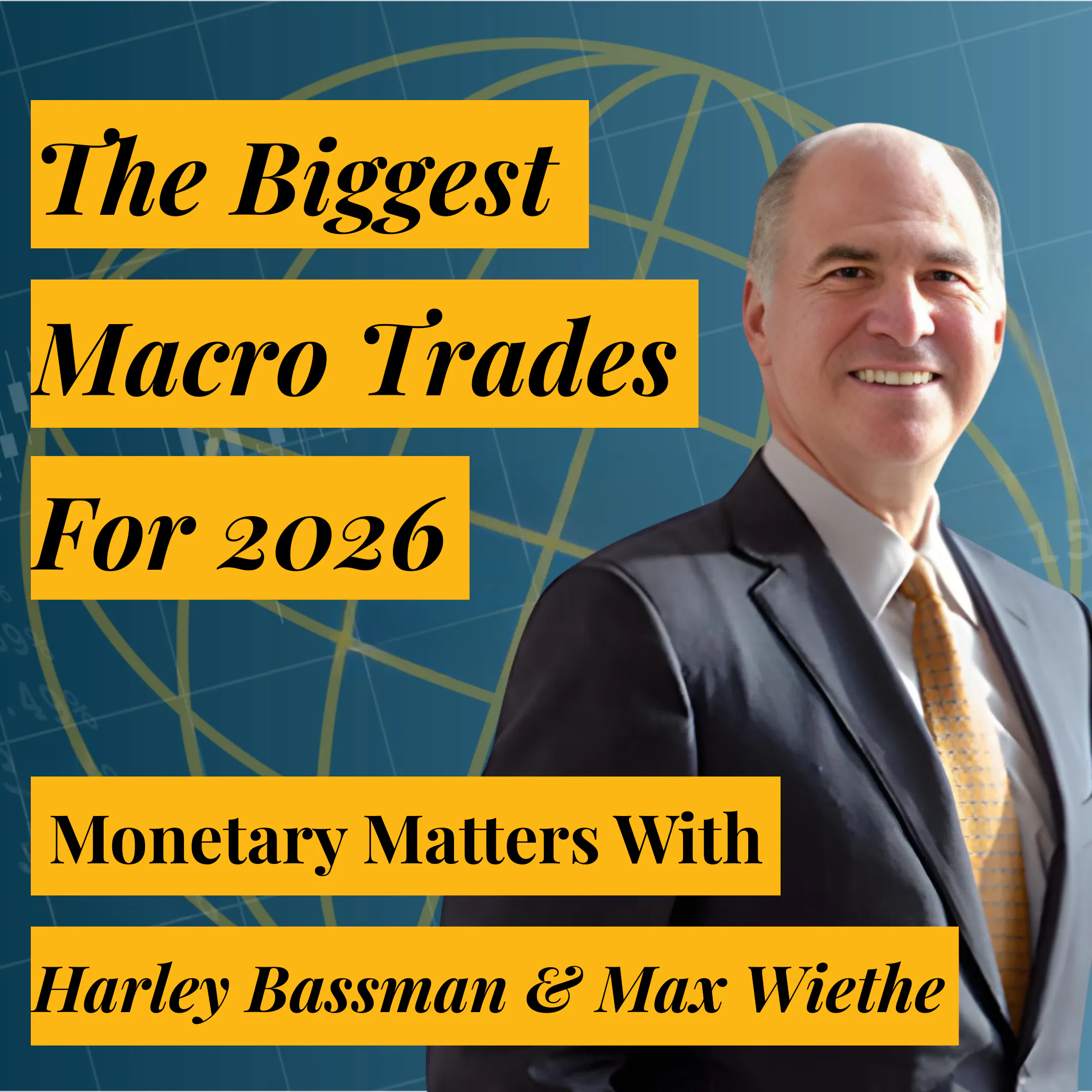

Harley Bassman, managing partner at Simplify Asset Management and known as the Convexity Maven, explains how rising fiscal deficits and aging demographics are reshaping global markets.
He shares why traditional strategies may fail in an era of currency debasement and offers practical ways to use bonds and gold to protect your portfolio from extreme risks.
Key takeaways
- Inflation is likely to settle around 3% because the retirement of skilled Baby Boomers is creating a more expensive, less efficient labor market.
- The Boomer generation's massive accumulation of wealth in stocks and housing means they will likely continue spending through retirement, contrary to traditional academic models.
- GDP is driven by population, hours worked, and productivity. Reducing the population through immigration policy will inevitably slow economic growth.
- Interest rates should naturally settle near nominal GDP because they represent the cost of capital for borrowers.
- Rising prices in gold and housing reflect the harm being done to the US currency by current fiscal policies.
- The US once had a fiscal surplus in the late 1990s that was so significant that bond traders feared Treasury bonds would stop being issued entirely.
- The 1936 retirement age of 65 is the demographic equivalent of age 83 today, yet policy has failed to adjust for this massive increase in longevity.
- The US is the cleanest dirty shirt in the global economy, facing demographic challenges that are significant but less severe than the projected population collapse in China.
- Passive flows into 401ks create a cycle where large-cap stocks grow disproportionately because index investing is market-cap weighted.
- The equity market's upward trend is likely to persist until unemployment reaches a level where contributions stop and withdrawals from retirees take over.
- Newly issued mortgage backed securities offer higher yields than investment grade credit bonds with zero credit risk because they are backed by government agencies.
- A bond hedge with a duration of negative forty allows investors to protect their portfolios against rising interest rates using very little capital.
- Long-dated options decay at the square root of time, allowing investors to earn more in interest from held cash than they lose in option value.
- Positive convexity creates non-linear returns in the investor's favor, while negative convexity is a common hidden cause of financial crises.
- Markets are currently in a Wile E. Coyote moment where rising bankruptcy rates have not yet been reflected in credit market pricing.
- Credit spreads for investment grade and high yield debt are at historical lows, making the cost of hedging against a market downturn relatively cheap.
- Sectors labeled as uninvestable due to political or social reasons often provide superior long-term returns because they trade at reasonable prices when capital is scarce.
- Gold functions as a hard currency rather than a traditional asset because it lacks a dividend and cannot be printed by any government.
- The high level of national debt makes currency devaluation through inflation the most likely strategy for the government to manage its obligations.
- Position sizes should be large enough to move the needle if you are right, but small enough to prevent a total portfolio collapse if you are wrong.
Demographic shifts and the persistence of inflation
Inflation is likely to remain around 3% for the foreseeable future rather than returning to the 2% target. While it may not reach extreme highs, several underlying factors will keep pressure on prices and wages. Demographics play a primary role in this trend. As the Baby Boomer generation retires, they are pulling skilled and efficient labor out of the market. This labor is being replaced by less experienced workers, which makes production more expensive.
We took all the money, man, I'm sorry to say. I mean, we got the stock market, we got the housing, and we have plenty of wealth. And there's all this talk of this transition of wealth from the boomers to the millennials, that is going to happen, but we're going to spend a bit of it on the way.
Harley suggests that the traditional academic view that retirees spend less may not apply to Boomers. This generation has accumulated significant wealth through the stock market and housing. Instead of slowing down, they have the resources and free time to continue spending. At the same time, Millennials are entering the household formation stage. Although they started later than previous generations, they are now catching up to historical trends. These dual forces of Boomer spending and Millennial household growth will likely keep the economy supported and inflation slightly elevated.
The relationship between population growth and economic output
GDP is essentially the product of people, hours worked, and productivity. If you reduce the number of people in a country, you will reduce GDP growth. This is a mathematical reality regardless of personal feelings on immigration policy. One reason the US has outperformed Europe and Japan is its significant population growth.
GDP is people times hours, times productivity. If we reduce the number of people, we reduce GDP growth and that is it. When you push out people, you are going to push out growth.
Fiscal policy is another major factor driving the economy. Currently, the US is running a deficit of about 6.5 percent. Harley notes that this is extreme for a time when the country is not at war and has nearly full employment. Neither political party shows any interest in cutting back on this spending. This injection of cash is good for the stock market and GDP but it keeps inflation high.
We are spending a 6.5 percent fiscal deficit. This is utterly insane to happen during a time of almost full employment and we are not at war. If we are pumping out that kind of money into the system, it is fine for the stock market, but also fine for inflation.
While these deficits support growth for now, they pose a long-term threat to the US dollar. This type of consequence takes a long time to play out. Japan took thirty years for their currency to experience the downside of their fiscal choices. It is a matter of time before the US faces a similar reckoning.
The outlook for interest rates and the yield curve
Harley predicts that the 10 year bond rate will settle at 4.35 percent. This figure is based on the expectation that the funds rate will eventually reach about 2.875 percent. By adding a long term historical spread of 147 basis points, the rate lands at this center of gravity. This target aligns with a nominal GDP of around 5 percent. In this framework, 5 percent nominal growth consists of roughly 3 percent inflation and 2.5 percent real growth.
The thought is that you have rates somewhat near nominal GDP because rates are the cost of capital and therefore if you cannot make a profit you are not going to borrow money. There should be a small profit there.
The Federal Reserve will likely reduce short term rates to slow down the growth of interest payments on national debt. Most new bond issuance is currently happening at the front end of the curve. While the Fed can pull down short term rates to reduce costs, they cannot easily control long term rates without returning to quantitative easing. This dynamic suggests the yield curve will steepen. A traditional rule of thumb for bond traders suggests that 2 year rates should be 50 basis points above the funds rate, while 10 year rates should be 100 basis points above that.
The impact of fiscal profligacy on bond yields
The 10-year Treasury yield sits around 4.12 percent. There is a strong case that yields will rise further despite widespread expectations for rate cuts. This move is driven by fiscal profligacy and a massive supply of new bonds hitting the market. The sheer volume of bond issuance is putting significant pressure on the US currency.
Massive supply of bonds? I mean we're just pumping them out there and the US currency is being harmed by what we're doing.
The consequences of this policy are already visible in the prices of hard assets. Values for gold and housing are rising because they are not fiat currency. While not identifying as a gold bug, Harley suggests that owning gold is a sensible move in this environment because the value of paper currency is being eroded by the current level of government spending.
Fiscal deficits and the future of entitlement programs
The administration likely supports a weakening dollar to address the trade deficit. However, the primary driver is the desire to inject money into the system to secure votes. There is little political will to cut major programs like Social Security or Medicare. Instead of broad cuts, the government will likely resort to means testing. This means people with higher incomes would receive fewer benefits. Another option is to uncap FICA taxes to increase revenue.
The main driver is they just want to flush money in the system to get votes. They don't have the stomach to go cut back on Social Security or Medicare. I think what is going to happen is they are going to means test the big programs. If you make over a certain amount of money, you get less of it.
Running a deficit appears to be the long-term plan because politicians avoid making unpopular decisions. Harley notes that no leader wants to be the person who takes away the punch bowl by cutting benefits. The last time the US saw a fiscal surplus was under Bill Clinton. During the late 1990s, the situation was so different that bond traders at Merrill Lynch actually feared losing their jobs. They worried the government would stop issuing Treasury bonds because there was no debt to fund.
In 1998, 1999, and 2000, the Merrill Lynch government bond trading desk was worried for our jobs. We thought they were going to stop issuing Treasuries because we actually had a surplus. It sounds insane now, but we actually thought that was a possibility.
Demographic shifts and the future of Social Security
Social Security was originally designed as a safety net for people who were desperate. When it was established in 1936, the retirement age was 65. Because life expectancy has increased so much, 65 years old in 1936 is equivalent to 83 years old today. We should have advanced the retirement age slowly over time to match these demographic shifts, but we did not. Now, people rely on Social Security as their core retirement fund rather than a backstop for their savings.
The original was an old age and survivor benefit. This was for people who were desperate back in the 30s. 65 years old in 1936 demographically is 83 years old now. Can you imagine having people work to their age 82? That is what it was. And we never moved it. We should have been advancing it slowly over time, but we did not.
The system is currently struggling with a massive demographic bubble as the baby boomer generation moves through. This bulge in the population was not anticipated when the program began. Harley suggests that means testing might be a necessary solution to keep the system viable. Many current recipients make over 100,000 dollars a year, often driven by dividends and investment portfolios rather than active wages. Setting a threshold for the top 10 percent of earners could be a starting point for reform.
Despite these internal issues, the United States is still in a better position than many other countries. China faces a much more severe demographic crisis, with its population projected to drop from 1.4 billion to 800 million in the coming decades. Harley notes that the US is the cleanest dirty shirt. While fiat currency is declining compared to real assets, the dollar remains relatively stable compared to the yen or the euro because those regions face even worse problems.
Passive flows and the mechanics of market growth
The current social safety net relies heavily on 401k plans and the continuous passive flow of money into the equity market. This trend is likely to persist as long as people remain employed. Harley suggests that index investing naturally favors the largest companies because money is allocated proportional to market cap. This creates a repeating pattern where the biggest companies get even larger because they receive the majority of the inflows.
Just max that thing out, take the free money, and go with 70 or 80% in the SPX and the balance in a five-year high-grade bond fund. Reinvest and call me in 30 years.
The upward momentum of the market is primarily driven by these consistent contributions. However, this cycle could reverse if unemployment hits a certain threshold. Harley uses 5% as a hypothetical point where job losses lead people to stop contributing to their retirement accounts. At that stage, the flow of new money stops and the impact of retirees taking money out becomes more significant.
You stop putting money into your 401k when you have no job. It makes sense. It is some number higher than this where people start losing their jobs, they stop putting in 401ks, and the flow of money does not go in anymore. Then you have the boomers taking money out because they have to and that will turn the tide.
Government spending also plays a role in sustaining the current environment. As long as the fiscal deficit remains around 6%, the economy is likely to stay strong. Potential risks that could push unemployment higher include a deep recession or significant shifts in immigration policy that impact the labor market.
The value of newly issued mortgage backed securities
Harley argues for newly issued mortgage backed securities over traditional investment grade credit bonds. While credit spreads in public markets are currently disconnected from rising bankruptcies because so much activity has moved to private markets, mortgage bonds offer a clear advantage. They provide a higher yield with essentially zero credit risk because they are backed by government agencies like Fannie Mae and Freddie Mac.
If you think Fannie and Freddie are going to go bankrupt, you should get a gun, cans of tuna and gold coins because that is where we are going to be.
Buying a mortgage bond is conceptually similar to a covered call on a Treasury. You earn a higher yield because you have essentially sold the upside potential. If interest rates drop sharply, mortgage bonds will not appreciate as much as other bonds because people will refinance their homes, causing the bonds to be called away. However, if rates stay within a stable range, these securities are a superior source of income. Harley notes that if you truly expect interest rates to plummet, you should avoid mortgage bonds entirely and buy long duration assets instead.
There is a significant difference between new issues and older bonds created a few years ago. Older bonds have very low coupons and trade like long duration securities, making them much more volatile. Newly issued bonds trade near their original value and have much shorter durations, offering better risk adjusted returns. They serve as a liquid anchor for a portfolio, providing high coupons without the credit risk found in corporate bonds. They are not meant to provide massive growth, but they ensure you have safe money available so you are not forced to sell stocks during a market downturn.
Hedging interest rate risk with ultra long bond options
A significant change in SEC rules now allows for the inclusion of derivatives like futures, options, and swaps directly into ETFs. This shift enabled the creation of sophisticated tools that were previously only available to large institutions like PIMCO. By obtaining an ISDA, smaller firms can now trade on an even footing with these giants. One result of this is an interest rate hedge that functions as a seven year put option on the thirty year treasury. This product offers extreme capital efficiency with a duration of negative forty.
There is nothing on the planet like this. My goal is to build very fancy fast sports cars and have you drive it. I am not going to drive the car for you. You can have your own opinion but if you want to go and make money if rates go up, this is it.
This hedge is designed for those who believe interest rates will continue to rise. Because its duration is so high at negative forty, an investor needs very few dollars to protect a larger portfolio. For context, a typical bond index might have a duration of positive six. While Harley does not necessarily predict that rates will hit six percent, he emphasizes that this tool provides a unique solution for those concerned about that specific risk. He views his role as a builder of high performance financial instruments, leaving the actual market timing and strategy to the individual investor.
Managing interest rate risk through long-term bond options
Harley expects a scenario where short-term rates fall while long-term rates continue to climb. This would result in a steeper yield curve. While he does not foresee a complete market collapse like the one experienced in England under Liz Truss, he acknowledges that the probability of such an event is never zero. He treats financial protection like any other form of coverage.
When you buy car insurance, you don't expect to crash your car. You have it so you can drive your car and feel safe. When you buy life insurance, you don't hope to die, but you have it for other reasons. This is an insurance product, plain and simple.
The specific strategy involves a put option on the 30-year bond with a strike price of 5.45 percent. The position generates profit as the market moves toward that strike rather than only at the moment it is reached. Harley notes the position has a negative 40 duration. This means it moves about 40 percent for every 100 basis point shift in rates. He intends to roll the option into the future rather than letting it reach its 2032 expiration date.
The bond bull and the power of convexity
Harley discusses a strategic financial trade known as the bond bull, which involves owning call options on 10-year Treasury bonds with a long expiration timeline. This approach is particularly interesting because it offers protection when markets become volatile. In a typical market crash, like the one seen during the early days of Covid, almost every asset class tends to fall simultaneously as investors sell off whatever they have for cash. However, if interest rates drop rapidly, these bond call options can increase in value very quickly.
The real power of this strategy lies in positive convexity. While standard Treasuries have zero convexity, most other high-yielding assets, such as junk bonds or credit products, leave the investor short on risk options. Combining the bond bull with credit products creates a clever trade because it buys back that convexity. This helps self-insure a portfolio against extreme market movements.
The bond bull's massively more positively convex. If things go haywire, what you're going to see happen with junk bond products is they might say they have a three, four, five year duration, but if all hell breaks loose, they're going to go down in price.
Current market conditions are more favorable for this trade than they were a year ago. Implied volatility has dropped significantly, making these options cheaper to purchase. Since these instruments are essentially a bet on volatility, investors receive an extra boost if uncertainty rises and interest rates move sharply in either direction.
Compared to owning long-duration zero-coupon bonds or ETFs, this strategy is more capital efficient. Because of the high convexity, an investor can put fewer dollars into the bond bull to achieve the same performance profile. This frees up capital to be invested in other opportunities.
The capital arbitrage is you need fewer dollars to get what you want, giving you other dollars to do more things.
The mechanics of positive carry and convexity
Long-dated options decay much more slowly than their short-term counterparts because options decay at the square root of time. For a seven-year option, the loss in value from one year to the next is minimal compared to the rapid decay seen in a one-month option. This slow decay allows for a unique investment structure where an investor can achieve positive carry even while being long an option.
Options decay at the square root of time. Square seven to square six is a very small number. Square one year to square half a year is a very big number. That is why you see people generally sell one to three month options because they decay very quickly. A seven year option does not decay that quickly.
The positive carry is generated by keeping the cash intended for the eventual option settlement in safe, high-yield instruments like Treasury bills. If the income from these bills exceeds the slow time decay of the option, the position pays a dividend. While this benefit is currently influenced by high interest rates and the shape of the yield curve, it remains a strategic way to gain exposure to convexity without the usual cost of holding an option.
Convexity is a non-linear return where the gains increase at a faster rate than the underlying moves. Positive convexity is a rare find in long-term investments, but it provides a significant advantage because the returns are unbalanced in the investor's favor. On the flip side, negative convexity is a dangerous feature often found at the root of market turmoil.
Whenever you see a financial crisis, I can assure you negative convexity is lurking in the shadows. This is one of the few places you can go in the investment world and get significant positive convexity that is not a one or two month option.
The broader goal is to translate these institutional-level strategies into accessible products for the general public. Many professional-grade trades, such as mortgage futures, require extensive documentation and structural advantages that most individual investors cannot access. Harley explains that by packaging these into ETFs, the same value and protection used by professionals can be offered to everyone.
Harley Bassman on complex interest rate trades
Harley describes a specific interest rate trade that is difficult for individual investors to replicate because of its complexity and margin requirements. He is essentially betting that short-term rates, specifically one and two-year rates, will remain stable rather than moving sharply in either direction. To execute this, he uses a levered put ladder with a one-year duration.
I put on basically a put spread, a levered put ladder. I am long a 3% put, I am short a 3.25% put, and I am short a 3.60% put. That got put up for one year at zero cost.
While these trades can theoretically happen on a futures exchange, they are difficult for individuals because of the need to post margin. Harley notes that if the Federal Reserve were to raise rates significantly, this specific position would suffer. To mitigate this risk, he maintains a hedge by balancing his exposure across the yield curve, effectively staying long on the front end and short on the back end by holding two-year and twenty-year positions simultaneously.
The impact of a steepening yield curve on leveraged funds
The Federal Reserve is expected to lower interest rates. This shift will likely steepen the yield curve by bringing short term borrowing rates below long term investment rates. For the last three years, the cost of borrowing has often exceeded investment returns. This meant leverage actually hurt performance rather than helping it. Harley believes this dynamic is about to change. When the yield curve steepens, having leverage of two to one or even seven to one becomes highly advantageous.
The problem you have had with a lot of funds in the last three years has been the cost of borrowing has been above the investment. So the leverage is actually detracted from your investment. I think that the Fed is going to take rates down. And as that curve steepens out and you get the one year rate and the three month rate under the investment rate, having leverage is going to be advantageous.
Mortgage REITs are already trading above their book value because the market expects their income to rise as the curve steepens. In contrast, many quality Business Development Companies (BDCs) are trading at a discount. Harley notes that some trade at 15 percent below book value because investors are skeptical of how private credit is valued. There is a concern that the marks on these books do not always reflect reality. However, buying into a high quality fund with a built in discount becomes attractive as borrowing costs drop.
Harley also sees opportunity in closed end municipal bond funds. These funds often trade at a significant discount. As the front end of the curve comes down, these bonds should trade at a premium because the leverage starts working for the investor instead of against them. A steep curve is the ideal environment for these leveraged vehicles.
Identifying quality in business development companies
Identifying high quality Business Development Companies (BDCs) often comes down to their management and pricing power. The best ones are transparent about their credit quality and focus on first tier paper. While some large BDCs chase higher yields by investing in second tier paper, Harley prefers to avoid that risk. He finds a 9% or 10% yield attractive when he is first in line to get his money back.
A lot of the capital markets like this Wile E. Coyote moment. They keep going off the cliff, don't look down. I suspect the credit markets are in that phase but the higher quality paper is fine. Low quality stuff is a different story.
Credit risks are currently a concern because the number of actual bankruptcies has risen significantly over the past year. Even if the market has not priced this in yet, the trend is clear. Harley explains that financial leverage plays become much more interesting when the yield curve steepens. As the Federal Reserve cuts rates, the cost of leverage stops being a hindrance. This shift makes high quality BDCs like ARCC more attractive, especially after recent price dips.
All these leverage plays all make sense when the curve gets steep. And so that is kind of the prediction.
The case for hedging credit risk
Market pricing for credit risk is currently hitting record lows. Investment Grade spreads are in the low 50s while High Yield spreads sit between the high 200s and low 300s. These levels are in the tenth decile of historical pricing, suggesting that the potential for spreads to widen is much greater than for them to tighten further. This creates a favorable risk-return profile for those looking to hedge against a credit downturn.
The risk return is kind of in your favor and the actual bankruptcies are rising. I am not predicting a credit crash, but would I rather be short than long credit? Yes. That is why I like owning mortgage bonds.
Even though a full-scale credit crash may not be imminent, bankruptcies are already on the rise. Because the cost of putting on hedges is relatively low right now, taking the side of the trade that benefits from widening spreads makes tactical sense. Harley notes that this perspective is why he currently prefers owning mortgage bonds over traditional corporate credit.
The investment case for oil and MLPs
Master Limited Partnerships, or MLPs, provide significant benefits for investors in high tax brackets. These structures offer a tax advantage where taxes are deferred until the investment is sold. When an MLP pays a distribution, the investor pays no immediate tax, but the cost basis of the investment decreases. This makes them an excellent vehicle for generating income rather than just seeking capital gains. Harley notes that while younger investors might prefer buying oil equities directly, MLPs are ideal for those prioritizing steady cash flow.
MLPs are for a problem of riches. It is for high income people in high tax brackets. There is a massive tax advantage to a K1 because basically your taxes get deferred until the day you get out. If you buy a 20 dollar MLP and it makes a 2 dollar distribution, you pay zero on the 2 dollars but your cost basis goes to 18.
The broader investment thesis centers on the necessity of reliable energy. While renewable sources like wind and solar are growing, they cannot yet provide the baseline power required for a modern economy. Stable energy requires sources that can run constantly, such as nuclear, gas, and oil. The idea that oil will soon vanish is likely unrealistic because the global demand for energy is too high to be met by renewables alone. Harley suggests that the energy complex remains a vital part of a portfolio despite political pressures.
I just do not see how we are going to satiate the demand for energy in the next decade. It is not happening by wind and solar. You need baseline power. You cannot just turn these toys off at night or when it is raining or when the wind is not going. You need baseline power and that is going to be nuclear, gas, oil, and maybe coal.
There is also a contrarian case for investing in sectors that are considered uninvestable. Historically, industries that face intense political or social opposition often produce strong returns. Tobacco stocks outperformed the broader market for years after their major legal settlements because they were undervalued and ignored. Today, oil faces similar hurdles where companies struggle to secure financing. This lack of capital often marks a point where assets are reasonably priced and ready for a recovery.
Evaluating risks and yields in Master Limited Partnerships
Master Limited Partnerships require continuous capital spending to maintain or expand their operations. Investors should evaluate these entities using ratios like free cash flow and enterprise value. Harley favors natural gas MLPs over those focused on liquid oil. Natural gas is a convenient energy source for powering large data centers.
I prefer natural gas for these things because I think that's going to be the easy source for these data centers.
Selecting the right partnership involves balancing yield against risk. Conservative trades might offer a solid 8 percent yield, while more speculative options could reach 14 percent with higher volatility. Harley prefers safer investments at this stage. Safety is defined by lower leverage and a reasonable budget for capital expenditures. These factors ensure the partnership can survive if market conditions decline.
You want to earn an 8, that's pretty solid, or earn a 14 that's going to be a little risky. Pick your poison. I tend at this stage of the game, I tend to pick the more conservative trades.
Legal exposure is another critical risk factor for these partnerships. Some entities face ongoing headline volatility due to specific drilling locations, such as projects on protected lands. While a tax-preferred 10 percent yield may seem attractive, it carries equity-like risks that require careful research.
Gold as an alternative to fiat currency
Gold is not a traditional asset because it does not produce a product or pay a dividend. Harley views it instead as an alternate, hard currency. Unlike fiat money, nobody can print more gold, and it carries no liability against a government. While some compare Bitcoin to digital gold, Harley prefers the physical metal due to its long history. He suggests a five to ten percent allocation that you should hold for at least ten years. The return on gold often happens in sudden jumps rather than steady climbs.
Gold is just an alternate currency. It doesn't make a product. It doesn't deliver oil. It doesn't cure cancer. It doesn't have a dividend. It is a hard currency. It is not being printed by anybody. There is no liability against it versus the government.
The primary concern today is the devaluation of paper currency rather than just standard inflation. The United States has too much debt to simply grow out of it. Since the government will not default, the only remaining path is to inflate the currency. This strategy helps grow the economy above the debt over many years. Past attempts by the Federal Reserve to create wage inflation failed. Instead, the money flowed into assets. This widened the wealth gap and created a tense political environment.
Harley sticks specifically to gold rather than silver or copper. Industrial metals like copper require more complex analysis. Gold has a five thousand year history of maintaining its value. A common analogy is that an ounce of gold has always been enough to buy a high quality suit, whether it was a Roman toga or a modern designer outfit. This consistency makes it the ideal hedge against fiscal policy that debases paper money.
Why position sizing matters more than entry level
Position sizing is more critical than finding the perfect entry price. When constructing a portfolio, it is important to distinguish between high-risk and low-risk assets. An investment should be large enough that a successful outcome significantly impacts the overall portfolio. Investing small amounts does little to help your wealth grow. At the same time, a position must be small enough that being wrong does not force a liquidation of other investments. Determining the right size requires honest self-reflection about your tolerance for loss and your confidence in the idea.
The bigger idea is you want to go and buy something or buy enough of it. So if you are right, it has an impact on the overall portfolio. But you want to be small enough so if you are wrong, and you will be wrong plenty of times, it is not going to go and stop you out.
Attempting to time the market is rarely successful. Historically, active managers struggle to beat indexes, and predicting short-term price movements is incredibly difficult. Harley suggests that if you like an idea, it is better to act on it now rather than wait for a better entry point. While he feels confident about interest rate trends over a three to five year horizon, he admits that tomorrow's price is unpredictable. Putting yourself in a position where you have to trade on short-term movements is often a mistake.